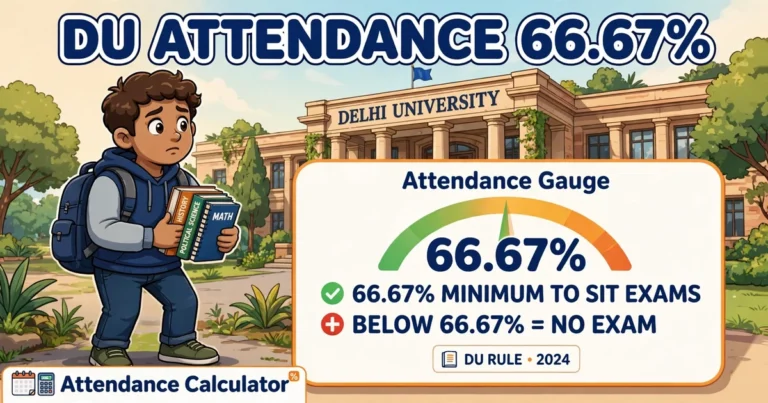

What Is Attendance Defaulter? (And How to Get Your Name Off the List)
The first time I saw a defaulter list on our department notice board, it stuck with me. It was a plain sheet of paper, names and roll numbers in small print, pinned next to the timetable. Half the class crowded around it, scanning for their own names, and the ones who found theirs went quiet. Nobody had explained what it meant. Nobody had told us what to do next.
If you typed “what is attendance defaulter” into Google after finding your name on a list like that, or because you are scared you might, this post is for you. An attendance defaulter is simply a student whose attendance has fallen below the minimum the college asks for, and the list is the college’s way of saying so in public. It is not the end of your semester. But it is a warning you should not ignore.
What is attendance defaulter, in plain words?
An attendance defaulter is a student whose attendance has dropped below the minimum percentage the college requires, usually 75 percent. The college puts such students on a defaulter list, often on the notice board, and warns them they may be barred from exams if the number does not improve.
That is the whole meaning. There is no secret legal definition hiding behind it. Defaulter is just the word colleges use for a student who has defaulted on the attendance rule. The line is almost always 75 percent, because that is the line most Indian universities use for exam eligibility. Some colleges use a different number for a semester or a course, so your own college’s rule is the one that counts. But the idea is the same everywhere: fall below the line, and your name goes on the list. That is the short answer to what is attendance defaulter, and the list is a warning, not a punishment.
What does the list actually look like?
It is usually a sheet on the department notice board, or a PDF on the portal, with roll numbers and percentages. Some lists show names, some show only roll numbers. It goes up once a month at some colleges, and only near exams at others.
It is usually a sheet on the department notice board, or a PDF on the portal, with roll numbers and percentages. Sometimes it shows names. Sometimes it shows only roll numbers. At some colleges the list goes up once a month. At others it goes up only near the end of the semester, when the exam forms are due. The timing matters, because a list that goes up early gives you time to fix the number, and a list that goes up late does not.
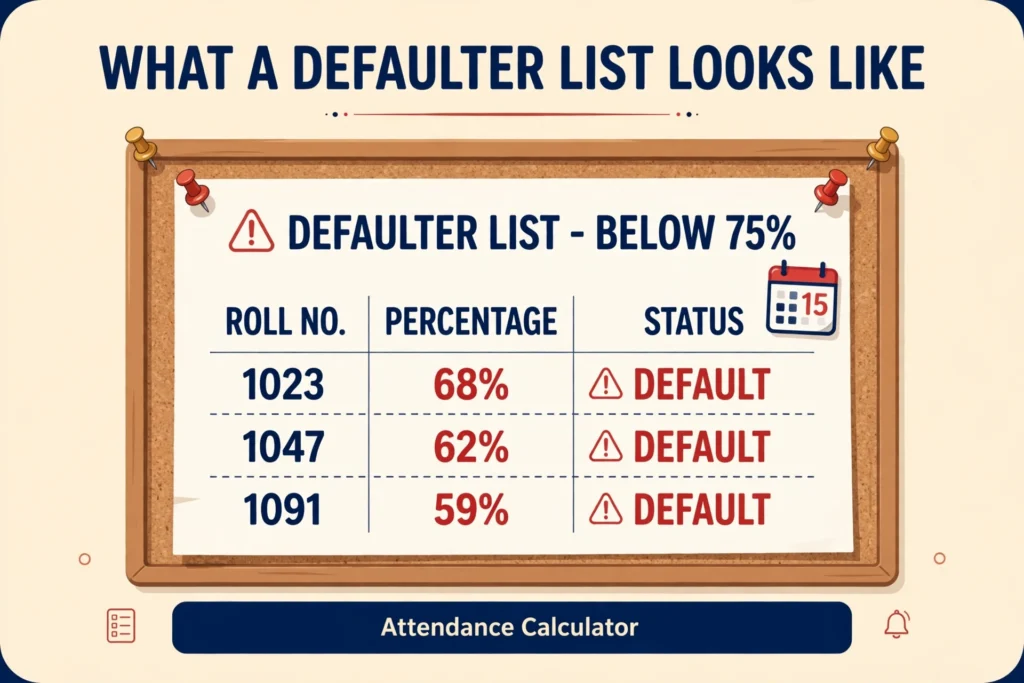
Here is the part most students get wrong. They treat the list like a punishment. It is not. It is a warning, and warnings come before the real penalty. The real penalty is detention, which means being barred from the exam. The list is the college telling you that detention is coming if nothing changes. That is why the list goes up in public. It is meant to be seen, and it is meant to push students to act while there is still time. Once you understand what is attendance defaulter, the list stops looking like a punishment and starts looking like a deadline.
One thing I want to say straight. A defaulter list is not a list of bad students. I have seen good students land on it for real reasons: a month of fever, a family emergency, a sports tournament that took them out of station. The list does not know why you missed class. It only knows the number. Your job is to give the college the reason, with proof, before the list turns into something worse. That is the part people miss when they ask what is attendance defaulter: the list is about the number, not about the student.
How does a college decide who is a defaulter?
The department counts the classes held and the classes you attended, subject by subject. If your percentage sits below the line, usually 75 percent, your name goes on the list. There is no meeting first. The count alone decides it.
The process is simple, and that is part of the problem. At the end of a month or a semester, the department counts the classes held and the classes you attended. If your percentage sits below the line, your name goes on the list. There is no meeting first. There is no phone call first. The count decides it. This is also why so many students search for what is attendance defaulter: the process is simple, but nobody explains it until the list goes up.
Most colleges count attendance subject by subject. The total is not the only number that matters. That catches students by surprise. You can sit at 78 percent overall and still land on the list because one subject sits at 62 percent. That is why I keep telling students to check every subject. The total can hide a weak one. If you want to see exactly where your number stands, my guide on how to check your attendance percentage in college shows you where the official number lives and how to cross-check it against your own count.
A few colleges also send a letter home before the list goes up, or ask the mentor to talk to the student first. That is the better way to do it, and some colleges do it well. But many do not. Do not wait for a letter. Check the board yourself, and check the portal the same week the list usually goes up. The students who get caught out are rarely the ones who skipped the most classes. They are the ones who never looked.
Defaulter vs detained: not the same thing
This is the mix-up I see most often, and it matters, because the two words mean very different things.
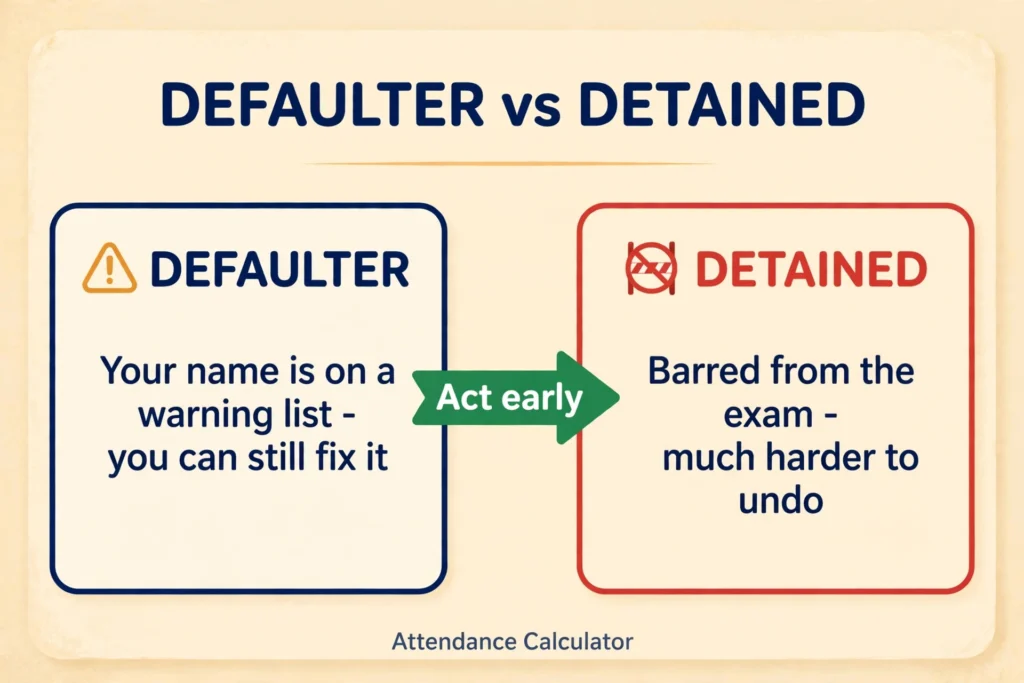
A defaulter is a student on a warning list. You can still fix it. You can attend classes, submit proof for the classes you missed, and get your name off the list. A detained student is a student who has been barred from the exam. The exam form is blocked, the hall ticket is not issued, and the semester is lost or repeated. Detention is the end of the road. Defaulter is a signpost on the way there. That is the core of what is attendance defaulter, and it is why acting early matters so much.
Here is a real example of how fast the line can move. In June 2025, St Stephen’s College in Delhi put 54 first-year students on a detained list because their cumulative attendance had fallen below 66.67 percent. Students and parents appealed, and the college later gave a one-time permission to sit for the exams. But those students spent days not knowing if they could write their papers at all. That is what happens when a defaulter list turns into a detained list. The gap between the two can be a single notice.
The gap is also where your options live. While you are only a defaulter, you can still talk to your mentor, submit medical certificates, and attend the remaining classes to lift the number. Once you are detained, the only route left is an appeal, and appeals take time you may not have. Act while the word on the list is still defaulter. Knowing what is attendance defaulter is what turns that gap into time you can still use.
What happens after your name goes on the list?
The list goes up, and your parents may get a call or a letter. You get a short window to respond, usually a week or two. If the number does not improve, the college moves to the next step, which can be a fine, a meeting, or detention from the exam. That short window is the whole point of what is attendance defaulter: a warning that arrives before any punishment.
It depends on the college, but the pattern is much the same everywhere. First, the list goes up, and your parents may get a call or a letter. Second, you get a short window to respond, usually a week or two. Third, if the number does not improve, the college moves to the next step, which can be a fine, a meeting with the principal, or detention from the exam. The exact steps sit in your college handbook, and the handbook is the document that actually decides your case, not a rumour in the class group.
Some colleges also follow a formal appeal process. Under Mumbai University rules, for example, a detained student can appeal to the principal within three days of the list going up, and the principal must give a personal hearing. If that does not work, the student can appeal to the Controller of Examinations within ten days. Your university may have a similar rule. It is worth asking your department office about it the same week you see the list, not the week before the exam.
One more thing worth knowing. In November 2025, the Delhi High Court directed law colleges to publish weekly attendance records online, send monthly notices to parents, and offer extra classes or assignments to help students cover a shortfall. That order was for law colleges, and it is still being worked through, but it shows the direction things are moving: colleges are being pushed to warn students early and give them a real chance to fix the number. If your college does not warn you early, that is a fair thing to raise with your mentor, calmly and with dates.
What to do if your name is on the list
Do not hide. Do not wait for the next list. Do these four things in the same week.
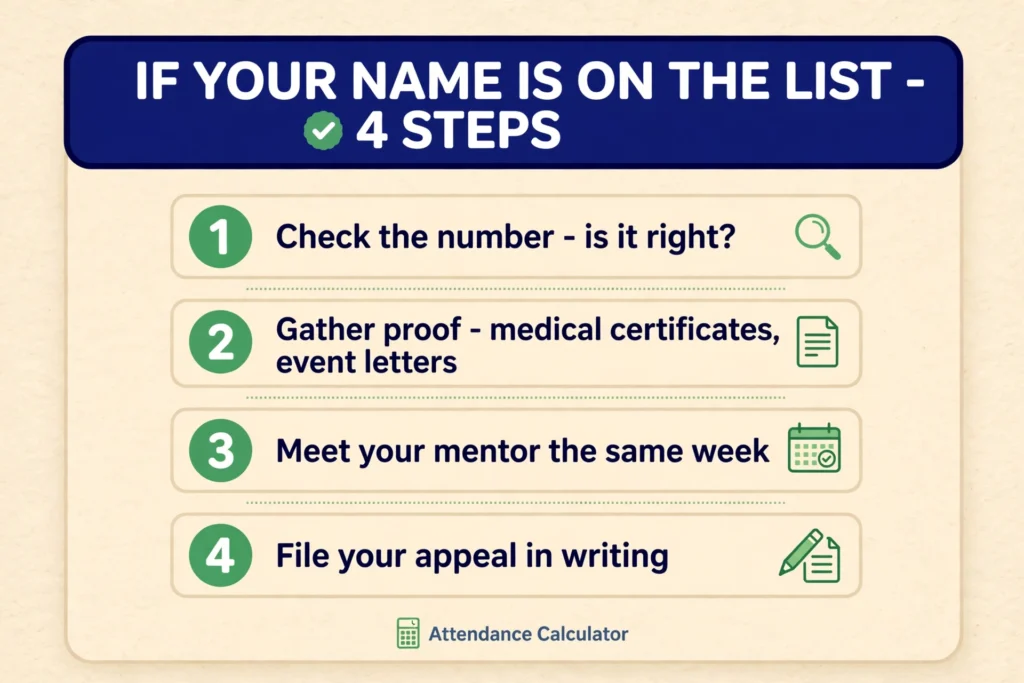
Step 1: check the number. Go to the portal and look at the subject-wise split. Is the number right? Teachers mark in a rush, and a wrong tick can cost you a few points. If the number looks wrong, note the dates that differ and ask the subject teacher about them. A wrong number is the easiest fix of all, and it is the one most students never ask for.
Step 2: gather your proof. If you missed classes for a real reason, collect the papers now. A medical certificate from a doctor. A letter for a sports event or a college activity. A death certificate if a family member passed away. Real proof, with dates on it, is the thing that turns a plea into a case. A story with no papers behind it rarely moves anyone.
Step 3: meet your mentor. Go after class, not in the middle of it. Take your papers and your own count of the classes you attended. Tell them the reason in two lines, then ask what the process is to get your name off the list. Mentors have seen this before, and they know which forms matter. They can also tell you if condonation is an option, which is an official excuse for part of the shortfall.
Step 4: put it in writing. If the college asks for a letter, write one. Keep it short and honest: your name, your roll number, the reason, the proof attached, and a promise to attend from now on. My template for an attendance shortage application letter to the principal gives you the exact format. A written letter with proof attached is much harder to ignore than a hallway conversation.
And one line I need to say plainly. Never ask anyone to change your attendance record for classes you did not attend. Never pay anyone to mark you present. That is fake attendance, and if it comes out, it can cost you far more than the exam it seemed to save. The fix you want is an honest number and a real reason, not a better number. That is the one thing to remember about what is attendance defaulter: never try to fix the number by faking it.
Can you get your name off the defaulter list?
Yes, in most cases, if you act early. Attend every class from today, submit proof for genuine absences, and follow the process your mentor tells you. Many colleges update the list monthly, so a month of full attendance can lift you back above the line.
Yes, in most cases, if you act early. Attend every class from today. Submit your proof. Follow the process your mentor tells you. In many colleges the list is updated every month, so a month of full attendance can lift you back above the line. The maths helps here too. If you are at 68 percent with 100 classes held, attending the next 20 classes in a row puts you at 88 out of 120, which is about 73 percent. Keep going and the number keeps climbing. It is slow, but it moves, and every class you attend moves it. That is the practical side of what is attendance defaulter: a warning you can still fix, not a verdict.
The students who do not get off the list are usually the ones who do nothing. They see the list, feel bad for a day, and then miss another week. A week of full attendance is the best reply you can give to a defaulter list. It is also the only reply the college actually counts. If you want the full picture of what the shortfall can cost you, my post on what happens if your attendance falls below 75 percent covers the exam and scholarship side of it.
Myth vs Fact
Myth: “Once your name is on the defaulter list, your semester is over.”
Fact: A defaulter list is a warning, not a verdict. You can still attend classes, submit proof for genuine absences, and get your name off the list in many colleges. The list turns into a real problem only when you ignore it. Detention is the verdict, and it comes later, after the warning has been ignored. So if someone asks you what is attendance defaulter, the honest answer is a warning list, not a punishment.
FAQ
What is attendance defaulter in simple words?
An attendance defaulter is a student whose attendance has fallen below the college’s minimum, usually 75 percent. The college puts the student’s name on a defaulter list as a warning. It means you may be barred from exams if the number does not improve soon. That, in one line, is what is attendance defaulter.
Is being a defaulter the same as being detained?
No. A defaulter is on a warning list and can still fix the number by attending classes and submitting proof. A detained student is barred from the exam and has lost the semester or must repeat it. Defaulter is the warning, detention is the result.
Can I remove my name from the defaulter list?
Yes, in most colleges. Attend every class, submit proof for genuine absences like illness or official events, and follow the process your mentor tells you. Many colleges update the list monthly, so a month of full attendance can lift you back above the line.
Will my parents be informed if I am a defaulter?
In most colleges, yes. Many colleges call or write to parents when a student lands on the defaulter list, and some ask parents to sign an undertaking. Tell your parents yourself first, with your plan to fix it, so the call does not come as a shock.
Does being a defaulter affect placements?
It can. A defaulter list is a sign that your attendance is below the line, and the same 75 percent line is what most placement cells check before a company drive. Fix the number now, and the placement question takes care of itself.
Your next step
Go and look at the notice board today, or open the portal and check your subject-wise numbers. If your name is not on the list, find out when the next list goes up and make sure it stays that way. If your name is on it, do the four steps above this week, starting with the number check. A defaulter list is a warning with a clock on it, and the clock is the number of classes left in the semester. Use them. Start there, and you will never have to ask what is attendance defaulter again.