BAMS Attendance Rule: 75% Line, 5 Powerful Facts
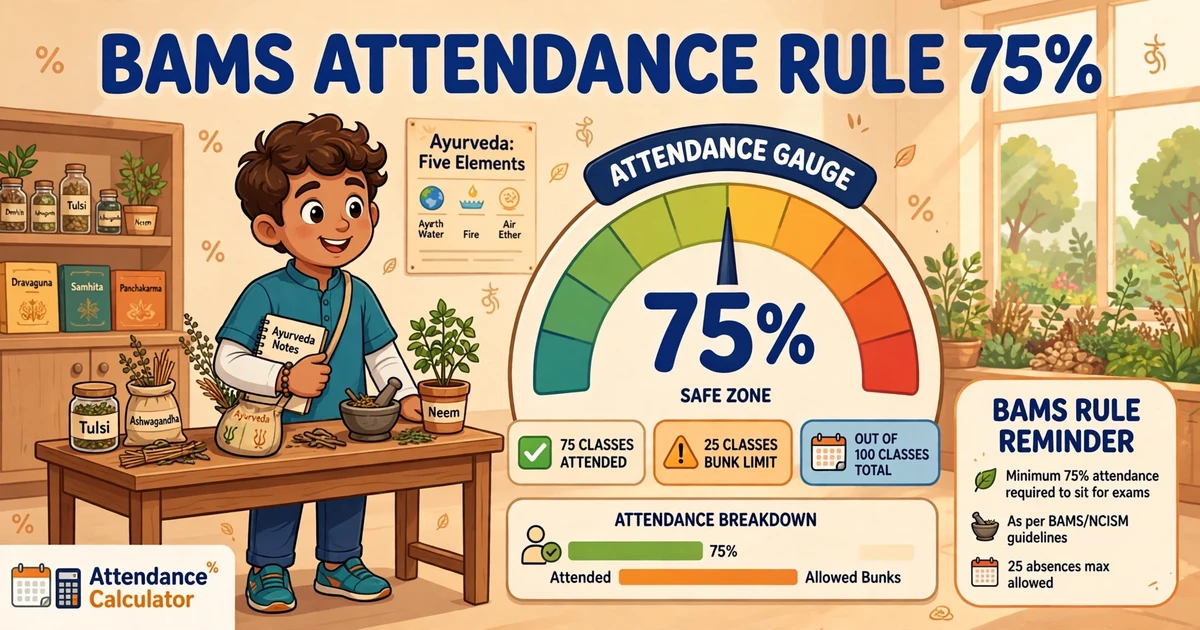
I tracked my own attendance by hand in a notes app all through my BSCS degree. Every evening I’d log the day’s classes, and I planned my whole semester around one number: 75%. So when I started looking into Ayurveda colleges, I assumed the BAMS attendance rule would be something softer, something different. It isn’t. The BAMS attendance rule is 75% too, but it bites twice. You need 75% in theory and 75% in practical, for each subject, separately. Miss one side and the other side can’t save you. This guide walks through the rule as it actually works: the theory-practical split, the colleges that ask for 80%, what detention really means, and how condonation works when life gets in the way.
What Is the BAMS Attendance Rule?
The BAMS attendance rule needs 75% in theory and 75% in practical, per subject. The 80% colleges, detention, condonation and how to stay safe.
This is a course governed by the National Commission for Indian System of Medicine (NCISM). NCISM sets the standard for Ayurveda colleges across India, and the 75% line sits at the heart of it.
Take the rule apart and it says three things. First, the line is 75%. Second, it applies to theory and practical separately. Third, it applies per subject. A student who hits 90% in theory and 70% in practical for the same subject is still short. The practical side is its own test, and it has its own bar.
Why Theory and Practical Are Counted Separately
Ayurveda is not just a theory subject. You learn to diagnose, to prepare medicines, and to work with patients. NCISM knows this, and that’s why the BAMS attendance rule keeps theory and practical apart.
Think of it like this. Reading about Panchakarma is not the same as doing Panchakarma. A student who attends every lecture but skips every practical has learned the words and missed the skill. The separate bar stops that from happening.
This is the mistake I see most often. A student adds up all their classes, theory plus practical, gets a nice 80% overall, and relaxes. Then the shortage list comes out, and they’re short in practical alone. The overall number never mattered. The two separate numbers did.
Why Do Some BAMS Colleges Ask for 80%?
Here’s a question every BAMS student asks at some point. If NCISM says 75%, why does my college say 80%? The answer is simple, and it’s the same answer as in many other courses. NCISM sets the minimum. Your college or university can set a higher bar on top of it.
Some colleges and universities want a stricter line. They ask for 80% in theory and 80% in practical, each counted on its own. That’s their rule, and it’s the one that applies to you, even though the national minimum is lower.
This is why you must check your own college’s rule, not just the national rule. A guide can tell you the minimum. Only your college handbook, your department notice board, or your college office can tell you the number that will actually decide your exam seat. If your college says 80%, then 75% is not enough for you, no matter what the internet says.
What Happens If You Fall Below 75%?
The word BAMS students dread is detention. If you fall below 75% in a subject, in theory or in practical, your college can detain you in that subject. Detention means you do not appear for that subject’s exam with your batch.
Detention is not the same as failing. Failing means you wrote the exam and did not pass. Detention means you did not get to write it at all, because your attendance was short. You then have to make up the attendance and appear later, which can push your whole timeline back.
The key point is that detention is per subject. Fall short in one subject and you are detained in that subject. Your other subjects, where you cleared 75% on both sides, are not affected. That’s why tracking per subject matters so much. One weak subject is one problem, not a lost year, but it is still a problem you want to avoid.
Can Your College Condone a Shortage?
Yes, sometimes. Condonation is when your college or university forgives a small shortage, usually up to a set limit, for a genuine reason. The limit and the reason both matter, and both vary by institution.
Condonation is not a right. It is a discretion, and it is usually tied to a genuine reason such as illness, with medical proof, or another approved cause. You apply, you show the proof, and the authority decides. If you have no proof, you have no case.
Here’s my advice, and it’s the same advice I gave in the DU guide. If you think you will need condonation, start the conversation early. Talk to your department, find out the limit, find out the form, find out the proof. Don’t wait until the shortage list is published, because by then the window for a calm, well-documented application has already closed.
Worked Example: Where the 75% Line Falls
A subject has 200 theory lectures and 100 practical sessions in the year. To clear 75%, you need 150 theory lectures and 75 practical sessions. Attend 160 theory and 70 practical and you are still short, because practical is at 70%, not 75%. Attend 140 theory and 90 practical and you are short on theory, even though your overall attendance across both is 230 out of 300, which is 76.7%. The overall number looks fine. The subject-wise, side-wise numbers do not, and those are the numbers that count.
Now check a college that asks for 80%. The same subject needs 160 theory lectures and 80 practical sessions. If you attended 155 theory lectures, you are at 77.5%. That clears the NCISM line of 75%, but it does not clear your college’s line of 80%. You are still short, in your college, and that is the line that decides your seat.
How I Tracked My Own Attendance (and What I’d Do Differently)
I tracked my attendance by hand in a notes app. Every evening, I’d log the day’s classes. It worked, but it was fragile. Miss a day of logging and the record had a hole. Miss a week and you were guessing.
If I did it again, I’d do two things differently. First, I’d track theory and practical in separate columns, not one total. Second, I’d compare my number with the official number every month, not once a semester. A monthly check catches a gap while you can still close it. A semester-end check just tells you what went wrong.
For BAMS, that second habit matters twice as much, because you have two numbers per subject to watch, not one. A simple table, subject by subject, theory and practical side by side, is worth more than any fancy app. You just have to actually fill it in.
The 7.5-Year Course: Why This Line Matters So Much
BAMS is not a short course. It runs for five and a half years of study, followed by a one-year internship. That’s seven and a half years in total before you are a registered practitioner.
That length is exactly why the attendance line matters so much. A detention in one subject doesn’t just cost you a paper. It can push your whole timeline back, and in a seven-and-a-half-year course, a delay is not a small thing. It’s a delay to your internship, to your registration, and to your first job.
Think of attendance as protecting that timeline. Every class you attend is a small payment towards finishing on time. Every class you skip is a small loan against that same timeline, and loans always come due.
The Other Costs Nobody Talks About
Detention costs more than time. It costs money, in extra fees and extra living costs for the extra months. It costs momentum, because you watch your batch move on without you. And it costs confidence, because you start the next attempt already feeling behind.
None of this is meant to scare you. It’s meant to make the stakes clear. Attendance is not a bureaucratic box to tick. It is the cheapest insurance you can buy for a seven-and-a-half-year investment. Showing up is the part of the course you control completely, and it’s the part that keeps everything else on track.
Mistakes That Cost BAMS Students Their Exam Seat
The first mistake is adding theory and practical together. You need 75% in each, separately, per subject. A strong theory number never rescues a weak practical number.
The second mistake is trusting the overall percentage. Your college may publish one overall figure, and it may look fine, while one subject or one side is quietly short. Check subject by subject, side by side.
The third mistake is assuming condonation will save you. Condonation has a limit, it needs proof, and it is a discretion, not a right. Plan as if it does not exist, and treat it as a bonus if it does.
The fourth mistake is leaving the check until the end. A shortage found in the last month is very hard to fix. A shortage found in the second month is just a few extra classes.
How to Check Your BAMS Attendance
Start with your college portal or student dashboard, if your college has one. Look for attendance by subject, and check theory and practical separately. If the portal only shows an overall figure, ask your department for the split. You need both numbers, and you need them per subject.
Check monthly. Write the numbers down in your own table, and compare them with the official numbers. If they don’t match, ask. A mismatch found early is a question. A mismatch found late is a crisis.
And keep your proof in one place. Medical certificates, leave letters, any document that might support a condonation application later. Paperwork is boring until the day it saves your semester, and in BAMS, that day comes for more students than you’d think.
Frequently Asked Questions
What is the BAMS attendance rule?
Under NCISM, BAMS students need 75% attendance in theory and 75% in practical, for each subject, separately. Both sides must clear 75%.
Can I pass if my overall attendance is 80% but practical is 70%?
No. Practical is counted on its own. At 70% in practical, you are short in that subject, even if your overall figure looks fine.
Why does my college ask for 80%?
Because a college or university can set a higher bar than the NCISM minimum of 75%. If your college says 80%, that is the number that applies to you.
What is detention in BAMS?
Detention means you do not appear for a subject’s exam with your batch because your attendance was short in that subject. It is per subject, not a whole-year failure.
Can a shortage be condoned?
Sometimes, up to a set limit, for a genuine reason with proof. Condonation is a discretion, not a right, and the limit varies by institution.
How long is the BAMS course?
Five and a half years of study, followed by a one-year internship. Seven and a half years in total.
One Last Thing
The BAMS attendance rule is simple to state and easy to get wrong. 75% in theory. 75% in practical. Per subject. Two numbers, not one, and both of them matter.
Check your numbers monthly, subject by subject, side by side. Aim above the line, not at it, because in a seven-and-a-half-year course, a small shortage now is a long delay later. And if you’re sliding, talk to your department while there’s still time to fix it. Your exam seat is worth a conversation.