

Low Attendance Notice from College? Do These 7 Things in the Next 7 Days
The envelope was waiting on the table when I got home one evening in my second year. College letterhead, my name on it, and inside, a short letter saying my attendance had fallen below the required level. I read it twice. My first thought was that I was in serious trouble. My second thought was that I had no idea what to do next.
If a low attendance notice from college has just landed in your hands, or in your parents’ hands, you are probably feeling the same mix of worry and confusion. This post is the thing I wish someone had handed me that evening. It explains what the notice means, what happens if you ignore it, and the seven things to do in the next seven days to put it right.
What is a low attendance notice from college?
A low attendance notice from college is a formal warning letter saying your attendance has fallen below the minimum the college requires, usually 75 percent. It asks you to improve, give a reason, or meet your mentor, and warns that further action will follow if the number does not rise.
That is all it is. A warning, in writing. It is not an expulsion. It is not a fine. It is the college putting you on notice, which is why it is called a notice. The letter usually goes to you and to your parents, and it usually gives you a deadline. The deadline is the part to take seriously. A notice with a deadline is a clock, and the clock starts the day the letter arrives. That is all a low attendance notice from college is: a warning in writing, not a punishment.
Read your notice in 60 seconds
Before you do anything else, read the letter properly. Not the whole thing in a panic. Just three lines. Read it slowly, because a low attendance notice from college always names the deadline you have to meet.
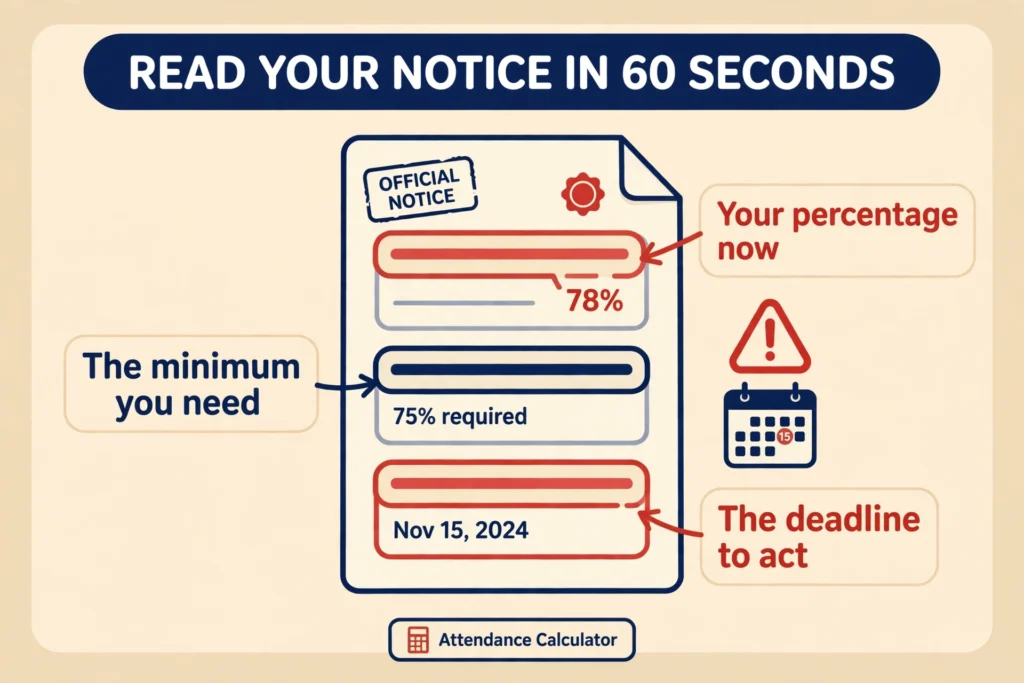
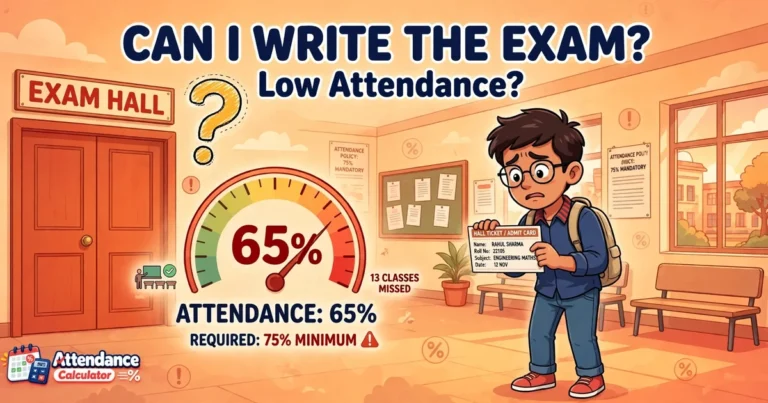
Your percentage now. The letter should say your current attendance, or at least the subject it is about. If it says 62 percent, that is your starting point. Write it down. If it does not give a number, ask your mentor for it the next day. You cannot fix a number you do not know.
The minimum you need. The letter should say the line you have to reach, usually 75 percent. Some colleges use a different number for a course, so read the letter, not the rumour. If the letter says 75 percent and you sit at 62, you need 13 points. That is the gap, and the gap is what your plan has to close.
The deadline to act. The letter may ask you to meet your mentor by a date, or to reply in writing within a week, or to bring your parents in for a meeting. Circle that date. It is the one date in the letter that matters most. Missing it turns a warning into a second warning, and a second warning is much harder to talk your way out of.
One more thing to check. Look for the name of the person you are meant to meet. It is usually your class mentor, your class teacher, or the head of department. That name is your first stop. Do not go to the principal first. Do not go to the office first. Go to the person the letter names.
Why did you get the notice?
Colleges send the notice when your attendance crosses a line they have set, usually the same 75 percent used for exams. Some send the first notice at 70 percent as an early warning. Others send it only when you drop below 65 percent. That is why a low attendance notice from college usually arrives soon after your attendance slips below the line.
Colleges do not send these letters at random. The notice goes out when your attendance crosses a line the college has set, and the line is usually the same 75 percent used for exams. Some colleges send the first notice at 70 percent, as an early warning. Others send it only when you drop below 65. A few send one every month to every student below the line. The pattern varies, but the trigger is always the same: the number dropped, and the college noticed.
The reason behind the number is a different question, and it is the one the college actually wants answered. Were you ill? Did a family emergency keep you home? Were you on a sports tour or a college event? Or did you just stop going? The college does not know, and the notice is its way of asking. Your reply is where you give the reason, and the reason is only as strong as the proof behind it. A medical certificate with dates on it is proof. A story with no papers behind it is not.
Here is a part students often miss. The notice is also a paper trail for the college. If your case ever reaches an appeal, the college will show that it warned you, in writing, on a date. That is why the letter matters even if it feels like a formality. It is the college’s record that it gave you a chance. Your reply becomes your record that you took it. Keep the letter safe, because a low attendance notice from college is the college’s record that it warned you.
What happens if you ignore the notice?
The steps get worse one by one. First comes a second notice, or a call to your parents. Then your name goes on the defaulter list. Then the exam form gets blocked, or a fine is charged. A notice is easy to answer. A blocked exam form takes an appeal.
Nothing good. The steps after a notice follow a pattern at most colleges. First comes the notice itself. Then comes a second notice, or a call to your parents. Then your name goes on the defaulter list. Then the exam form gets blocked, or a fine is charged, or both. Each step is worse than the one before it, and each step is harder to undo. A notice is easy to answer. A defaulter list takes a month of full attendance to fix. A blocked exam form takes an appeal. Every step after a low attendance notice from college costs more than the one before it.
I have seen students ignore the first notice because it looked like a routine letter. It is routine, in the sense that the college sends hundreds of them. But your name on one is not routine for you. The letter is the cheapest warning you will ever get. Every step after it costs more time, more money, or more stress.
One thing worth knowing here. In November 2025, the Delhi High Court directed law colleges to send monthly attendance notices to parents, publish weekly attendance records online, and offer extra classes to help students cover a shortfall. That order was for law colleges, but it shows what good practice looks like: warn early, warn in writing, and give the student a real way back. If your college sent you a notice, it did the first two. Your job is to take the third.
Your 7-day plan
You do not need a month to answer a notice. You need a week of steady steps. Here is the plan, one thing per day. One week is enough to answer a low attendance notice from college, if you start on the day it arrives.
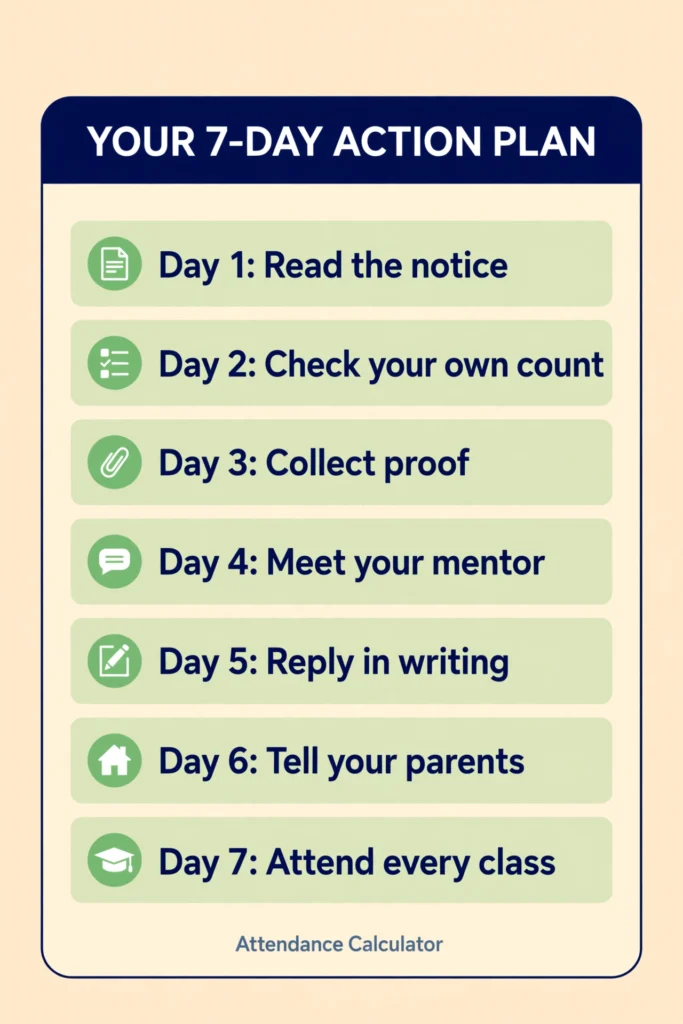
Day 1: read the notice. Find the three lines above: your percentage, the minimum, and the deadline. Write them on a piece of paper and stick it where you will see it. Tell your parents the same day. Hearing it from you is far better than hearing it from a college letter.
Day 2: check your own count. Open the portal and look at your subject-wise attendance. Is the college number right? Teachers mark in a rush, and a wrong tick can cost you a few points. If you need the steps, my guide on how to check your attendance percentage in college shows you where the official number lives and how to cross-check it against your own count. A wrong number is the easiest fix in this whole process.
Day 3: collect your proof. Medical certificate from a doctor, with dates. Letter for a sports event or a college activity. Any paper that explains a real absence. If the reason was illness, my template for a medical leave application for college shows you what to write and what to attach. Put the papers in one folder, originals and copies together.
Day 4: meet your mentor. Go after class. Take your papers and your own count. Tell them the reason in two lines, then ask what the process is. Mentors have seen this before. They know which forms matter and how much time you have. Ask them directly: what do I need to do to close this notice?
Day 5: reply in writing. If the notice asks for a written reply, send one. Keep it short and honest. Your name, roll number, class, the reason, the proof attached, and a promise to attend from now on. My format for an attendance shortage application letter to the principal works for this too. A written reply with proof attached is much harder to ignore than a hallway chat.
Day 6: tell your parents the plan. Tell them the problem and the plan. Show them the papers, the reply, and the dates. Parents worry less when they can see a plan, and they worry more when the college calls before you have told them. If the college asks your parents to come in, go with them. A student who walks in with a plan gets a very different hearing from one who walks in with excuses.
Day 7: attend every class. This is the step that actually moves the number. A week of full attendance is the best reply you can give to a notice. It is also the only reply the college counts in the end. The number moves slowly, but it moves, and every class you attend moves it.
How to reply to the notice
The reply itself is simple, and simple is good. Colleges read hundreds of these letters. The ones that work have four things in them. A short, honest reply is the best answer to a low attendance notice from college.
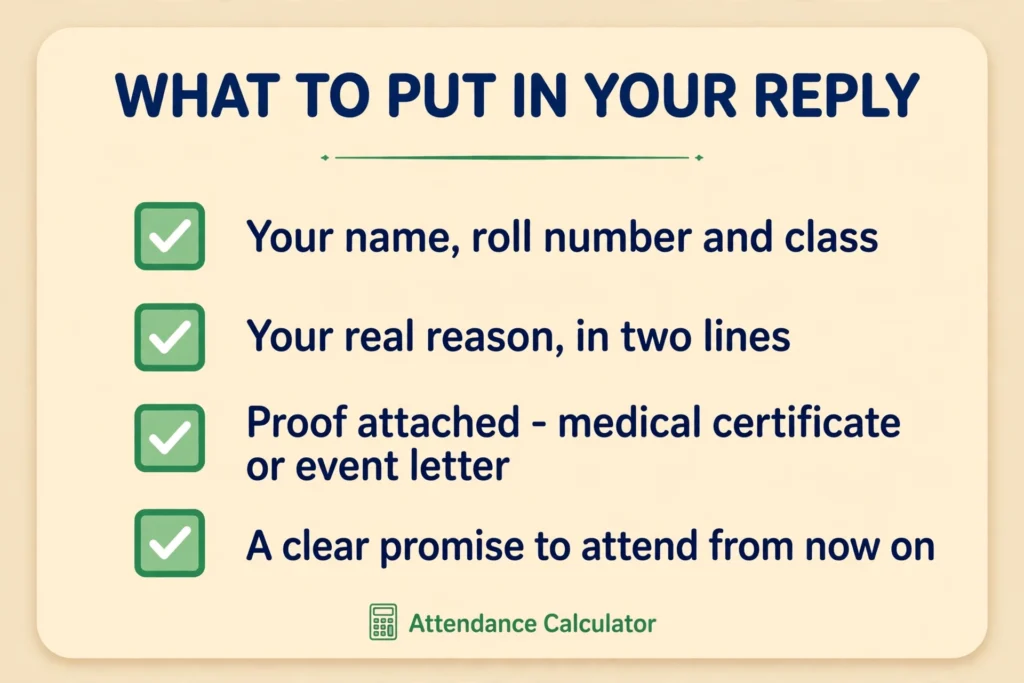
Your name, roll number, and class. Right at the top. Make it easy for the office to file your letter against your record.
Your real reason, in two lines. Not a long story. “I was ill from 3 to 12 March with typhoid, as per the attached medical certificate.” That is enough. If the reason is not medical, say what it is, in the same short way.
Proof attached. Name the papers you attached. “Medical certificate attached. Discharge summary attached.” The office needs to see the list, and the papers behind it.
A clear promise to attend from now on. One line. “I will attend all classes from today and keep my attendance above 75 percent.” Then do it. A promise you break is worse than no promise at all.
Keep the tone calm and respectful. You are not arguing with the college. You are giving it the information it asked for. Short, honest, and with proof will beat long and emotional every time.
And one line I need to say plainly. Never ask anyone to change your attendance record for classes you did not attend, and never offer money to make a notice go away. That is fake attendance, and if it comes out, it can cost you far more than the notice it seemed to fix. The reply you want is an honest reason with real proof, not a better number.
Myth vs Fact
Myth: “A low attendance notice means you are about to be expelled.”
Fact: A notice is a formal warning, not an expulsion. It means your attendance is below the line and the college wants a reason and an improvement. Expulsion comes much later, after warnings, meetings, and a defaulter list have all been ignored. The notice is the early step, and it exists to give you time. That is the fact behind every low attendance notice from college: it is a warning, not an expulsion.
FAQ
What should I do first after getting a low attendance notice?
Read the notice and find three things: your current percentage, the minimum you need, and the deadline to act. Then check your own attendance on the portal to see if the number is right. Tell your parents the same day, and meet your mentor within the week.
Will my parents be told about my low attendance notice?
In most colleges, yes. The notice usually goes to parents as well as the student, or the college calls them. Tell your parents yourself first, with your plan to fix it, so the college letter does not come as a shock to them.
Can a low attendance notice stop me from sitting exams?
Not on its own. A notice is a warning. But if you ignore it and your attendance stays below the line, your name can go on the defaulter list and your exam form can be blocked. Answer the notice now, while it is still just a warning.
How do I reply to a low attendance notice from college?
Write a short letter with your name, roll number, and class, your real reason in two lines, the proof attached, and a promise to attend from now on. Hand it to your mentor or the office before the deadline in the notice, and keep a copy.
How long do I have to improve after a notice?
It depends on your college. Most notices give you a week or two to respond, and the rest of the semester to lift the number. The deadline in your letter is the real answer. If it says seven days, seven days is what you have.
Your next step
Find the letter. Read the three lines. Write down your percentage, the minimum, and the deadline. Then start day one today, not on Monday, not after the weekend. A notice is a warning with a clock on it, and the clock is the number of classes left in the semester. Every class you attend from today is a point back toward the line. That is how you answer a low attendance notice from college: read it, count it, and reply.

One Comment