Attendance Shortage Application Letter to the Principal: 3 Copy-Ready Samples That Actually Work
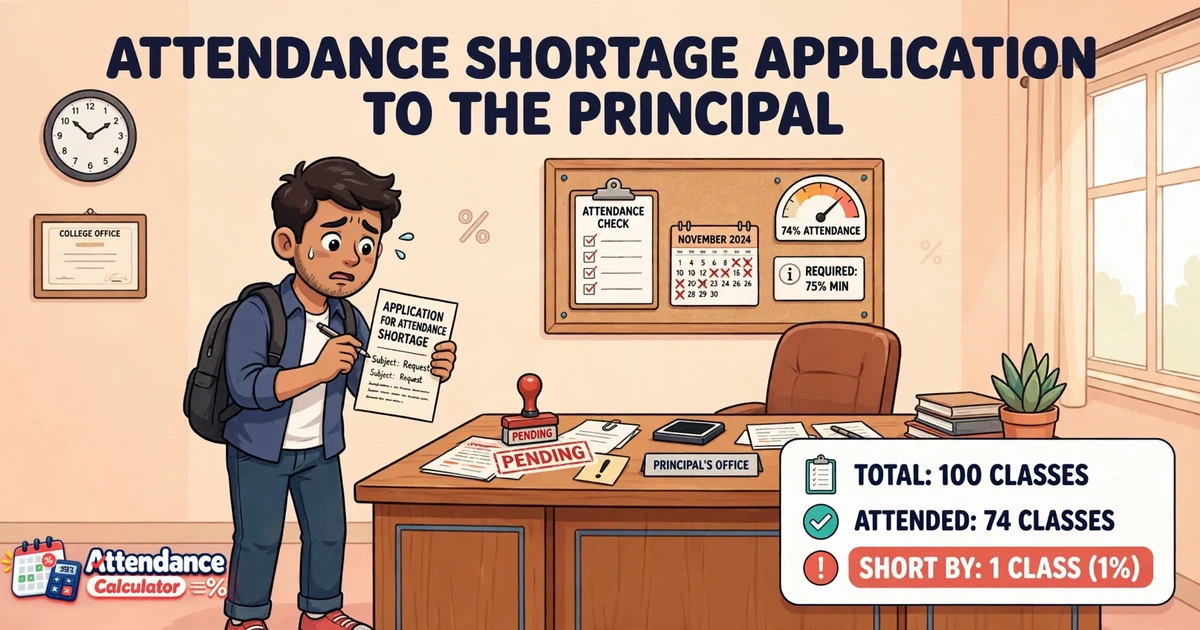
My attendance hit 61 percent in my third semester. One morning I walked past the notice board and saw my roll number on the shortage list. My stomach dropped. I had two weeks before the exam forms closed, and no clue what to write to the principal.
That letter is the whole game when your attendance falls short. An attendance shortage application letter to principal is a short, formal request that asks your college to condone the shortage and let you sit for your exams. Get it right and the office moves your file forward. Get it wrong and it sits in a pile.
I wrote mine the hard way, with three drafts and a lot of crossed-out lines. This post gives you what I wish I had then: the exact format for an attendance shortage application letter to principal, three letters you can copy and change to fit your case, and the list of papers to attach. No guesswork. Just a letter that reads like a serious student wrote it.
What is an attendance shortage application letter to the principal?
An attendance shortage application letter to principal is a formal request asking the principal to excuse your low attendance and let you sit for your exams. You give your name, class, roll number, current attendance percentage, and the reason for the shortage, and you attach proof like a medical certificate.
It is not a leave application. A leave application asks for permission to stay away in the future. This letter looks back at classes you already missed, and asks the college to accept the gap.
It is also not a note to your teacher. Your teacher can mark you present or pass on a message, but only the principal’s office can clear a shortage. That is why the letter goes to the principal, even if your class teacher is the one who hands it over.
The rules behind this letter, the condonation limits and who can approve what, are a separate topic. I wrote about them in detail in my guide to what attendance condonation is and how it works. Read that first if you do not know your college’s condonation limit. This post is about the letter itself.
When do you actually need one?
You need one when your attendance falls below your college’s required line, usually 75 percent, and the office asks for a written request before it clears your exam form. Write it as soon as you see your name on the shortage list, not on the last day the office accepts forms.
Most colleges put up a shortage list a few weeks before exams. If your name is on it, that is your signal. Some colleges ask for the letter before you fill the exam form. Others ask for it after the list comes out. Either way, the clock is short.
Do not wait to see if the problem goes away on its own. It will not. A shortage does not fix itself, and the office will not chase you. The students who get cleared fastest are the ones who walk in with a letter and their papers in the same week the list goes up.
One honest warning. If your attendance is short because you skipped class for no real reason, the letter still matters, but it will not do magic. Be straight about what happened. Principals have seen every excuse in the book, and a plain, honest letter gets further than a dramatic one.
The format principals expect
A principal reads dozens of these letters every semester. The ones that get approved fast all look the same. Short. Clear. Easy to file. Here is the shape to follow.
Start with the date and the address block. “To, The Principal,” then your college name and city. Then a subject line. Make the subject line do real work: “Request for condonation of shortage of attendance” plus your name, class, and roll number. An office clerk should know what your letter is about without reading past the subject line.
Then the body, in three short paragraphs. Paragraph one: who you are. Name, class, section, roll number, and your current attendance percentage. Put the number in plainly. “My attendance stands at 68 percent” beats a vague line about being short.
Paragraph two: why it happened. Dates, facts, nothing extra. “I was ill from 12 March to 28 March” is enough. The principal does not need your life story. Save the detail for the papers you attach.
Paragraph three: what you are asking for, and a promise. Ask clearly for condonation and permission to appear for the exams. Then say you will cover the missed work and keep your attendance above the line next semester. One line. That is it.
Close with “Thanking you,” then “Yours obediently,” your name, class, roll number, and phone number. Then list your enclosures at the bottom, so the office can check nothing is missing.

What to say for each reason
The reason changes what you write and what you attach. This table covers the four cases I see most often.
| Reason for shortage | What to say in the letter | What to attach |
|---|---|---|
| Medical illness | Dates you were ill, where you were treated | Medical certificate, discharge papers |
| Family emergency | What happened, dates you were away | Hospital papers or any paper that backs the dates |
| Sports, NCC or NSS duty | Event name, dates, who sent you | Duty certificate from your coach or NCC officer |
| Approved college work | What the work was, dates, who asked you to do it | Letter from the teacher or office that sent you |
If your reason is medical, your letter should match your certificate. Dates in the letter, dates on the certificate, same story. A mismatch is the fastest way to get a letter sent back. My full guide to a medical leave application for college covers the medical format in more depth if that is your case.
And before you write a single line, check your real number. Use the attendance shortage calculator to see exactly how far short you are. A letter that says 68 percent when the register says 61 percent loses trust before anyone reads paragraph two.
Sample 1: medical reason
This is the most common case, and the one most students get wrong by writing too much. Keep it to one page.
To,
The Principal,
[College Name],
[City]
Date: [DD/MM/YYYY]
Subject: Request for condonation of shortage of attendance — [Your Name], [Class], Roll No. [XXXX]
Respected Sir/Madam,
I am [Your Name], a student of [B.Sc. Computer Science, 3rd Semester], Roll No. [XXXX]. My attendance for this semester stands at 68 percent, which is below the required 75 percent.
I was down with typhoid from [12 March] to [28 March] and could not attend classes during that time. I was under treatment at [Hospital/Clinic Name], and I have attached my medical certificate and discharge papers with this letter.
I request you to kindly condone my shortage of attendance and allow me to appear for the semester examinations. I will cover the missed work and keep my attendance above the required level in the next semester.
Thanking you,
Yours obediently,
[Your Name]
[Class and Section]
Roll No. [XXXX]
[Phone Number]
Enclosures:
- Medical certificate
- Discharge summary
Change every bracket to your own detail. Dates, hospital name, your real percentage. A letter with someone else’s dates in it is worse than no letter at all.
Sample 2: family emergency
Family emergencies are hard to write about, and principals know that. You do not need to explain everything. Give the facts, keep your dignity, and let the papers speak.
To,
The Principal,
[College Name],
[City]
Date: [DD/MM/YYYY]
Subject: Request for condonation of shortage of attendance — [Your Name], [Class], Roll No. [XXXX]
Respected Sir/Madam,
I am [Your Name], a student of [B.A., 2nd Semester], Roll No. [XXXX]. My attendance for this semester stands at 66 percent, which is below the required 75 percent.
My father was admitted to hospital on [date] after a serious accident, and I had to stay with my family in [City/Village Name] from [date] to [date]. I could not attend classes during that period. I have attached the hospital papers with this letter.
I request you to kindly condone my shortage of attendance and allow me to appear for the semester examinations. I will work to cover the missed syllabus and keep my attendance above the required level in the next semester.
Thanking you,
Yours obediently,
[Your Name]
[Class and Section]
Roll No. [XXXX]
[Phone Number]
Enclosures:
- Hospital admission papers
If the emergency was a death in the family, one plain line is enough: “My grandmother passed away on [date], and I had to travel to my village for the last rites.” No principal needs more than that, and no student should have to write more.
Sample 3: sports or NCC duty
This one is different, because the college itself sent you away. Say so clearly. Your letter is not really asking for a favour. It is asking the college to count duty it ordered.
To,
The Principal,
[College Name],
[City]
Date: [DD/MM/YYYY]
Subject: Request for condonation of shortage of attendance — [Your Name], [Class], Roll No. [XXXX]
Respected Sir/Madam,
I am [Your Name], a student of [B.Com., 4th Semester], Roll No. [XXXX]. My attendance for this semester stands at 70 percent, which is below the required 75 percent.
I represented our college in the [Inter-University Cricket Tournament] from [date] to [date], and I attended the NCC annual training camp from [date] to [date]. I was away on official college duty during these periods. I have attached my duty certificate from [Coach/NCC Officer Name] with this letter.
I request you to kindly condone my shortage of attendance and allow me to appear for the semester examinations. I will cover the missed work and keep my attendance above the required level in the next semester.
Thanking you,
Yours obediently,
[Your Name]
[Class and Section]
Roll No. [XXXX]
[Phone Number]
Enclosures:
- Duty certificate from coach/NCC officer
Get the duty certificate signed before you submit the letter. A letter that says “certificate to follow” usually waits in a pile until the certificate arrives. Submit both together.
What to attach with your letter
A letter without proof is just a story. Attach copies, not originals. Keep the originals with you, and carry them when you go to the office in case someone wants to see them.
- Medical certificate from the doctor or hospital that treated you, with dates that match your letter.
- Discharge summary if you were admitted to hospital.
- Duty certificate from your coach, NCC officer, or NSS coordinator, if the absence was official duty.
- Hospital papers for a family emergency, if you have them.
- Any paper that backs your dates. A bus ticket, a train ticket, an event letter. Dates matter more than words.
One thing I will say plainly. If you have no paper for your reason, do not make one. A fake medical certificate can get you suspended, and it can follow you into your record. Tell the truth about what happened, attach what you do have, and let the principal decide. An honest letter with thin proof beats a strong letter built on a lie.
Mistakes that weaken your letter
Most rejected letters fail on the same few points. Check yours against this list before you hand it in.
No numbers anywhere. A letter that never says your attendance percentage or your dates gives the office nothing to check. Numbers are the spine of the letter. Without them, it is just a request with no case behind it.
A long, sad story. Three pages of feelings will not move a file faster than one page of facts. Principals read these letters in bulk. Keep it short and let the papers carry the weight.
Blaming the college. Lines like “the teacher never marked me present” or “the timetable was unfair” turn the reader against you. Even if you feel the system was unfair, the letter is not the place to fight that battle.
Copying a sample word for word. These samples are a starting point, not a finished letter. Change the names, the dates, the numbers, the reason. An office clerk who has seen the same letter three times in one week knows what happened.
Sending it to the wrong person. Hand it to the office or your class teacher, as your college asks. A letter left on a random desk or sent to a teacher’s personal number may never reach the file at all.
Myth vs. Fact
Myth: A long, emotional letter works better than a short one.
Fact: Principals read dozens of these letters every semester. A short letter with dates, a clear percentage, and proof attached gets a faster decision than a long one that says the same thing in three pages.
Myth: A good letter can fix any shortage.
Fact: The letter starts the process, it does not end it. Your college still checks your percentage against its own condonation rules, and no letter can push you past a hard limit. The letter matters, but it works inside the rules, not above them.
Myth: You should wait until the exam form is blocked.
Fact: Write the letter the week your name appears on the shortage list. Offices get slower as exam season gets closer, and a letter filed early has time to move through the remarks and the approval before the deadline.
What happens after you submit it?
Your letter goes to the office, then to your class teacher or head of department for remarks, and then to the principal for a decision. If it is approved, the office clears your exam form, sometimes after a condonation fee. Follow up politely if you hear nothing in a few days.
Ask the office for a receipt or an acknowledgement when you submit it. A stamped copy of your letter is your proof that you filed on time. Without it, a lost letter becomes your problem, not theirs.
Some colleges charge a condonation fee. I will not quote a number here, because the fee changes from college to college. Ask your office what it is and pay it at the counter, not to any student or middleman.
If a few days pass with no news, go back and ask, calmly. “Sir, I submitted my shortage application on Monday, could you tell me if it has been cleared?” That is enough. Do not argue, do not beg, and do not send five friends to ask on your behalf.

Frequently asked questions
Can I write an attendance shortage application letter to principal by hand?
Yes, a neat handwritten letter is fine if your handwriting is clear. A typed letter looks tidier and is easier for the office to file, so type it if you can. Either way, sign it by hand and keep a photocopy for yourself before you submit it.
What attendance percentage needs a shortage letter?
It depends on your college. Most Indian colleges ask for a shortage letter when you fall below 75 percent, and some set the line at 65 or 70 percent with condonation. Check your college handbook or ask your class teacher what the line is for your course.
Do I need a medical certificate with the letter?
Only if your reason is medical. A letter that claims illness without a certificate rarely gets approved. Attach the certificate from the doctor or hospital that treated you, plus discharge papers if you were admitted. Never attach a fake certificate, as that can lead to strict action.
How long should the letter be?
One page is enough. Three short paragraphs do the job: who you are and your attendance number, why you fell short, and what you are asking for. Principals read many of these letters, so a short letter with clear dates and proof beats a long one every time.
Can I email the letter instead of handing it in?
Some colleges accept an email, but most still want a signed hard copy on file. Email it if your office asks for that, then hand in the signed copy too. Keep the receipt or acknowledgement, so you can prove you submitted it on time.
Your next step
Here is the order I would follow if my name showed up on the shortage list tomorrow. First, check your real number on the attendance shortage calculator. Then pick the sample above that fits your reason, change every bracket to your own detail, and attach the papers that prove your dates. Hand it in this week, not on the last day.
A shortage letter is not a punishment. It is the one form in college that exists to help a student who had a rough semester. Write it straight, keep it short, and let the facts do the talking.