Mumbai University Attendance Rule: 5 Powerful 75% Facts
I want to start with a small confession. I never thought I would be the person who checks attendance percentages for fun. But after my own notes-app days in BSCS, when I discovered I was closer to the line than I thought, I started paying attention to these rules properly. I built this site because I kept seeing the same question from students: “Am I safe, or am I in trouble?” This guide answers that for Mumbai University students, in plain words, with real numbers you can check yourself.
If you study at Mumbai University, the rule you need to know has two parts, not one. Most students only hear about the 75%. They miss the second part, and that second part is what catches people. I will explain both parts, what counts and what does not, how condonation works, and how to work out exactly how many classes you still need. No jargon, no guessing, just the rule and the maths.
A warning first: check which syllabus year your batch follows
Before anything else, check which syllabus year your batch follows. This is the most important line in this article, so I am putting it first. Mumbai University has run more than one syllabus version over the years, and older texts talk about 75% overall plus 50% in each subject, while newer NEP versions describe the same idea in different words and sometimes with different numbers. I have seen the double test in older ordinance material, and I have also seen newer notes that read differently. I cannot settle which version covers your batch from here. Your college office can. Ask them, in person, which syllabus year and which ordinance your batch follows. Get the answer in writing if you can. That one question decides whether the numbers in this article apply to you as written.
What is the Mumbai University attendance rule in simple words?
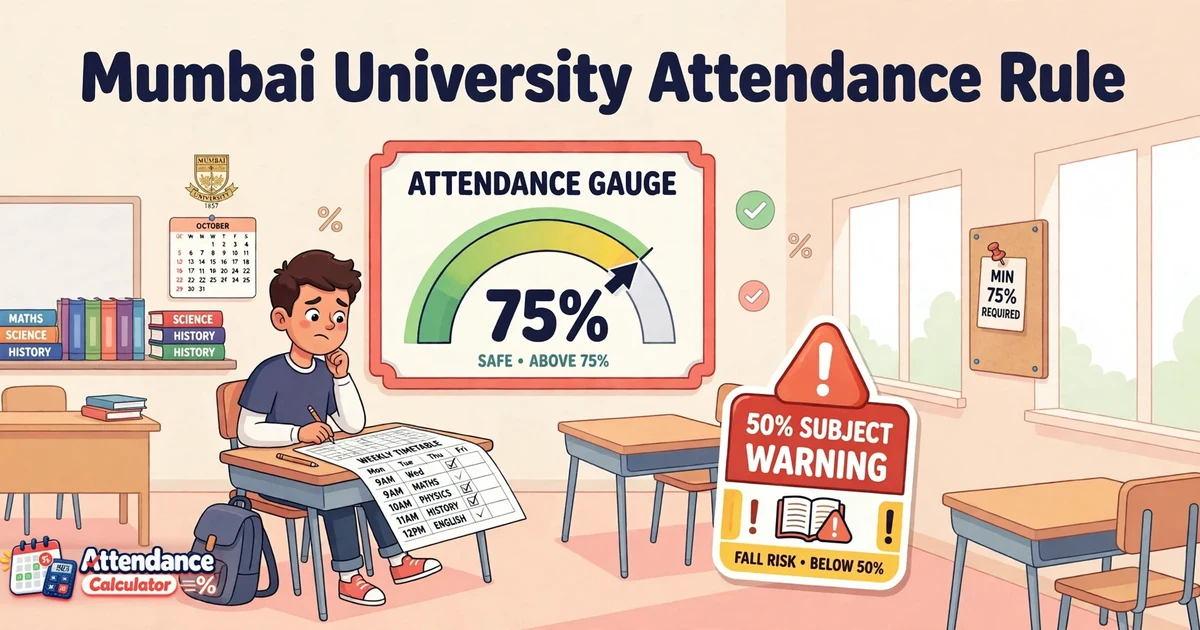
The Mumbai University attendance rule asks for 75% overall attendance plus at least 50% in every subject, and students below the required attendance are not allowed to appear for their semester examinations, so early tracking matters more than last-minute panic for every student in the batch, without exception.
That is the core of it. Think of it as two gates, not one. The first gate is the overall number: 75% across all your lectures, practicals and tutorials. The second gate is per subject: 50% in each subject on its own. You need to pass both gates. If you clear the overall number but fail one subject badly, you are still in trouble. If you clear every subject but your overall is low, you are still in trouble. Both gates matter. That is the whole point of this article, so let me say it once more: 75% overall, 50% in every subject.
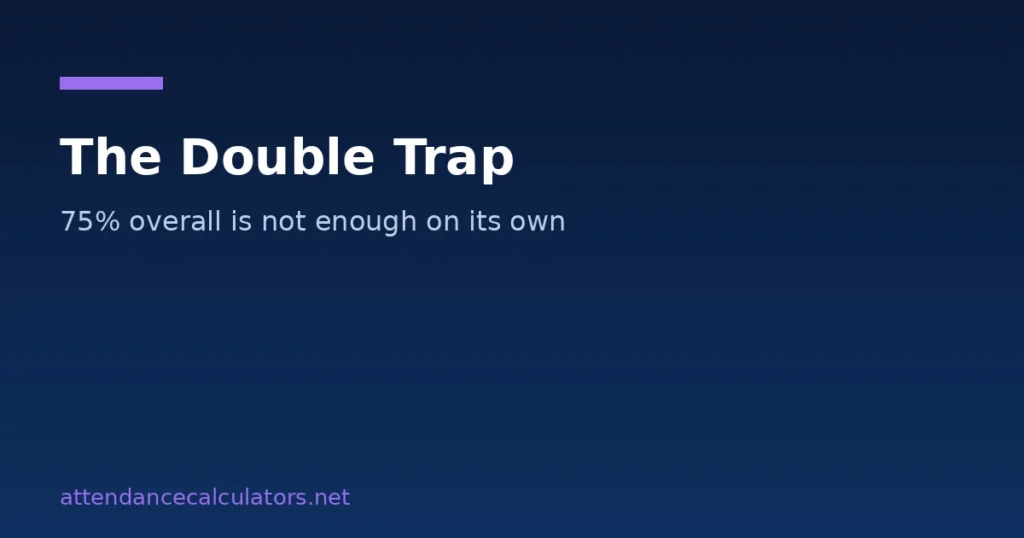
The double trap: 75% overall and 50% in every subject
Clearing the overall 75% is not enough on its own, because a single subject below 50% can still block you, and the only way to stay safe is to check both numbers every week and keep every subject healthy, not just your total.
Here is how the trap works in real life. Say your overall attendance is 78%. You feel safe. Then you check subject by subject and find one subject at 42%. Under the double test, that one subject is a problem. Your overall number does not rescue it. The rule is not “75% and you are done”. It is “75% overall AND 50% in each subject”. I have seen students learn this the hard way, and it is a horrible way to learn it.
The fix is simple, even if it takes a bit of discipline. Every Friday, check two things: your overall percentage, and your lowest subject. If either one is drifting, act on it that week, not next month. A subject at 52% with three weeks to go is fixable. A subject at 38% in exam week is not. The weekly check is the whole trick. It takes five minutes and it is the difference between a calm semester and a panicked one.
What counts, and what does not count?
Lectures, practicals and tutorials all count towards your attendance, while NSS, NCC, sports and field visits count only if your college marks them as present, so keep your attendance sheet honest and ask your department what counts in your college before you assume anything.
This is the part that causes the most confusion, because different colleges handle it differently, and students hear different stories from different seniors. Here is the honest picture. Your regular lectures count. Your practicals count. Your tutorials count. Those three are the backbone of your attendance, and they are what your sheet is mostly made of.
The tricky ones are NSS, NCC, sports days and field visits. Some colleges mark them as present. Some do not. Some mark them only if the activity was approved in advance. I cannot give you a single answer that covers every college, because the practice varies. So ask your department: which of these count as present in your college, and do they count towards the overall number, the per-subject number, or both? Write the answer down. If your college counts sports days as present, that changes your maths. If it does not, you need to know that before you plan around it.

Can condonation save you? What Ordinance 6086 allows
Ordinance 6086 lets the university condone a shortage of up to 25% in some cases, but only on genuine grounds and only with the right papers, so treat it as a safety net for real problems, not as a plan, and check the current ordinance limits with your college office before you rely on it.
This is the question every short student asks, and I want to give you a straight answer. Condonation is real, and Ordinance 6086 is the name students will hear. In the older texts I checked, the university can condone a shortage, with limits, on genuine grounds. But the details matter, and they have changed over time. The older material I found says the shortage can be condoned in some cases up to 25%, and it is handled through the college and the university. Newer notes describe the process differently.
So here is what I will not do: I will not give you a precise condonation number and pretend it is settled for your batch. It is not settled in what I could verify. Here is what you should do instead. If you think you will need condonation, talk to your college office this week, not in exam week. Ask what the current limits are for your batch, what grounds are accepted, and what papers you need. If you want the general idea of how these exemptions work, read how to check your attendance percentage first, so you know your exact number, and then ask your college about the process. Condonation is a safety net for genuine problems. It is not a plan for skipping class.
How do I work out how many classes I still need?
Use this formula: classes needed = (target x total classes held – classes attended) / (1 – target), and round up, because you cannot attend part of a class, and check your answer by adding the needed classes to both totals before you plan anything else.
Let me show you with real numbers, step by step, so you can copy the method for your own sheet. Say you have attended 80 classes out of 120 held so far, and your target is 75%.
Step 1: Multiply your target by the total classes held. That is 0.75 x 120 = 90.
Step 2: Subtract the classes you attended. That is 90 – 80 = 10.
Step 3: Work out 1 minus your target. That is 1 – 0.75 = 0.25.
Step 4: Divide the Step 2 answer by the Step 3 answer. That is 10 / 0.25 = 40.
So you need to attend the next 40 classes in a row, with no misses, to reach 75%. Let me check that, because I do not want to hand you a wrong number. After 40 more classes, you will have attended 80 + 40 = 120 classes, out of 120 + 40 = 160 held. And 120 / 160 = 0.75, which is 75%. The maths checks out.
If doing this by hand feels fiddly, use the 75 percent attendance calculator on my site and punch in your own numbers. It does the same calculation for you. The point is not the tool, though. The point is knowing your number while you still have time to change it. Forty classes in a row is a lot. Finding that out with two weeks left is very different from finding it out with two months left.
But remember the double trap. The formula above fixes your overall number. It does not fix a weak subject. Run the same calculation for your weakest subject, with a 50% target, and check that number too. If a subject needs 20 more classes in a row and your overall needs 40, the subject is the tighter constraint. Plan for the tighter one.
Here is a simple way to read your own position:
| Your attendance | What it usually means | What to do now |
|---|---|---|
| 75% overall and 50% in every subject | Safe on attendance | Keep tracking weekly, do not drift |
| 75% overall but a subject under 50% | Double trap, still at risk | Push the weak subject up first |
| Below 75% overall | Short on the main gate | Work out your classes-needed number |
| Any subject under 50% | At risk in that subject | Talk to your department this week |
| Under 75% and under 50% somewhere | Short on both gates | Talk to your college office now, plan ahead |

What should I do this week if I am short?
If your number is below 75%, do not panic, but do not drift either. Here is a short checklist that has helped students I know:
- Count your real attendance today, subject by subject and overall, from your college sheet, not from memory.
- Check your lowest subject first, because the 50% per-subject gate is the one students forget.
- Work out your classes-needed number for your overall total and for your weakest subject, with the formula above, or with the calculator, so you know the size of the gap.
- If illness or approved activities caused the gap, collect your certificates now and ask your advisor what form your college wants.
- Ask your college office which syllabus year your batch follows, and whether any newer condonation limits apply to you.
- Make a simple weekly plan: which classes you will not miss, and what you will do if you fall ill again.
One more thing from my own notes-app days. Tracking only works if you update it. I used to tell myself I would count at the end of the month, and then the month would vanish. Count every Friday. Five minutes, once a week, beats a frantic count the night before exams. If you want a starting point, the Attendance Calculator homepage has the tools I built after living through this myself.
For a fuller picture of how colleges frame these rules, a college academic page that lays out attendance expectations is worth a look: Mumbai University attendance rules as published by a college academic office. It is not your college’s final word for your batch, but it shows how the rule is normally written up. Your own college office still has the last say.
Quick questions students ask me
Can I still write exams at 70% attendance?
Yes, you may be able to, but only through the condonation route, and only if your college and the university accept your case, so talk to your advisor early, not in exam week, and do not assume condonation is automatic.
That is the honest answer. Seventy percent on its own does not clear the 75% line. It puts you in the range where condonation may be possible, depending on your batch’s rules and your reasons. File early, keep copies, and talk to your advisor before you assume anything.
Does one low subject fail me if my overall is above 75%?
Yes, it can, because the rule asks for 50% in every subject as well as 75% overall, so one subject below 50% is enough to block you, and you should fix the weak subject before you relax about the overall number.
I know that answer is annoying. I would love to give you one clean yes. The truth is that the two gates work together, and your weakest subject matters as much as your total. Check both every week.
How do I apply for condonation?
Ask your college office for the current condonation form and the list of accepted grounds, and file it with your papers well before the exam forms close, because late applications are much harder to get through, so start the conversation now, not in exam week.
Do not sit on it. Ask for the form, ask what counts as a genuine ground, and ask what the deadline is. If your college has its own process, follow that process, not a random format you found online.
What if my college counts NSS days differently?
Ask your department to confirm in writing whether NSS, NCC, sports or field visits count as present in your college, because practice varies, and you should not plan around days that might not count towards your total.
Some colleges count them, some do not, and some count them only when the activity was approved in advance. Get the answer for your college, in writing, before you count those days in your maths.
Your next step today
Do one thing today, not ten things someday. Open your attendance sheet, count your overall percentage and your lowest subject, and work out your classes-needed number for both. If you are at 75% overall and 50% in every subject, keep your Friday counting habit and stay there. If any number is short, talk to your advisor this week. And ask that one syllabus-year question, because it shapes everything else. You have got this, but only if you know your numbers. Go and find them today.