
Delhi University Attendance Rule: 5 Powerful 66.67% Facts
I tracked my own attendance by hand in a notes app all through my BSCS degree. Every evening I’d log the day’s classes, and I planned my whole semester around one number: 75%. So when a friend from Delhi University told me his college only asked for 66.67%, I thought he’d got it wrong. He hadn’t. I’d got it wrong, because I’d assumed every Indian university used the same line. Delhi University doesn’t. The Delhi University attendance rule comes from Ordinance VII, and it asks for two-thirds attendance each semester. That’s 66.67%, not 75%. Lower bar, yes. But the catch is real too, and this guide walks through all of it: the three attendance bands, the undertaking route, the internal marks link, and the 75% myth that keeps confusing DU students each year.
What Is the Delhi University Attendance Rule?
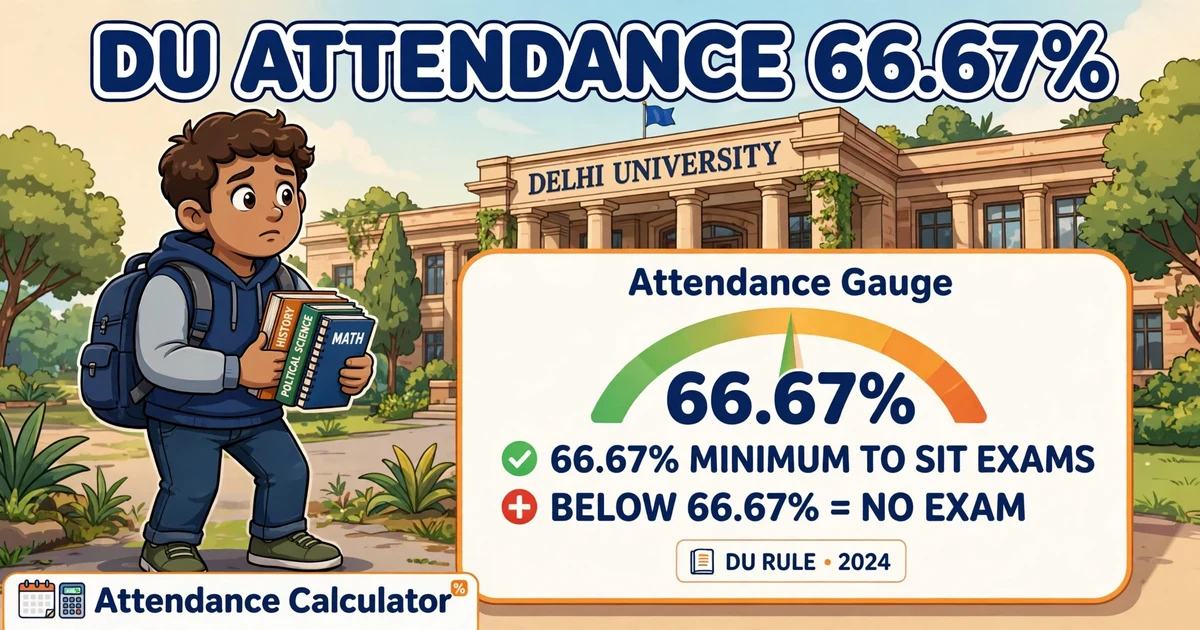
The Delhi University attendance rule comes from Ordinance VII. It asks for 66.67% attendance each semester, which is two out of every three classes. That sits below the usual 75% line. Fall below 66.67% and your college can bar you from exams.
Two out of three. That’s the number to hold in your head. Attend two classes, miss one, and you’re still on the line. Miss two in a row and you’re sliding under it. The rule sounds kind next to 75%, and in a way it is. But a lower bar is not a free pass. Colleges in DU enforce it, and October 2026 showed exactly what happens when they do.
Why 66.67% and Not 75%?
Most Indian universities picked 75% as their line. Delhi University picked two-thirds. The figure comes straight from Ordinance VII of the university, which governs attendance for its colleges. It’s not a rumour. It’s the written rule.
So why do so many DU students believe the line is 75%? A few reasons stack up. First, nearly every other university uses 75%, so students hear that number from friends, cousins, and the internet long before they read their own college handbook. Second, the 75% figure does exist inside DU life, just in a different place, and I’ll get to that mix-up further down. Third, some DU colleges talk about 75% as a good target even though the legal bar is lower. A target is not a rule, but students hear the two as the same thing.
Here’s my honest take. Treat 66.67% as the floor, not the goal. The floor is what keeps your exam seat. The goal is a number with some slack in it, because life happens. A week of fever, a family emergency, a transport strike. If you aim at exactly 66.67%, one bad week puts you under. If you aim at 75% or so, the same bad week leaves you standing. That’s the habit I built in my own degree, and it’s the one I’d pass on to any DU student.
The Three Attendance Bands
This is the part most guides skip, and it’s the part that decides your semester. The Delhi University attendance rule doesn’t have one outcome. It has three bands, and each one ends differently.
| Your attendance | What happens |
|---|---|
| 66.67% and above | You sit for the exams. You’re clear. |
| 40% to 66.67% | You may get a provisional admit card by giving an undertaking to make up the deficit. |
| Below 40% | You can be barred from exams entirely and face re-admission the next year. |
Read that middle band twice. Between 40% and 66.67%, your college can let you write the exam on a provisional admit card if you submit an undertaking, a written promise, to make up the deficit. That’s a second chance, not a right. Your college decides, and the undertaking means you owe those classes back.
Below 40% there is no second chance in the same year. The college can bar you from the exams entirely, and you face re-admission the next year. That’s a lost year. Not a lost paper, a lost year. If there’s one number in this whole guide to fear, it’s 40%, not 66.67%.

Below 40%: What Really Happens
Below 40% in a semester, a DU college can bar you from the exams and require re-admission the next year. The provisional admit card route does not apply here.
October 2026 put this in the headlines. Dyal Singh College and other DU colleges started barring students with very low attendance from the exams, and the students pushed back hard. Reports put the protest at Dyal Singh College in the hundreds, with students saying the college had not warned them clearly enough. The colleges said the rule was always there. Both can be true at the same time. A rule can be written down and still catch students by surprise.
If you are anywhere near this band, stop reading guides and go and talk to your college office this week. Ask for your exact percentage, in writing if you can get it. Ask what your college’s own process is, not just what the university rule says. And ask now, not in the week before the exams, when every option has already closed.
The Undertaking Route: Between 40% and 66.67%
This is the middle band, and it’s where the most confusion lives. If you sit between 40% and 66.67%, your college may issue a provisional admit card on the strength of an undertaking. An undertaking is your written promise to make up the attendance deficit. You write the exams, and you owe the classes back.
Three things to get straight about this. First, the college decides. It’s not automatic, and it’s not a right you can demand. Second, the undertaking has teeth. You promised to make up the deficit, and the college can hold you to that. Third, it only applies in that middle band. It does not rescue a student below 40%.
My advice is simple. If you are in this band, file the undertaking early and keep a copy. Don’t wait for the exam week scramble. And once you’ve filed it, treat the make-up classes as non-negotiable. The undertaking bought you a seat. The make-up work keeps it.
Attendance and Internal Marks: The Hidden Link
Attendance doesn’t just decide whether you sit the exam. In DU, it also touches your internal assessment marks. Here’s the link students miss. The internal assessment has a component for attendance, and losing that component pulls your whole internal mark down.
Think of it this way. Two students can write the same exam paper and score the same marks on it, and still walk away with different totals, because one of them lost attendance marks. The exam isn’t the whole story. The semester is.
This is another reason to aim above the floor. Every class you attend isn’t just protecting your exam seat. It’s also protecting marks you have already earned in other parts of the course. Attendance is not a separate chore. It’s part of the grade.
Who Gets Relaxation?
Not everyone faces the same bar. The Delhi University attendance rule allows relaxation for students in certain categories, and this is where the October 2026 debate got heated.
Students in sports, NCC, and NSS can get attendance relaxation for the time they spend representing the university or the country. That relaxation is not a blank cheque. It covers the days you were actually away for an approved activity, and your college still has to record it properly. If you played, marched, or volunteered, keep the proof. Letters, certificates, attendance sheets from the event. Paperwork is boring until the day it saves your semester.
The same principle applies to medical cases and other genuine emergencies, but the route is different. Medical relaxation is not the same as the undertaking route, and it’s not the same as the sports and NCC relaxation either. Each route has its own paperwork and its own approver. If you think you qualify for one of these, don’t guess. Ask your college office which route applies to you and what proof they need, in writing.
The 75% Confusion: The Student Election Rule
Here is the mix-up that causes half the confusion around the Delhi University attendance rule. There is a 75% figure in DU life, but it does not belong to exams. It belongs to student elections.
Under the Lyngdoh Committee recommendations, a student needs 75% attendance to contest a student union election in DU. That’s a rule about standing for office, not about writing exams. It has nothing to do with Ordinance VII, and it has nothing to do with your exam seat.
So when someone says ‘DU needs 75%’, ask them which 75% they mean. If they mean elections, they’re right. If they mean exams, they’re mixing up two different rules. Keeping those two apart will save you a lot of needless panic, and it will stop you aiming at the wrong target for the wrong reason.
What Happened in October 2026?
The attendance debate didn’t stay theoretical in October 2026. DU colleges moved to enforce the rule, and students pushed back. Reports at the time put the number of students affected at Dyal Singh College alone in the hundreds. The protests were loud, and the details were messy. Some students said they had not been warned. Some colleges said the warning was always in the handbook.
Here’s what I take from it. The rule is real, and enforcement is real. If your college says it will enforce attendance, believe it. Don’t wait for a protest to find out where you stand. Check your percentage now, while you still have time to fix it.
The other lesson is about records. Students who could show their attendance, their medical papers, or their sports letters were in a far stronger position than students who could only say they’d been told something. Keep your own record. A simple spreadsheet, a notes app, anything. Don’t rely on the college portal alone, and don’t rely on memory.
How to Check Your DU Attendance
Every DU college handles this slightly differently, but the steps are usually the same. Log in to your college portal or student dashboard. Look for the attendance section, usually under academics or student services. Check your percentage subject by subject, not just as one overall number. And if the portal looks wrong, ask your department office for the official figure.
Check it monthly, not once a semester. A monthly check catches a slide while you can still fix it. A once-a-semester check just tells you what went wrong. If your college doesn’t publish attendance online, ask your class teacher or department for a printout. You have a right to know where you stand.
One more habit that helped me. Track your own attendance in parallel. Write down the classes you attended and the classes you missed, and compare your number with the portal’s number each month. If they don’t match, you have a question to ask, and you have your own record to ask it with.
Myth vs Fact: DU Attendance
| Myth | Fact |
|---|---|
| DU needs 75% for exams. | The exam bar is 66.67%, two out of three classes, under Ordinance VII. |
| Below the line means you fail the year. | Between 40% and 66.67% you may get a provisional admit card with an undertaking. Below 40% is where re-admission comes in. |
| 75% is the exam rule. | 75% is the Lyngdoh rule for contesting student elections, not for exams. |
| Attendance only matters for exams. | It also feeds into internal assessment marks. |
| Sports and NCC students get a free pass. | They get relaxation for approved activity time, with proof, not a blank cheque. |
Worked Example: Two Out of Three
A semester has 300 lectures in total. You attend 200. That’s 200 ÷ 300, which is 66.67%. You’re on the line, and you can sit the exams. Attend 210 and you’re at 70%, with a little slack. Attend 180 and you’re at 60%, in the undertaking band if your college allows it. Attend 110 and you’re at 36.67%, below 40%, and that’s the band where re-admission comes into play.
Now work it the other way. A semester has 90 lectures. Two-thirds of 90 is 60. So you need 60 lectures attended to hit 66.67%. If you’ve attended 55, you’re at 61.1%, five lectures short of the line. Five lectures. That’s the difference between an exam seat and an undertaking. Small numbers, big consequences.
Frequently Asked Questions
What is the Delhi University attendance rule?
Under Ordinance VII, Delhi University asks for 66.67% attendance each semester, which is two out of every three classes. That is the bar for sitting the exams.
Can I write the exam with 50% attendance?
Possibly, through the undertaking route. Between 40% and 66.67%, your college may issue a provisional admit card if you give an undertaking to make up the deficit. It is your college’s decision, not a right.
What happens below 40%?
Below 40%, a DU college can bar you from the exams entirely and require re-admission the next year. The undertaking route does not apply in this band.
Is the 75% rule for exams or elections?
Elections. Under the Lyngdoh Committee recommendations, 75% attendance is needed to contest a student union election in DU. It is not the exam rule.
Do sports, NCC, and NSS students get relaxation?
Yes, for approved activity time, with proof. It is relaxation for the days you were away, not a blanket exemption.
Does attendance affect internal marks?
Yes. Internal assessment includes an attendance component, so low attendance can pull your internal marks down even if your exam paper goes well.
One Last Thing
The Delhi University attendance rule is kinder than the 75% line most students expect, and harsher than most students realise once they hit the bands. 66.67% keeps your exam seat. 40% is the line you cannot cross. And 75% belongs to elections, not exams.
If you remember nothing else, remember this. Check your attendance monthly. Aim above the floor, not at it. And if you’re sliding, talk to your college office while there’s still time to fix it. Your exam seat is worth a conversation.