
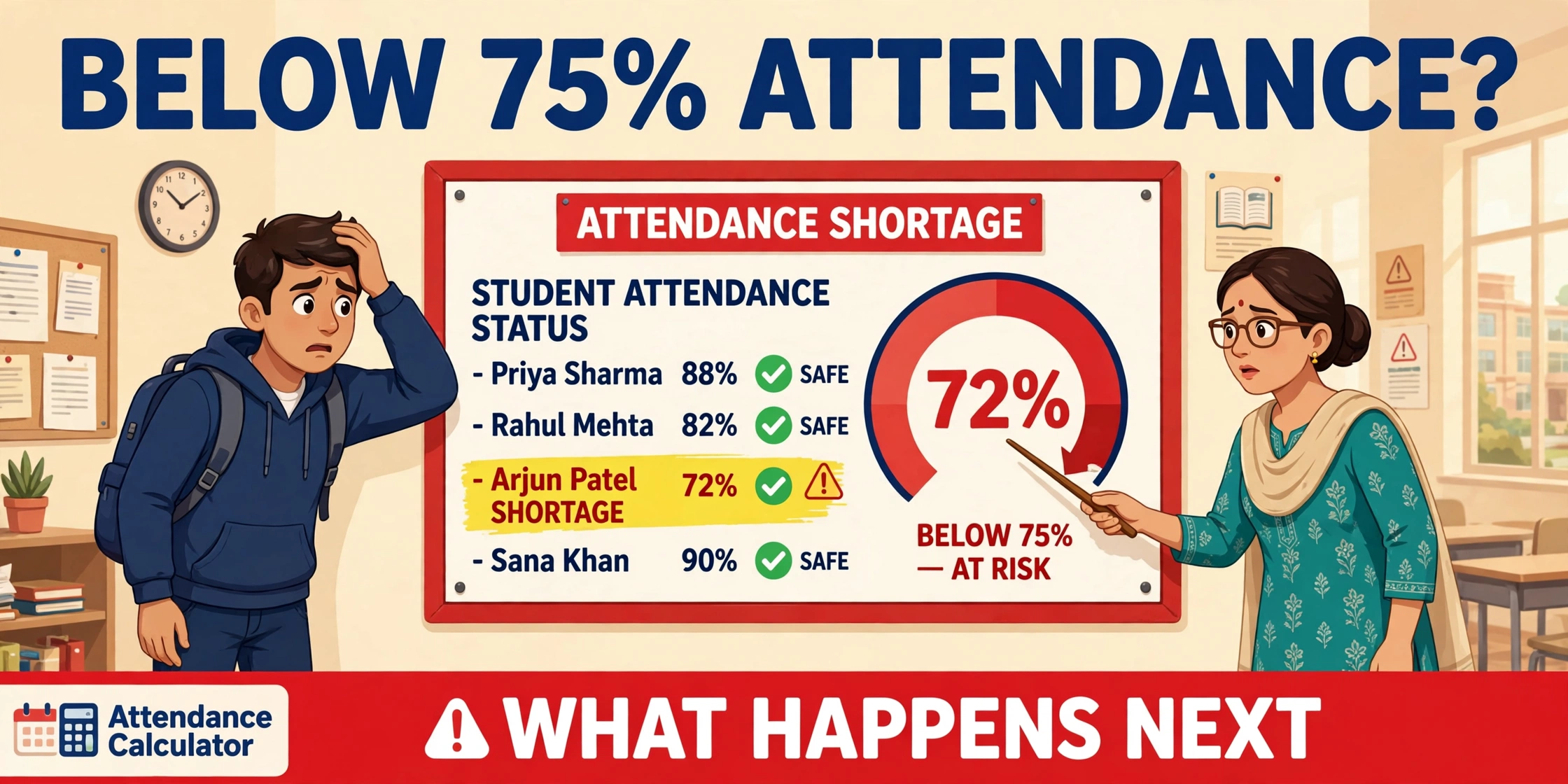
What Happens If Your Attendance Is Below 75%? Detained, Debarred, and Your Options
You check the portal at night. Seventy-one percent.
Your stomach drops. Not because of the number. You are scared it costs you the whole semester.
I know that fear. I tracked my own attendance by hand in a notes app during my BSCS, often late, often with a knot in my chest. A low number feels like a door closing.
So let me be straight with you. Below 75% is serious at most colleges in India and Pakistan. It can block your exam. It can cost you marks. In the worst case, it can make you repeat a course.
But it is not one fixed punishment. Colleges move in steps. The step you land on depends on how far below you sit, and how much of the term is left.
Find your zone first. Then act in order.
Will you be stopped from writing the exam?
At many colleges, yes, if you stay below 75% when the term ends. Rules built on the UGC pattern treat 75% as the line for exam entry, in total or in each subject. Some colleges bar you from sessional tests too, not only the final exam.
That per subject part catches good students out. Your total can sit at 78%. One lab can sit at 69%. At colleges that check each course on its own, that one lab can block that one exam.
The block has a formal side too. At many places, your name goes on a list of students who cannot sit. Staff send that list to the exam cell. A hall ticket may never reach you for that subject.
Rules vary by university. Some are strict on the total only. Some check theory and lab apart. A few set their line at 80% for some courses. Your college rule book is the only version that counts for you.

Does below 75% mean you have failed the course?
At some universities, yes in effect. Their rules say a student short of attendance in a course is debarred from its final exam and awarded an F grade in that course. Other colleges use the word detained instead, and make you repeat the course later.
Failed here does not mean you knew too little. You may know the subject well. The grade comes from the shortage, not from your answers.
Detained sounds softer. It is not soft. It means the college holds you back from that exam in that term. The course stays unfinished on your record until you clear it in a later term.
And a repeat is a real cost. One university rule I checked makes a detained student take the failed courses again in a later term, when the department offers them, after paying the set fee again. In real life, that often means sitting in that class with the batch below you.
Your enrolment may stay the same. Your pride takes the hit. So does your wallet, and your time.
Where your number sits, and what tends to follow
No table can speak for your college. Rules change from one university to the next, and some change by course. Read this as a map of common patterns, then check your own rule against it.
| Your attendance | What tends to happen at many colleges |
|---|---|
| 75% and above | You stay eligible for the exam. Internal marks for attendance may still be low if your college grades that part on a scale. |
| 65% to 74.9% | Shortage zone. Exam entry is at risk. Condonation may be open to you if you have a real cause and papers to back it. |
| 50% to 64.9% | Past the floor many colleges can forgive. Detention in that subject is likely. A repeat of the course becomes a real path, not a scare story. |
| Below 50% | Hard zone. At least one large university states in its rules that it cannot forgive attendance below 50%. A repeat is the usual road back. |
Two things stand out in that map. First, the fall is not slow and even. Each band changes what staff can do for you. A teacher may want to help at 71%. The same teacher has far less room at 58%.
Second, time matters as much as the number. At 71% with six weeks left, you hold a live case. At 71% in the last week, with no classes left to attend, the math has closed. Same number. Very different spot.
You can lose marks before any exam block
Exam entry gets all the fear. Marks loss is quieter. It starts earlier, and it hits students who never get detained at all.
Many colleges set a small block of internal assessment marks aside for attendance. A common size is five marks for a course.
Those marks often slide down as your percentage slides. One college table gives the full five marks at 90% or above. It gives two marks in the 75% to 79% band. Below 75%, a student who still gets condonation is left with one mark.
A large university in Kolkata uses a close pattern in its new rules. Full marks sit at high attendance. A student in the 60% to 74% band gets two marks. Below 60%, that part earns zero.
So a term spent at 68% can cost you marks in each subject, term after term. No one sends you a warning letter about those marks. You feel them later, in a grade that lands one step lower than your work earned.
The list goes up, and the clock is short
At some point, a shortage stops being a private worry. It becomes a list on a board.
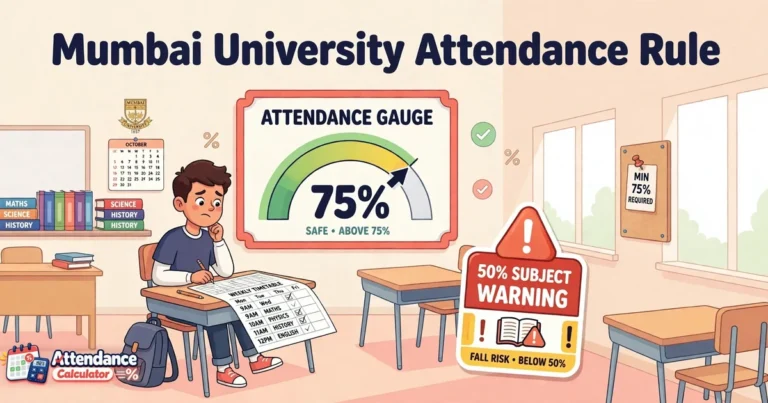
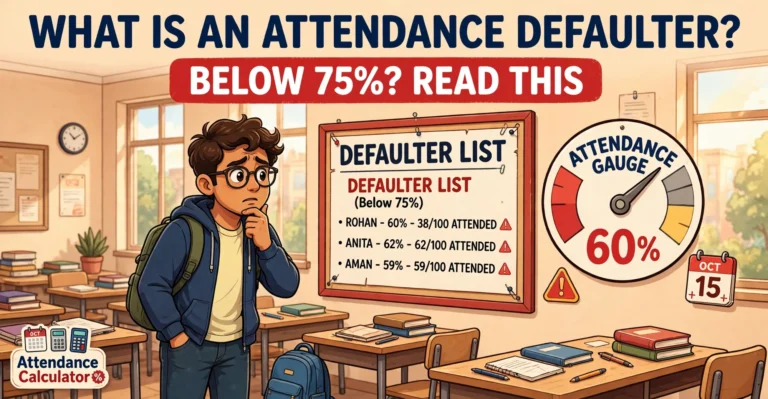
Here is how that step runs at colleges under one Mumbai university pattern. The college puts up a list of detained students on the notice board at the end of the semester. A student on that list can appeal to the head of the college within three days of the list going up. The student gets a personal hearing.
After the hearing, the college puts up the final list of debarred students. It sends that list to the university exam controller at least ten days before the semester exams start. A student can then appeal that call to the controller within ten days.
Read those gaps again. Three days. Ten days.
Miss the first gap and your hearing may never happen. That is why a student in this spot should check the board, the portal, and the exam cell notice daily near term end. News this big does not always arrive by message.
Your college may give you more time. It may give you less. The shape stays close at many places, though. A list. A short appeal window. A final list. Then the exam runs without you.
One route exists for a small shortage. It has a floor.
If your shortage is small and your cause is real, condonation may still open a door. I will not teach the steps here. I wrote the full guide on that route in my post on what attendance condonation is and how to apply.
One fact from that guide matters here, though. It sets your zone.
Under the UGC pattern a court dealt with, the rule is 75%, and the part a college can forgive is capped at 10%. That puts the floor near 65%. The court refused to help a student whose overall attendance sat at 57%. It said aid there would mock students who showed up.
That is the line in plain words. At 65% or above, a strong case can be heard at many colleges. Below it, staff at most places have no room left to grant you one.
Myth vs. Fact
Myth: If my total attendance is above 75%, I am safe in every subject.
Fact: Many rules ask for 75% in total and 75% in each theory and lab course on its own. A strong total can hide one weak subject. That one subject can still get you detained.
Myth: If I plead well, or pay a fee, any shortage can be sorted at the office.
Fact: A court refused relief to a student at 57% overall, even with the forgivable share added. The court pointed him to redoing the course on payment of the fee. Past the floor, pleading runs out.
What cannot be fixed in the last week
I will not dress this part up. Some of this cannot be undone, and you plan better once you know which parts those are.
Classes that have ended cannot be attended again. If too few classes are left, no streak of perfect days can pull you back over the line. The math is the math.
A shortage far below the floor cannot be talked away. Staff work inside a printed rule. A kind teacher cannot sign past a limit the university has fixed, and a court is slow, costly, and rarely kind in these cases.
Papers also go stale. A medical visit from two months ago, with no certificate taken at the time, is hard to prove now. Some doctors will not write a note for an old visit at all. If you were ill, that paper had a shelf life, and it may have passed.
And once a final debarred list is sent and the appeal window has shut, offices treat the case as closed. Late tears at the exam cell desk do not reopen it.
None of this means you do nothing. It means you spend your effort on the doors that are still open, not the ones that have shut.
What to do this week
Stay calm. Work in this order. Each step takes less than a day, and the early ones cost nothing.
Day one: get your exact numbers, per subject. Do not trust one total on a portal screen. Work out each subject on its own. The Attendance Shortage Calculator shows how far below your target each number sits. Write each one down.
Day one or two: read your own college rule. Find the line for exam entry, the floor for condonation, and the last dates. The rule book, the exam cell, or your class teacher can point you to it. A rule from a friend at a second college can mislead you badly.
Day two: talk to a human, early. Go to your class teacher or head of department with your numbers in hand. Ask what path your case fits. Staff deal far better with a student who comes early with facts than one who comes in exam week with panic.
Day three: start the route your zone allows. If you sit at 65% or above with a real cause, read the condonation guide linked above and start your file now. If you sit below the floor, ask the department, in writing if you can, what the repeat path looks like. Ask about fees, timing, and which term the course runs again.
All week: keep showing up. While any case is open, each class you attend is the one fact that still moves in your favour. Use the Semester Attendance Planner to see what the classes left can still do for your number.

Questions students ask when they fall below 75%
Can I write the exam at 70% attendance?
Sometimes, but not by right. At 70%, you sit in the shortage zone at most colleges. If your college allows condonation and your cause and papers are strong, staff may forgive the gap. If they refuse, you can be debarred from that exam.
Is detention per subject or for the whole semester?
It can be per subject, and that catches many students out. Some university rules ask for 75% in total and 75% in each theory and lab course. You may be cleared for most exams and detained in one subject where your number fell short.
Will I lose internal marks if my attendance is low?
At many colleges, yes. Attendance often carries a small set of marks inside internal assessment, commonly up to five marks for a course. The marks fall as your percentage falls, and at some colleges a very low percentage earns zero for that part.
Can I appeal if my name is on the detention list?
At many colleges, yes, but the window can be very short. One university pattern gives a detained student three days from the list going up to appeal to the principal, with a hearing. A further appeal to the university exam office may follow.
If I am detained, do I repeat the whole year?
Usually you repeat the course you were detained in, not always the whole year. Many rules make you take that course again in a later term when it is offered, and pay a fee again. Some terms and courses differ, so confirm with your department.
Decide by zone, not by hope
Here is a plain way to choose your next move. Match it to the number you wrote down on day one.
If classes are still left and your number can still climb over 75%, your job is attendance and proof. Show up for each class left. Keep papers for any day you are forced to miss.
If you sit between 65% and 75%, and the term is closing, your job is a clean condonation file, filed early. That route lives or dies on cause, papers, and dates.
If you sit below your college floor, your job is a planned repeat, not a last week fight. Talk to your department now. Fix the term, the fees, and the start date while you can still shape them.
Whichever zone is yours, run your real numbers first on the Attendance Shortage Calculator. A plan built on your exact number will beat a week of dread built on a guess, each time.



4 Comments