Condonation Fee for Attendance Shortage: How Much Will Your College Actually Charge?
There is no single condonation fee for attendance shortage in India. That is the honest answer, and it is also the annoying one.
I have never paid a condonation fee myself. My attendance never fell far enough to need one, because I tracked it class by class in a notes app on my phone through my whole degree. But the condonation fee for attendance shortage is the question that follows every short-attendance panic, right after “can I still write the exam?” So I went looking at real college fee notices and university rule books, and the answer is a range, not a number.
This post gives you the real figures I found, explains why your college’s figure will be different, and shows you how to keep the fee as low as it can be.
How much is the condonation fee for attendance shortage?
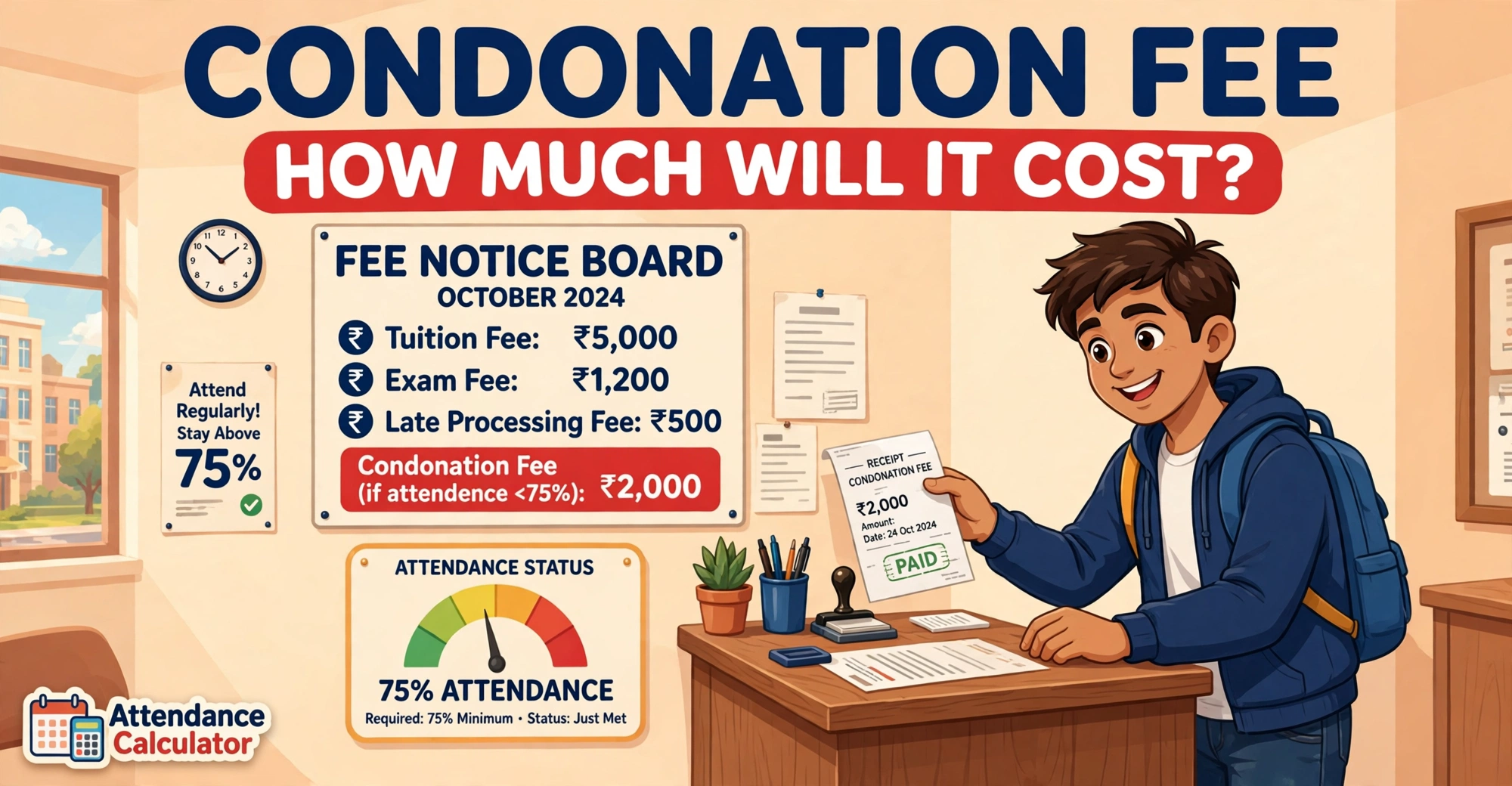
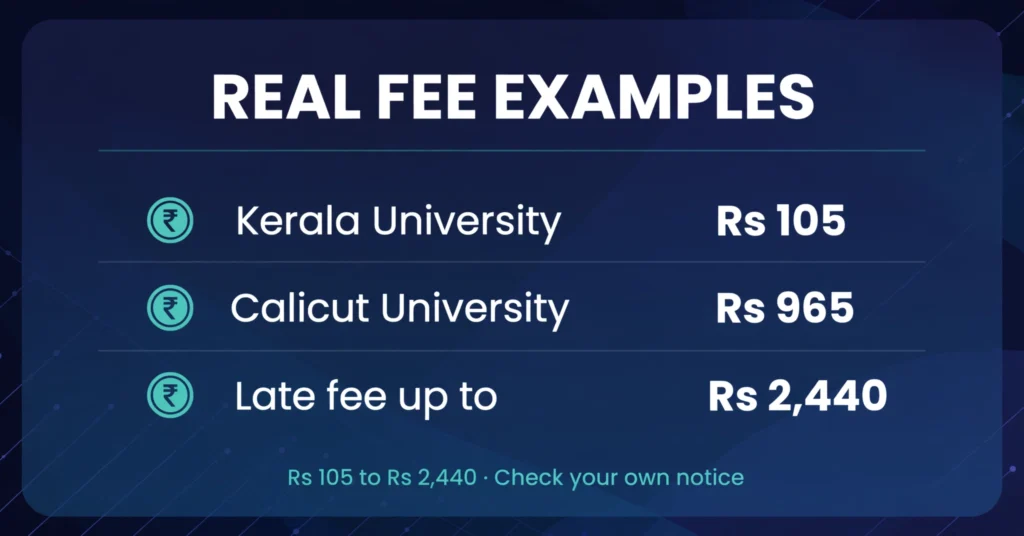
There is no single condonation fee for attendance shortage in India. Published college and university notices put it anywhere from about ₹105 to around ₹2,500, based on the university, the size of the shortage, and whether you applied late. Your own college’s fee notice is the only figure that counts for you.
Those figures come from published notices, not from a guess. Here are the real examples I found, so you can see the spread for yourself:
| University or college | What the notice says | Fee |
|---|---|---|
| Kerala University | Shortage up to 10 days | ₹105 |
| Kerala University (B.Tech / LLB) | Shortage up to 20 days | ₹210 |
| Kerala University | Late submission of the application | ₹1,050 |
| Calicut University colleges | Semester course, shortage up to 10% | ₹920 to ₹965 |
| Calicut University colleges | With medical certificate, up to 24 days or 20% for professional courses | ₹1,225 to ₹1,270 |
| Calicut University colleges | Late fee | ₹2,440 |
| University of Madras | Demand draft to the Registrar | ₹250 |
| JIS University / MAKAUT (guide) | Per subject, reported figure | About ₹500 to ₹1,000 |
Two warnings sit under that table. First, these figures come from notices and forms that colleges publish, and colleges revise them. A figure from a 2024 form may not match the 2026 notice on your college board. Second, the range is wide because the system is wide. A ₹105 fee and a ₹2,440 fee are both real, at different universities, for the same problem. Neither one is wrong. That is why you have to read your own college’s fee notice instead of trusting a number from the internet, including this post.
Why your college’s fee will be different
There is no central rule that fixes the condonation fee for the whole country. Each university sets its own figure, and each college applies it in its own way. That is the whole reason the table above looks so scattered.
Government universities tend to charge less. Kerala University charges ₹105 for a short shortage, and the University of Madras charges ₹250 by demand draft. Private universities tend to charge more, and they often charge per subject, which changes the total fast. Professional courses cost more too. The Calicut University forms charge a higher fee for professional courses than for arts and science courses, and the Kerala University rates split B.Tech and LLB students into their own slab.
The size of the shortage matters as well. A shortage of a few days sits in the lowest slab. A shortage of three weeks sits in a higher one. And the reason matters. Some colleges charge one figure for a shortage with a medical certificate and a different figure without one, because the certificate changes how the case is treated.
None of this is hidden. It is all printed in the condonation rules your college already has. The problem is that almost nobody reads those rules until the shortage letter arrives. If you are reading this post before that letter, you are already ahead.
Per subject or per semester? It changes the total
This is the detail that catches students out, and it is worth a minute of your time.
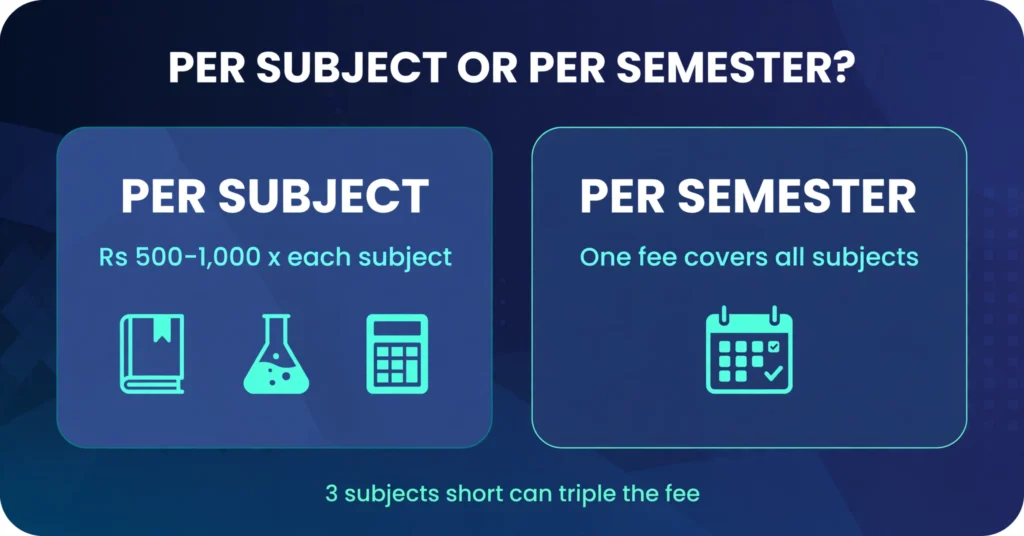
Some colleges charge the fee once per semester. You pay one figure, and it covers every subject you are short in that semester. The Calicut University forms work this way. The fee is for the semester course, so one payment covers the whole semester’s shortage.
Other colleges charge per subject. The JIS University guide puts the fee at about ₹500 to ₹1,000 per subject. That sounds small until you do the sums. Short in three subjects at ₹1,000 each, and you owe ₹3,000, not ₹1,000. Short in five subjects, and the bill is ₹5,000.
Ask your office which model your college uses before you pay anything. It is a one-line question, and the answer changes your budget by thousands of rupees. If you are short in several subjects, work out the total first with the attendance shortage calculator so you know exactly how many classes you still need, and then ask the office for the fee per subject or per semester in writing.
The late fee is where it stings
The base fee is rarely the painful part. The late fee is.
Look at the Kerala University figures again. The fee for a shortage of up to 10 days is ₹105. The fee for submitting the application late is ₹1,050. Ten times the fee, for being late. The Calicut University forms show the same pattern. The base fee is ₹965, and the late fee is ₹2,440. More than double, for the same shortage, filed late.
Colleges do this on purpose. Condonation has a deadline, and the deadline is usually well before the exams. Kerala University says applications should reach the university at least ten days before the exams start. Miss that window, and you pay the late fee on top of the base fee, if the college accepts a late application at all.
So the cheapest condonation fee is an early one. The week your attendance slips into the shortage zone is the week to start the application, not the week the exam form opens. By then the deadline has usually passed, and the late fee has already kicked in.
Who pays, and who has to apply
You pay. The fee comes out of your pocket, or your parents’ pocket, and it is paid to the college fund under the head of “Fee for Condonation of Shortage of Attendance”. That exact wording matters, because the receipt has to show the right purpose. Keep the receipt. It is your proof that you paid, and you will need it with the application.
But paying is only one part of the job. Condonation is not granted as a matter of course, and every university rule book says so in plain words. It is granted only when the student could not reach 75% or 80% attendance for reasons beyond their control, and only when the shortage sits inside the condonable limit.
That means three things have to line up. First, you need a genuine reason. Illness, a family emergency, representing your college at an approved event. Second, you need proof. For illness of five or more days in a row, the rules ask for a proper medical certificate. For other reasons, you need whatever paper shows it happened. Third, your Principal has to recommend the application. A form without the Principal’s recommendation is not considered at all.
If you need the format for the medical side of this, my guide on the medical leave application format walks through what a proper application looks like, and my guide on what attendance condonation is and who can apply for it covers the eligibility side in full.
When no fee can save you
A fee only helps when your shortage sits inside the condonable limit. Outside it, no amount of money fixes the problem.
Kerala University’s rules say it plainly. If the shortage goes beyond the condonable limit, the student must repeat the course to make up the shortage, and then register for the exam with the junior batch. The Principal is told not to forward applications that sit beyond the limit at all.
Mumbai University’s ordinance, which Wilson College prints on its attendance undertaking, draws the line at 50%. No condoning is possible if a course’s attendance falls below 50% of its lectures, whatever the reason. That is a hard floor, and no fee moves it.
And some colleges offer no condonation at all. St. Claret College in Bengaluru states on its attendance page that there is no provision for condonation, and that students short of the UGC’s 75% in a paper cannot write the end-semester exam for it. If your college is one of those, the fee question never comes up, because there is no application to file.
Check this before you pay. A receipt for a fee your college cannot accept is money gone for nothing.
How to pay, step by step
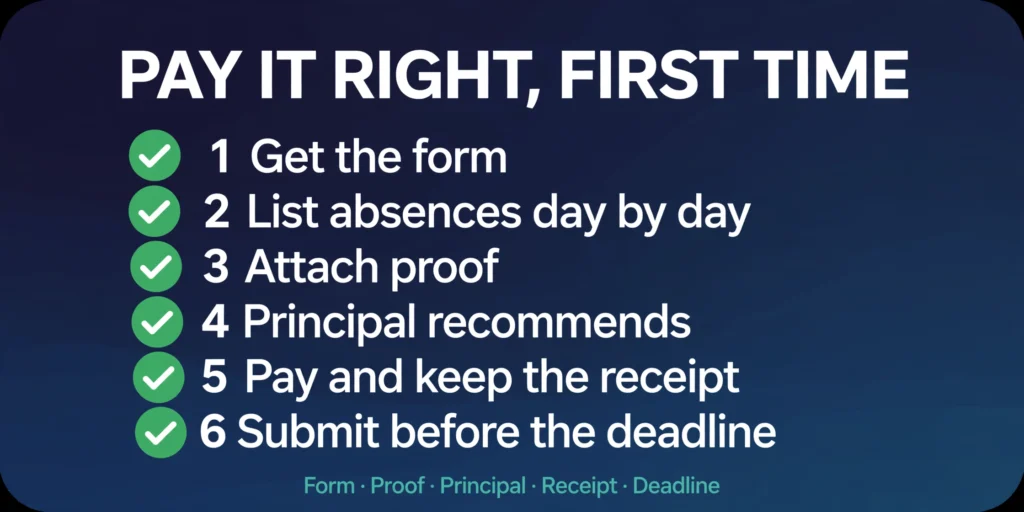
Step 1: get the form. Pick it up from the department office or download it from the student portal. It is usually called the condonation form or the shortage of attendance form.
Step 2: write out your absence, day by day. The rules ask for a statement showing each day you were absent, with the reason for each day. Do not write “sick for two weeks”. Write the dates, one by one, with the reason next to each one.
Step 3: attach your proof. A medical certificate for illness of five or more days in a row. Event certificates, hospital papers, whatever fits your reason. No proof, no case.
Step 4: get the Principal’s recommendation. Take the filled form to the Principal through your mentor or head of department. This step takes time, so do not leave it for the last day.
Step 5: pay at the college account. Pay the fee under the head “Fee for Condonation of Shortage of Attendance”, and the late fee under its own head if one applies. Keep the receipt and attach a copy to the form.
Step 6: submit before the deadline, and keep a copy of everything. Ten days before the exams is the usual outer limit. Keep a photocopy of the form, the proof, and the receipt. If the office loses your file, your copy is the only one that exists.
Myth vs Fact
Myth: “Paying the condonation fee guarantees you can write the exam.”
Fact: The fee buys you a hearing, not a pass. Your application still needs a genuine reason, proof, and the Principal’s recommendation, and the university can still say no. Paying the fee without those three things is just an expensive receipt.
FAQ
How much is the condonation fee for attendance shortage in Kerala?
Kerala University’s published rules put the fee at ₹105 for a shortage of up to 10 days, ₹210 for B.Tech and LLB students with a shortage of up to 20 days, and ₹1,050 for a late application. Check the current notice at your own college, because universities revise these figures.
Is the condonation fee charged per subject or per semester?
It depends on your university. Some colleges charge once per semester, covering every short subject in that semester. Others charge per subject, so three short subjects can triple the bill. Ask your college office which model it uses before you pay.
What is the late fee for condonation?
Late fees are steep. Kerala University charges ₹1,050 for a late application against a ₹105 base fee. The Calicut University forms put the late fee at ₹2,440 against a ₹965 base fee. Apply at least ten days before the exams to avoid it.
Do I get the fee back if my condonation is rejected?
Most college notices do not say the fee is refundable, and in practice it is treated as a processing charge for the application, not a deposit. Ask your college office before you pay, and get the answer in writing if it matters to you.
Can I apply for condonation without a medical certificate?
Yes, if your reason is not illness. Bereavement, a family emergency, or representing your college at an approved event can all support an application, with the right proof attached. A medical certificate is needed when the reason is illness of five or more days in a row.
Your next step
Go and read your own college’s fee notice today, before you need it. It is usually pinned on the department notice board or printed in the student handbook, and it will tell you the exact figure, whether it is charged per subject or per semester, and the last date to apply. If your attendance is already short, start the application this week, while the base fee still applies. And if you are not sure how short you actually are, run your numbers through the attendance shortage calculator first, so you walk into the office with the real figure in your hand.