
UGC 75% Attendance Rule: What the 2003 Regulation Actually Says (and What It Doesn’t)
My college notice board had one line in red: 75% attendance or no exam hall ticket. I read it three times and still felt lost. Was this a real law, or just my college being strict?
That question is why I started digging into the UGC 75 percent attendance rule. I’m Zain, a BSCS student. I used to track my own attendance by hand in a notes app. I know what it feels like to do the maths in your head instead of listening to the lecture.
So I read the actual regulation, not a blog summary. What I found surprised me. The rule is real, but it is not quite what most students think it is. Your college has more say in the details than the notice board lets on, and the courts have had plenty to say about it too.
Here is the regulation in plain words: what it says, who it covers, where the 65% floor comes from, and what the courts have said about it.
What the regulation actually says
The rule comes from the UGC (Minimum Standards of Instruction for the Grant of First Degree through Formal Education) Regulations, 2003. Two parts of it matter for you.
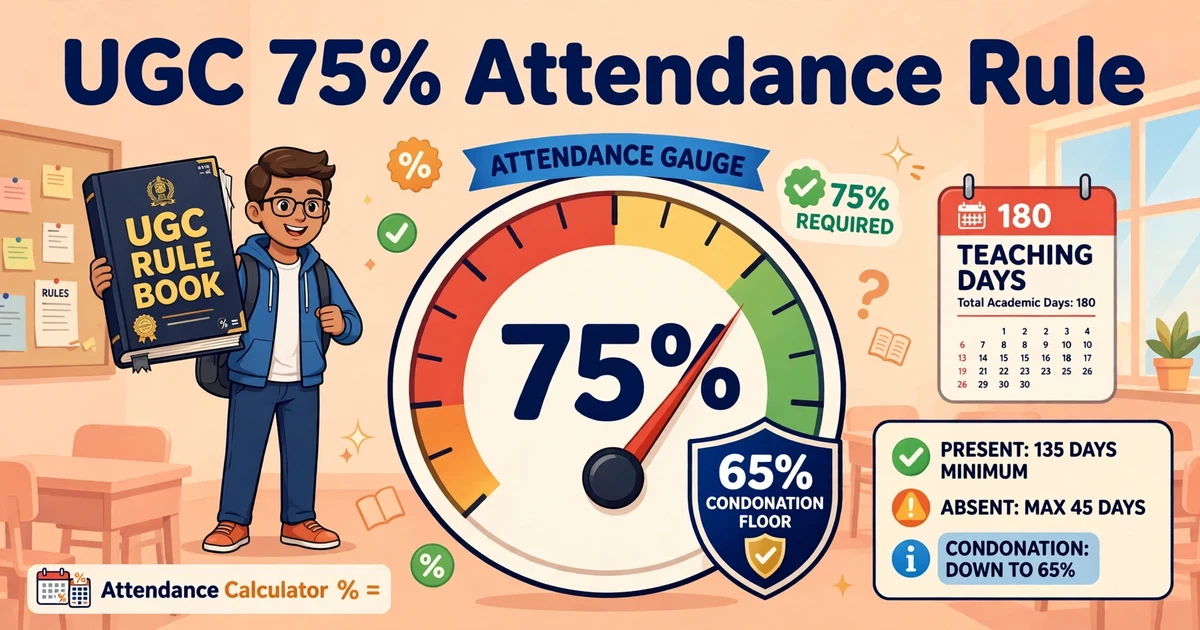
Regulation 4.1 says a university must provide at least 180 actual teaching days in an academic year, not counting holidays and vacations. Regulation 5.8 says the university must set a minimum attendance bar for exam eligibility, and that bar should ordinarily not be less than 75 percent of all lectures, tutorials, seminars and practicals.
That word “ordinarily” does a lot of work. It means 75 percent is the normal floor, not a fixed number for every course. Your university still sets the bar, and it can add extra conditions.
Put the numbers together and the rule gets very concrete:
| Teaching days in the year | 75 percent means present on | Most you can miss |
|---|---|---|
| 180 | 135 days | 45 days |
| 90 (one semester) | 68 days | 22 days |
A 90-day semester needs 67.5 days at 75 percent. You cannot attend half a class, so it rounds up to 68. Students who count 67 days and think they are safe are wrong.
Is 75% attendance compulsory in every college in India?
Yes, in most cases. The UGC regulation tells every university to set a minimum attendance bar, and that bar is 75 percent of all lectures, tutorials, seminars and practicals. Your own university then writes the detailed rule, so the exact number and the condonation process can differ from one college to another.
Here is the part students usually miss. The UGC does not run your college. It sets the floor and tells universities to write their own rules on top of it. So the 75 percent bar is real and it comes from the UGC, but the fine print lives in your handbook.
That is why two friends at two colleges can face different rules. One counts attendance subject by subject, another in total only. One condones 10 percent, another less. The UGC regulation is the roof. Your university builds the rooms under it.
The 65% condonation floor: where does it come from?
Condonation means your university forgives part of your attendance shortage. In many universities the most it can forgive is 10 percent, which is why 65 percent is the floor. Drop below 65 percent and even condonation cannot bring you back up to 75 percent.
The 65 percent floor is simple maths. The bar is 75 percent. The most a university can condone is 10 percent. 75 minus 10 is 65. So a student at 65 percent can be lifted to 75 percent on paper. A student at 64 percent cannot.
Courts have backed this reading again and again. In January 2025 the Madras High Court heard the case of K. Shrish, a second-year B.Com student at SRM Institute of Science and Technology. His attendance was 45.71 percent in one semester and 48.73 percent in the other, 57 percent overall. Even after adding the 10 percent that could be condoned, he would only reach 67 percent. The court refused to help him write his exams.
The judges were blunt. The UGC regulation needs 75 percent, and the condonable limit is only 10 percent. Feeling sorry for one student, they said, would be unfair to the students who showed up every day. The court gave him one door: redo the course and pay the fee, and the university had to take him back.
A classmate of mine caught dengue in second year, missed a month, and came back to 61 percent attendance. He had a hospital file thick enough to stop a door. It did not matter. The condonation committee could only stretch to 65 percent, and he was below it. He repeated the semester. Nobody had told him the 65 percent line existed until he had already crossed it.
If you want the full process for asking, read what attendance condonation means and how to apply for it.
Who does the rule cover, and who does it not cover?
The UGC regulation covers students in universities and their affiliated colleges. That is most degree students in India. But it is not the only rule in town. Professional courses have their own regulators, and those regulators set their own bars.
Law is the clearest example. The Bar Council of India sets the bar for LLB students at 70 percent under Rule 12 of its Rules of Legal Education, relaxable only down to 65 percent when a student shows good cause. The Madras High Court said exactly that when it refused relief to a group of law students earlier this year.
Medical students have their own bar too, set by the National Medical Commission. The numbers differ there as well.
Some universities add their own twists. Gujarat University, for example, asks for 75 percent overall and 70 percent in each subject, and it ties attendance marks to internal assessment. Only your handbook tells you what your university does.
Private universities and deemed universities are not outside this. They are still under the UGC, and the 75 percent floor still applies to them.
What the courts have actually said
Students go to court over attendance every year. The results tell you a lot about how seriously the rule is taken.
In late 2024 the Bombay High Court heard a public interest case about the University of Mumbai’s attendance rules. The UGC filed an affidavit quoting its regulation word for word: 180 teaching days, attendance ordinarily not less than 75 percent. The court then asked the university to file its own affidavit by 14 November 2024, saying what minimum attendance it had prescribed. That is the pattern: the court starts with the UGC regulation, then asks the university what it did with it.
The Madras High Court case is the one students should study. The student had 57 percent. The court did the maths in the judgment itself: 57 plus 10 is 67, and 67 is not 75. Case closed. The judges also made a point that matters for anyone thinking of filing a case. Courts leave academic decisions to academicians. They step in if a college breaks its own rules, but they will not rewrite the 75 percent bar because a student had a hard semester.
The rule cuts both ways. In one Kerala case, students got relief because the college had not held the minimum number of classes it was supposed to. Your college has to hold the classes before it can demand your attendance.
NEP 2020 and the flexibility debate
You have probably heard someone say the 75 percent rule is finished because of NEP 2020. It is not. Not yet, anyway.
NEP 2020 brought in four-year degrees, multiple entry and exit points, and the Academic Bank of Credits. UGC’s draft regulations would let colleges set their own minimum attendance based on the programme. Students who work part-time or do internships say the current rule treats everyone the same, and plenty of people think that is outdated.
But draft is the key word. A draft is not a rule. Until a new regulation is notified, the 2003 regulation is the one that decides your hall ticket. I would love more flexibility for students who learn outside the classroom. I just would not bet my semester on it arriving in time.
Myth vs. Fact
Myth: UGC says every student must have exactly 75 percent in every subject.
Fact: The regulation says 75 percent of all academic activities in total. Per-subject rules come from your university, not from the UGC.
Myth: A medical certificate forces the college to let you sit the exam.
Fact: A certificate supports a condonation request. It does not force the university to grant it. Below 65 percent, even condonation usually cannot save you.
Myth: The 75 percent rule was scrapped under NEP 2020.
Fact: NEP 2020 talks about flexibility, and draft UGC reforms discuss it. But the 2003 regulation is still the rule in force, and colleges still enforce it.
What to do if your attendance is short right now
First, find your real number. Do not guess. Use the 75% Attendance Calculator and see where you stand against the 75 percent bar and the 65 percent floor.
Second, work out how many classes you still need. I explain the basic 75 percent rule in detail in my post on the 75% attendance rule in engineering colleges, and the maths works for any degree.
Third, talk to your mentor or head of department early, before the detention list comes out, not after. Bring your documents: medical certificates, event letters, anything that proves where you were. A condonation request filed early, with proof attached, has a far better chance than one filed the day before the exam.
And do not make a court case your plan A. Courts back the regulation far more often than they bend it.
Frequently asked questions
Is the UGC 75 percent attendance rule compulsory for all students?
Yes, for students in universities and affiliated colleges. The 2003 regulation tells every university to set a minimum bar, normally 75 percent. Professional courses like law and medicine follow their own regulators, so their numbers can differ. Check your university handbook for your exact rule.
What is the minimum attendance needed to sit for university exams?
Normally 75 percent of all lectures, tutorials, seminars and practicals. With condonation, a student at 65 percent can still be allowed to sit, since most universities can condone up to 10 percent. Below 65 percent, condonation cannot bridge the gap.
Can attendance below 75 percent be condoned?
Yes, if your university’s rules allow it and you have a genuine reason with proof. Most universities condone up to 10 percent, which means 65 percent is the lowest attendance that can still be saved. Medical reasons, sports and serious family emergencies are the usual grounds.
Does the UGC rule apply to private universities?
Yes. Private universities and deemed universities are still under the UGC, so the 75 percent floor applies to them too. Their handbooks may describe the rule in different words, but the bar is the same. Always confirm the details in your own university’s handbook.
Can I go to court if my college bars me from exams over attendance?
You can, but courts rarely overrule the 75 percent bar. They step in when a college breaks its own rules, like not holding enough classes. If your attendance is between 65 and 75 percent, apply for condonation first. That route works far more often than a court case.
Three numbers decide your semester
180. 135. 117. Teaching days in the year. Days you need to be present. Days you need even after condonation. Those three numbers are the UGC 75 percent attendance rule in a nutshell, once you strip away the legal language.
So check your number tonight. Open the calculator, type in your attended and total classes, and see which side of the line you are on. Above 75 percent, keep it that way. Between 65 and 75 percent, start your condonation paperwork now. Below 65 percent, talk to your department tomorrow morning, because that is the one situation where waiting makes everything worse.