
CBSE Says 75% or No Board Exam: The 2026 Rule, the 1 January Cut-Off, and the 25% Relaxation
You have spent two years preparing for your board exams. Now imagine being told at the gate that you cannot sit for them, not because of your marks, but because of your attendance. That is not a scare story. It is exactly what the CBSE rule allows.
This is the CBSE 75 percent attendance rule board exam guide I wish someone had handed me in Class 11. I’m Zain. I went through my own board exams, and back then nobody explained the attendance rule to me in plain words. I only worked it out later, when I was a BSCS student tracking my own college attendance by hand in a notes app. School students deserve the same plain version, before it is too late to fix anything.
So here it is: the rule as CBSE wrote it, the 1 January cut-off, the 25 percent relaxation, the dummy-school trap, and a worked example with real numbers. Read this before December.
What the rule actually says
Students keep searching for the CBSE 75 percent attendance rule board exam details, and they live in Rules 13 and 14 of the board’s Examination Bye-Laws. The board spelled it out again in a circular dated 4 August 2025, repeating an earlier circular from 9 October 2024. The message in both is the same.
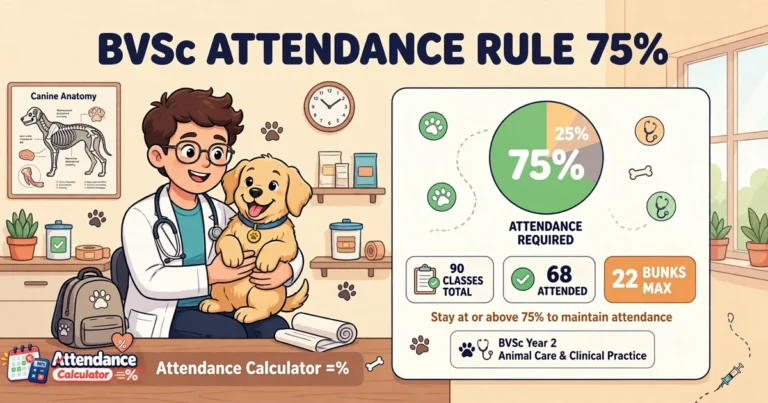
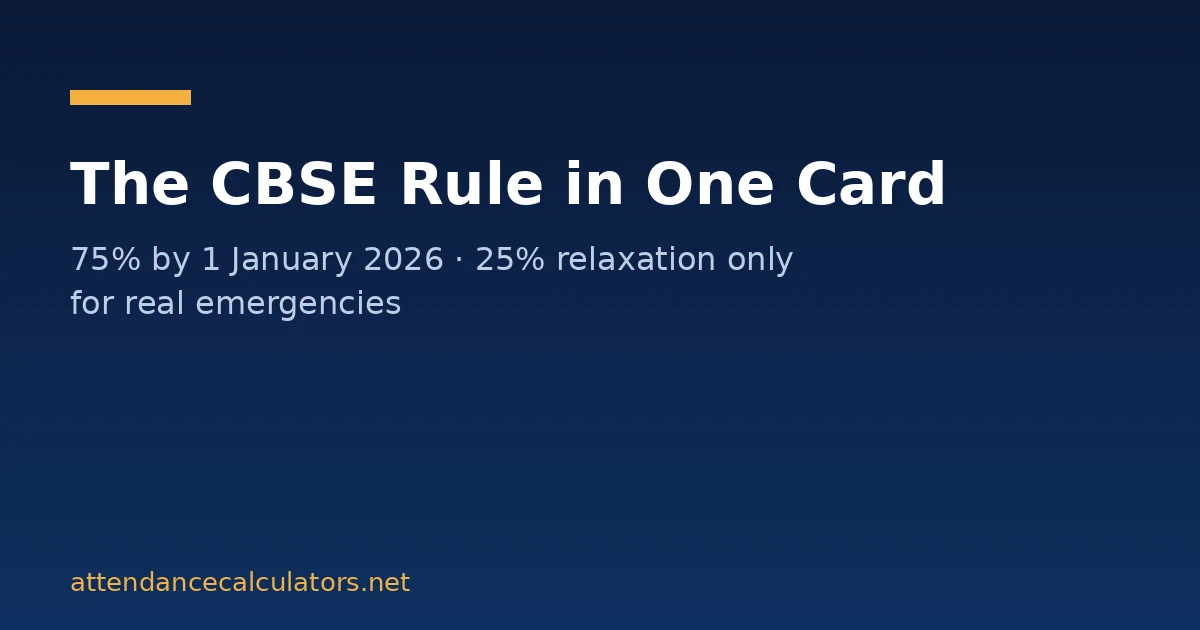
Students in Class 10 and Class 12 must have at least 75 percent attendance in regular classes, counted from the start of the academic session up to 1 January of the exam year. For the 2026 board exams, that date is 1 January 2026. Only students who meet that mark are eligible to appear for the board exams.
Two details matter. The count stops on 1 January, so attendance after that date does not count. And it starts from the first day of the session, not from the day you decide to start taking attendance seriously.
CBSE also told schools what they must do: tell students and parents about the rule in writing, keep daily attendance records updated and signed for inspection, and inform parents in writing if a student’s attendance falls short. If your school has not told you any of this, that is a problem with the school, not with the rule.
What does the 25% relaxation actually cover?
CBSE can relax the 75 percent rule by up to 25 percent, but only in exceptional cases: prolonged illness, participation in national or international sports events, the death of a parent, or another serious reason. You need proper documents, and your school must forward the case. Casual absences are never condoned.
Read that again, slowly. The 25 percent relaxation is not a discount every student gets. It is an exception for students who had a genuine emergency and can prove it. A month off for a family wedding does not count. A month in hospital with records does.
Your school plays a big part here. You do not apply to CBSE yourself. Your school puts your case together, adds its own recommendation, and sends it to the CBSE Regional Office. Without that recommendation, CBSE rarely approves anything. That is why your relationship with your class teacher and principal matters more than most students think.
And there is a hard deadline. CBSE says no case will be accepted after 7 January 2026, and it gives its decisions by 7 February 2026. Get your papers to your school well before that, because a case sent late is a case rejected.
How many school days can you actually miss?
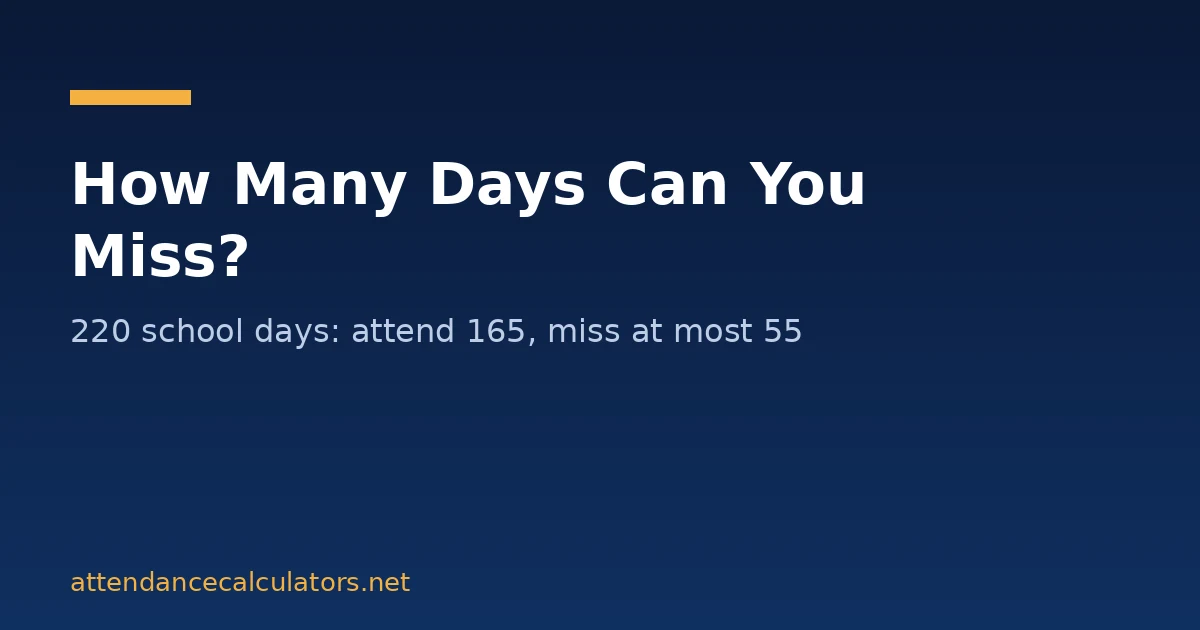
This is the question every student really wants answered, so let us do the maths with real numbers. The answer depends on how many working days your school has, so ask your school for its exact count:
| Working days in your school year | Days you must attend (75 percent) | Most days you can miss |
|---|---|---|
| 220 | 165 | 55 |
| 210 | 158 | 52 |
| 200 | 150 | 50 |
A 210-day year needs 157.5 days at 75 percent. You cannot attend half a day, so it rounds up to 158. Students who count 157 and think they are safe are wrong.
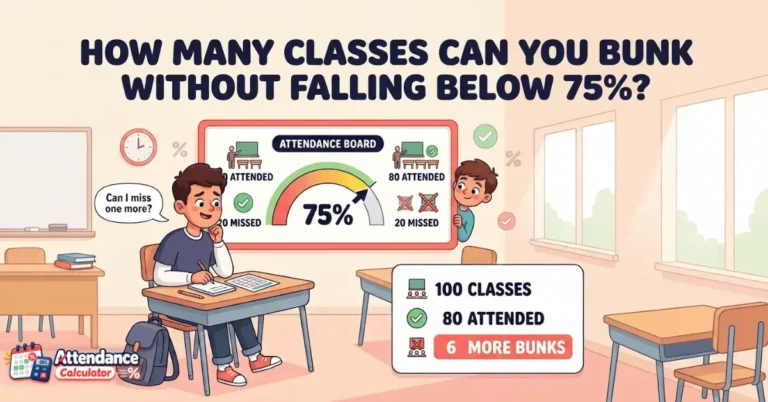
Look at it the other way. If your school has 220 working days and you have already missed 40, you have 15 days left in the whole year. That includes sick days, family functions, everything. Once you see the number written down, it becomes a budget, and you can plan around it.
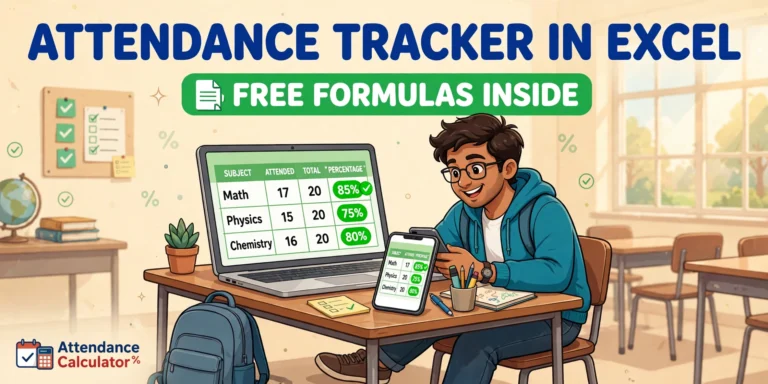
If you want to check your own number, use the Attendance Calculator on our homepage. Type in the days you attended and the total days so far. I also explain how to work out your attendance percentage step by step if you want to do it by hand.
The dummy-school trap
This is the part of the rule that scares parents the most, and it should. A “dummy school” is a school where a student is enrolled on paper but barely attends, usually because the student is busy with coaching classes instead.
CBSE has made its position clear. Its inspectors can visit a school without warning. If they find students absent without proper leave records, CBSE treats those students as non-attending candidates. That means the school’s word is not enough. The leave records have to exist, day by day, signed and on file.
The risk runs both ways. A student found to be a dummy candidate may not be allowed to appear for the board exams. A school that keeps dummy students can face penalties, including disaffiliation. CBSE has already acted against schools over this, and the 2025 circular warns schools again in plain terms.
So if you are enrolled in one school and attending coaching somewhere else all day, talk to your parents and your school now. Do not wait for an inspection to find the gap. Coaching may help your entrance exam score, but it will not help you if CBSE bars you from the board exam. You need both.
How condonation works, step by step
If your attendance falls short for a genuine reason, there is a process. It is slow, and it needs paperwork, but it exists. Here is how it runs.
First, tell your school as soon as the problem starts, not in December. A written leave application goes in at the time of the absence, with medical certificates or other proof attached. Leave without a written request counts as unauthorised absence, and that is very hard to condone later.
Second, your school checks the case. The principal and your teachers look at your records, your documents, and whether your reason fits one of the exceptional categories. The school’s recommendation carries real weight. A school that backs you honestly helps your case. A school that will not recommend you ends it.
Third, the school sends the case to the CBSE Regional Office with all the documents in CBSE’s proforma. The case must reach the Regional Office by 7 January 2026, and CBSE gives its decision by 7 February 2026. If a document is missing, CBSE points out the gap and the school has a short window to fix it. A case with weak or missing documents usually gets rejected outright.
One thing to know: the decision is CBSE’s alone. Your school cannot promise you condonation. It can only recommend. So if anyone tells you “don’t worry, we will manage it,” ask them to show you the rule that lets them manage it. There is not one.
Mistakes that get cases rejected
Most condonation cases fail for reasons that were easy to avoid. These are the ones I see again and again.
The biggest mistake is not filing leave in writing. Students tell the teacher verbally, or send a message, and assume that counts. It does not. CBSE wants a written application with documents, filed at the time. A verbal message leaves no record, and no record means no case.
The second mistake is waiting until December. Start the paperwork the week the problem happens.
The third mistake is thinking a medical certificate alone is enough. It is not. CBSE wants the certificate plus the leave application plus the school’s recommendation, all together. One piece without the others is a weak file.
And the last mistake is the saddest one: assuming the rule does not apply to you. Every year, students find out in January that it does. By then, the only fix left is a condonation case, and those are never a sure thing.
Myth vs. Fact
Myth: CBSE will let you sit the exam if you are at 70 percent and your marks are good.
Fact: Marks do not change the attendance rule. Below 75 percent, only condonation can save you, and only for a genuine emergency with documents.
Myth: Your school can fix a low attendance figure on its own.
Fact: Your school can only recommend. The decision sits with the CBSE Regional Office, and the hard cut-off is 7 January 2026.
Myth: Attendance after 1 January counts toward the 75 percent.
Fact: The count stops on 1 January of the exam year. Days after that date do not change your percentage.
What to do this week
Do not wait for a notice from school. Do these four things now, while there is still time to fix a shortfall.
First, find your real number. Ask your class teacher for your attendance percentage, then check it yourself with the calculator. If the two numbers do not match, ask why. Errors are easier to fix in October than in January.
Second, count your remaining days with the table above. If you have 15 days left and three months to go, you cannot afford casual leave. Plan your sick days like a budget, because that is what they are.
Third, file every absence in writing from today onward. A short leave application, a medical certificate if you were ill, and a copy kept at home. That paper trail is what saves you if you ever need condonation.
Fourth, if your attendance is already below 75 percent for a genuine reason, talk to your principal this week. Ask what documents the school needs and when it will send your case. If you want the full picture, read what attendance condonation means and how to apply for it.
Frequently asked questions
Is 75% attendance compulsory for CBSE board exams?
Yes. CBSE’s Examination Bye-Laws, Rules 13 and 14, make 75 percent attendance compulsory for Class 10 and Class 12 board exams. The count runs from the start of the session to 1 January of the exam year. Students below 75 percent can sit only if CBSE condones the shortage.
Can I appear for CBSE board exams with 70% attendance?
Not automatically. You need 75 percent, or CBSE must condone the shortage. Condonation of up to 25 percent is possible only for genuine emergencies like prolonged illness or national-level sports, with documents and your school’s recommendation. Casual absences are never condoned.
What is the last date to apply for CBSE attendance condonation?
Your school must send your case to the CBSE Regional Office by 7 January 2026. CBSE gives its decisions by 7 February 2026. Get your documents to your school well before the deadline, because late cases are not accepted and missing documents usually mean rejection.
What is a dummy school, and why does CBSE act against it?
A dummy school is one where a student is enrolled on paper but rarely attends, usually because the student is at coaching classes instead. CBSE runs surprise inspections, and students absent without leave records are treated as non-attending candidates. Schools keeping dummy students can face penalties, including disaffiliation.
Does attendance after 1 January count for the board exam?
No. CBSE counts attendance from the start of the academic session up to 1 January of the exam year. Days attended after that date do not change your percentage for the board exam, even though going to school still helps your studies.
The number that decides your board exam
Here is the whole rule in one line: 75 percent by 1 January 2026, or a condonation case your school sends before 7 January. That is the CBSE 75 percent attendance rule board exam students and parents need to know. Everything else is detail.
So check your number tonight. Not after Diwali, not in December. Tonight. Ask your teacher, run the calculator, and count how many days you can still afford to miss. If the number is comfortable, keep it that way. If it is tight, stop spending sick days like they are free. If you are already below the line for a real reason, get your paperwork to school this week, because January is closer than it feels.