Attendance Rule in IIT and NIT: 5 Powerful Facts
The attendance rule in IIT and NIT is not one rule. That is the first thing I wish someone had told me before I started comparing them. I spent my degree under a plain 75% rule, tracked by hand in a notes app, and I assumed the IITs and NITs all worked the same way. They do not. One IIT asks for 85%. One IIT dropped the rule completely in 2025. One NIT makes you sit extra classes after your exams if you land between 50% and 75%. Same country, same JEE crowd, very different numbers. This post lines them up side by side, so you can see your own institute’s rule, what happens when you fall short, and what to do about it.
What is the attendance rule in IIT and NIT?
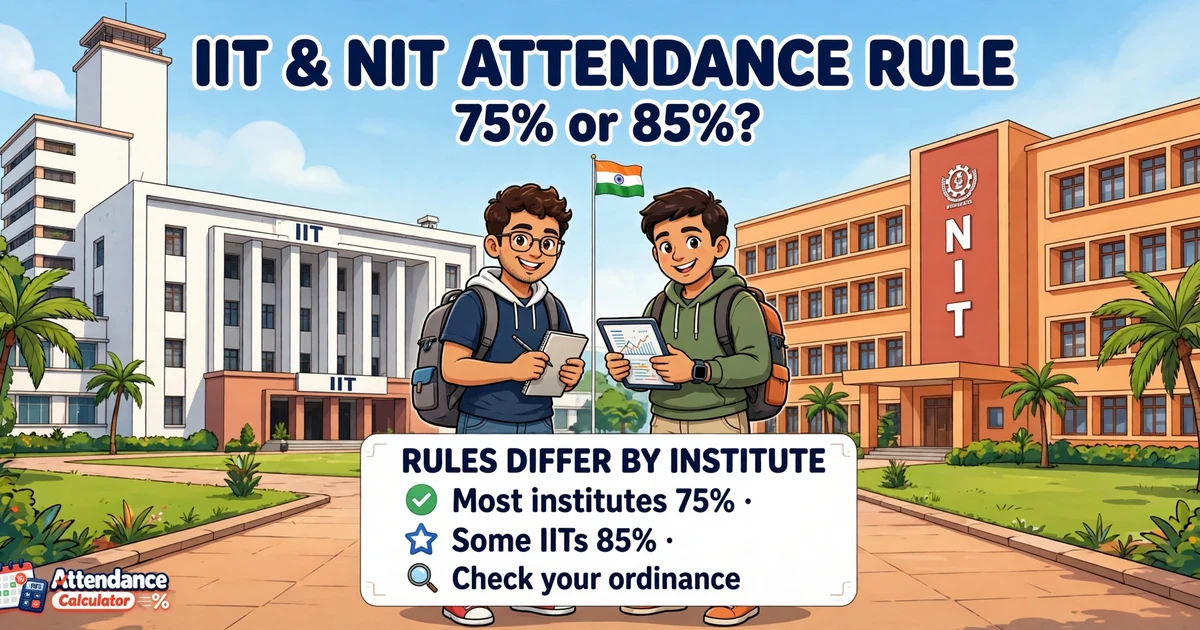
The attendance rule in IIT and NIT is set by each institute, not by one central rule. Most IITs and NITs ask for 75% in every course. IIT Madras and IIT Palakkad ask for 85%. IIT Dhanbad dropped compulsory attendance from 2025-26. NIT Trichy asks for 75% and runs make-up classes for students at 50 to 75%.
That is the whole answer in one paragraph. The rest of this post is the detail behind it, because the detail is where students get caught. A student who moves from a 75% IIT to an 85% IIT for an exchange semester can lose a course without ever knowing the bar moved. A student at NIT Trichy who thinks 60% means a failed year is wrong. There is a second chance built into that rule, and most first-years never hear about it. So do not just take the headline number. Find your own institute in the table below.
IIT vs NIT: the numbers side by side
Every IIT and NIT writes its own ordinance. There is no single national rule for them, the way the UGC pattern works for general colleges. I checked the ordinances and institute FAQs that are public, and this is what they say. If your institute is not listed here, the rule still sits in your own ordinance, and the last section of this post tells you where to look.
| Institute | Minimum attendance | What happens if you fall short |
|---|---|---|
| IIT Delhi, Guwahati, Kharagpur, Roorkee | 75% in each course | Debarred from the end-semester exam in that course |
| IIT Madras, IIT Palakkad | 85% in each course | Not allowed to sit the end exam, registration cancelled, W grade |
| IIT Gandhinagar | Set by the course instructor | Too many early misses can bar you from quizzes and mid-semester exams |
| IIT Dhanbad (ISM) | No compulsory attendance from 2025-26 | No penalty for attendance in any form |
| NIT Trichy | 75% in every subject | Below 75% you cannot sit the end-sem exam; 50-75% means mandatory make-up classes |
| Most other NITs | 75% in each course, per their own ordinance | Debarment or repeat of the course, check your NIT’s rule |
Two things in that table surprise most readers. The first is the 85% row. The second is the last IIT row. Both are real, and both change how you should plan a semester.
One honest note on the numbers. Institutes revise their ordinances. IIT Dhanbad changed its rule in September 2025, after a senate meeting on 1 September 2025. Another institute could do the same next year. So use this table to find your ballpark, then check your own institute’s current ordinance before you make a decision that costs you a course.

A quick worked example, so the difference is concrete. Take one course with 100 classes. At a 75% IIT you must attend 75 of them and can miss 25. At Madras or Palakkad you must attend 85 and can miss only 15. That gap of 10 classes is the whole story: a student sitting
at 80% feels safe, because 80% clears the bar almost everywhere else, but at an 85% IIT that same 80% loses the course.
The 85% IITs: Madras and Palakkad
IIT Madras asks for 85% attendance in each course. That is the strictest bar among the IITs I could verify. The rule sits in its ordinances as R.10.2. A student below 85% in a course, for any reason, is not allowed to appear for the end-quarter or end-semester exam in that course. The registration for that course is treated as cancelled, and the student gets a W grade on the grade card. W stands for registration cancelled for want of minimum attendance. If the course is a core course, the student has to register for it again and repeat it when it is offered next.
That last part is the bit students miss. A W grade is not a fail you can clear with a supplementary exam next month. It is a cancelled registration. You take the whole course again. And the attendance is counted per course, not across the semester. You can sit at 90% overall and still lose one course where you managed 80%. The 85% bar bites course by course.
IIT Palakkad asks for 85% too. The two institutes are often named together in the same reports, and both sit above the 75% that most IITs use. Why 85%? Nobody outside the senates can say for sure. The practical point for you is simpler. If you study at Madras or Palakkad, 80% is not safe. It feels safe, because 80% clears the bar almost everywhere else. At these two institutes, 80% loses you the course. That gap between feeling safe and being safe is where students get hurt.
And a small correction to a claim that floats around online. Some guides say IIT Roorkee asks for 85%. Its own ordinance says 75%. A student needs at least 75% attendance in a course in a semester to sit the end-term exam, and the institute writes to parents when attendance falls below 75%. Roorkee is a 75% IIT, not an 85% one. Check the ordinance, not the guide.
The 75% IITs and what debarment looks like
Most IITs sit at 75%. IIT Delhi, IIT Guwahati, IIT Kharagpur and IIT Roorkee all ask for 75% in each course. The word they use is debarred. Fall below 75% in a course and you are debarred from appearing in the end-semester exam for that course. Your registration for the course can be treated as cancelled.
Roorkee’s ordinance is the clearest one I found. A student needs at least 75% attendance in a course in a semester to be eligible for the end-term exam. The institute sends a notice to parents when a student’s attendance falls below 75%, listing the courses by name. That letter is not a formality. It is the warning before the debarment list.
IIT Gandhinagar works differently. There, the course instructor sets the attendance expectation. Skip too many early classes and you can be barred from quizzes and mid-semester exams, not just the end exam. That is a softer rule on paper and a harder one in practice, because it depends on the professor in front of you. One professor may never check. Another may count every seat. If you study at Gandhinagar, ask each professor in week one what they expect. Do not guess.
The attendance rule in IIT and NIT also touches your internal marks, and not in a small way. A debarred course means no exam, which means no grade for that course at all. It is not a small penalty on top of your marks. It is the whole course, gone for the semester. My guide on does attendance affect internal marks explains how the marks side works in general colleges, and the same logic applies here, only stricter.
NIT Trichy: the one NIT that gives you a second chance
NIT Trichy asks for 75% in every subject. That part is standard. The part that is not standard is what happens next.
The institute’s own FAQ says it plainly. Students whose attendance is between 75% and 50% in any given subject shall attend mandatory classes after the current session’s semester examinations to make up for the lack of attendance in that particular subject. Read that twice. You miss the end-semester exam for that subject, but you do not lose the year. You sit extra classes after the exams, make up the hours, and the subject stays alive.
Below 75%, the rule is firm. A student with less than 75% attendance will not be permitted to sit for the end-semester exam in the course where the shortfall exists. The registration for that course is treated as cancelled, and the student is awarded a U grade. The institute also allows condonation of a shortage of up to 25% on medical grounds, with a condonation fee and a medical certificate given to the Head of Department within a week of returning. And on-duty permission for sports, games, cultural meets and similar approved activities is capped at four days in a semester, with prior permission needed.
That make-up system is the most forgiving setup I found anywhere in this comparison. It still hurts. You lose the exam, you spend your break in extra classes, and your friends go home while you stay back. But it is a second chance, and it is written into the rules, not granted as a favour. If you study at Trichy, know the 50% line. Above it, the make-up classes can save the subject. Below it, ask your department what options exist, because the FAQ does not spell that part out.
Most other NITs set 75% in each course in their own ordinances, with debarment or a repeat of the course as the penalty. I could not verify every one of the 31 NITs line by line, and I will not pretend I did. Your NIT’s ordinance is the only number that counts for you. The pattern is 75%, but the pattern is not your rule.

IIT Dhanbad dropped the rule entirely
This is the newest change in the whole comparison, and it is worth knowing even if you do not study there. IIT (ISM) Dhanbad removed its 75% attendance rule from the 2025-26 academic year. The senate approved the proposal on 1 September 2025, after a push from the Student Gymkhana. The policy covers undergraduate, postgraduate and PhD students, and the institute said students will face no penalties in any form over minimum attendance.
The dean said the aim was to let students build skills through clubs and technical and socio-cultural groups. The education minister has backed relaxing attendance norms for top students. Dhanbad will review the policy after one trimester to see if it is helping.
I have two honest thoughts on this. The first is that Dhanbad is now the only IIT of the 23 with no compulsory attendance, and that makes it a real test case. If it works, other IITs may follow. If grades slip, the rule could come back. The second is that no rule does not mean no consequence. Lectures still carry the material, quizzes still count, and a professor still notices who shows up. Freedom to skip is not the same as a reason to skip. Students who treat it as one will find out the difference at the end-semester exam.
What to do if you are short at an IIT or NIT
The attendance rule in IIT and NIT is strict, but it is also written down, and written rules have written routes through them. Here is what to do.
First, check the figure per course. IIT and NIT rules are per course, not overall. Open your portal and write down the number for every course. One short course can cost you that course even if the rest are fine.
Second, talk to the course professor early. At Gandhinagar the professor sets the bar. At the other IITs the professor is the one who reports the shortfall and can advise on condonation. Go in week ten, not in exam week. A professor who has seen your face all semester is a different conversation from a stranger with a form.
Third, ask about condonation and make-up classes in writing. At NIT Trichy, medical condonation needs a certificate within a week of your return. At most IITs, exceptional cases go to a committee. Put the request in writing, attach the proof, and keep a copy. A verbal yes from anyone is worth very little when the debarment list is published.
Fourth, count the gap before you panic. Work out how many classes you need to reach your institute’s bar. Run your numbers through the 75 percent attendance calculator and plan which classes you cannot miss from here on. A student at 71% with three weeks left can often climb back. A student at 71% with three days left cannot.
Fifth, if you are at Trichy between 50% and 75%, plan for the make-up classes now. Do not book travel for the day after your exams. Those classes run after the semester exams, and missing them can cost you the subject for good.
And the same line I put in every post on this site. Do not ask anyone to mark you present for a class you missed. Do not pay anyone to fix your attendance. At an IIT or NIT, a fraud finding can end more than a semester. The honest routes are condonation, make-up classes, and a written appeal. Nothing else is worth it.

Myth vs Fact
Myth: “All IITs and NITs have the same 75% attendance rule.”
Fact: They do not. IIT Madras and IIT Palakkad ask for 85%, IIT Dhanbad asks for nothing since 2025-26, IIT Gandhinagar leaves it to each professor, and NIT Trichy runs make-up classes for students at 50 to 75%. The number depends on the institute, and the penalty depends on it too.
FAQ
What is the attendance rule in IIT and NIT for B.Tech students?
Most IITs and NITs ask for 75% attendance in each course, judged course by course. IIT Madras and IIT Palakkad ask for 85%. IIT Dhanbad has no compulsory attendance from 2025-26. Check your own institute’s ordinance, because each institute sets its own number and its own penalty.
What happens if my attendance is below 75% at an IIT?
You are usually debarred from the end-semester exam in that course, and your registration for the course can be cancelled. At IIT Madras, below 85% brings a W grade and a repeat of the course. Ask your professor and academic office about condonation before the debarment list is published.
Does NIT Trichy allow students with low attendance to write exams?
Students below 75% in a subject cannot sit the end-semester exam in that subject and get a U grade. But students at 50 to 75% attend mandatory make-up classes after the semester exams. Medical condonation of up to 25% shortage is also possible with a certificate and fee.
Is there really no attendance rule at IIT Dhanbad?
Yes, from the 2025-26 academic year IIT (ISM) Dhanbad removed compulsory attendance for UG, PG and PhD students, after a senate decision on 1 September 2025. Students face no attendance penalties. The institute will review the policy after one trimester, so it could change again.
Which IIT has the strictest attendance rule?
IIT Madras and IIT Palakkad, at 85% in each course. Below 85%, the student cannot sit the end exam, the registration is cancelled, and a W grade is given. A core course must then be repeated. That is stricter than the 75% bar at most other IITs and NITs.
Your next step
The attendance rule in IIT and NIT is not a single number, and that is the whole point of this post. Find your institute’s ordinance today and read the exact figure for your courses, not the number your friend at another IIT quoted you. If you are at Madras or Palakkad, treat 85% as your real bar, because 80% will not save you. If you are at Trichy between 50% and 75%, plan for the make-up classes instead of panicking. And if you are short anywhere, count the gap with the 75 percent attendance calculator and read the UGC 75 percent attendance rule so you know how the general college pattern compares with your institute’s own rule. Your ordinance is the only number that counts. Go and read it before exam week reads it to you.