
MBBS Attendance Rule: 75% Theory, 80% Practical — Miss It and You Could Lose a Whole Year
A first-year MBBS student can go to most of his classes and still lose a whole year. Not because he failed a paper. The MBBS attendance rule 75 percent theory 80 percent practical is the rule that did it, and no one warned him in time.
I know that sick feeling. I am a BSCS student, and I once watched my own attendance slide to 74 percent while I told myself I would fix it next week. I tracked it by hand in a notes app, class by class, because no one else was going to do it for me. That habit is why I run this site now.
The MBBS attendance rule 75 percent theory 80 percent practical is stricter than the rule most college students know. It splits your attendance in two. It counts each subject on its own. And it can block you from the regular exam and the supplementary exam both. This post lays out the rule in plain words, so you never learn it from a detention list.
What is the MBBS attendance rule for theory and practical?
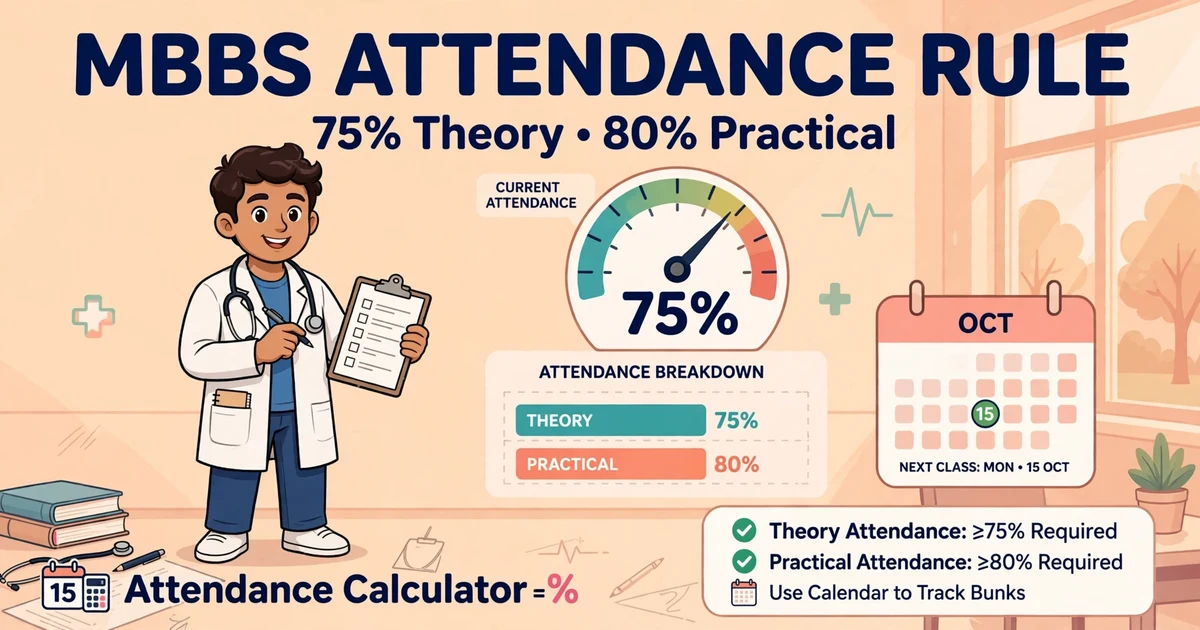
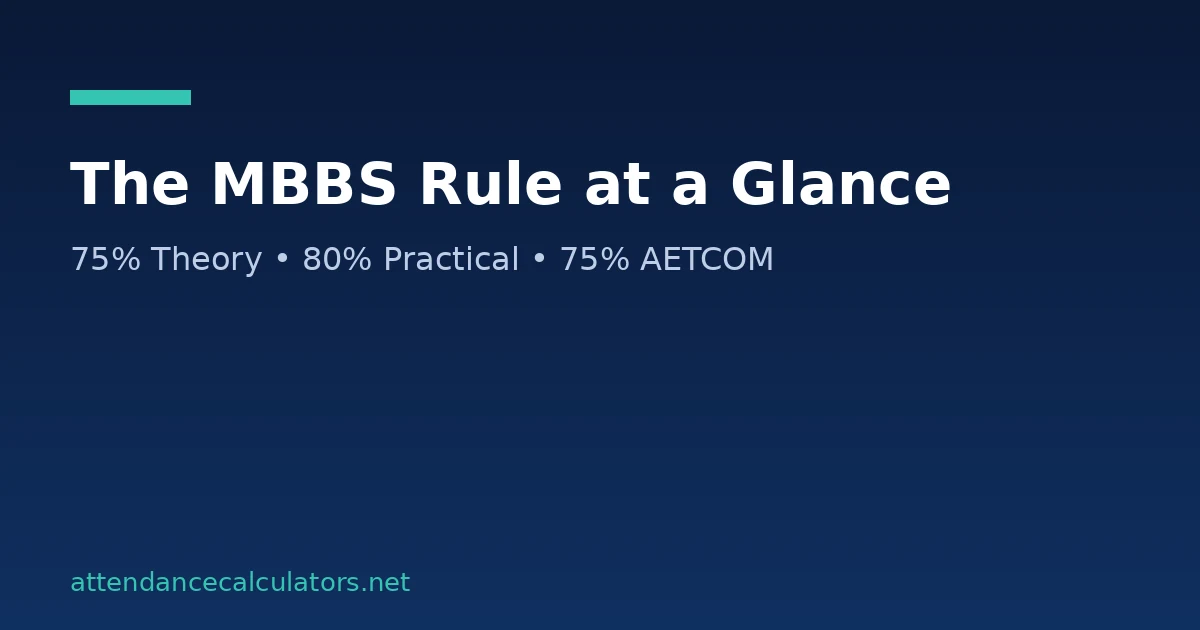
The MBBS attendance rule 75 percent theory 80 percent practical means you need at least 75 percent attendance in theory classes and 80 percent in practical or clinical sessions in each subject to sit for university exams. Miss either mark in any subject and you lose that paper.
The rule comes from the National Medical Commission, in the Competency-Based Medical Education (CBME) Regulations 2023, published on 1 August 2023. The NMC then clarified it in FAQs: the same bar applies to the supplementary exam after the regular annual exam. It is the national rule, and it applies to batches admitted since 2019.
Theory and practical are two gates, not one. You can sit at 90 percent in theory and still lose the paper if your practicals sit at 79 percent. I made that mistake in my own course. Stop thinking in one number. MBBS counts two.
The full rule in one table
AETCOM is the Attitude, Ethics and Communication module. Electives are short optional courses in the later phases. Family visits are part of the Family Adoption Programme, where you follow families in a village.
| Part of the course | Attendance needed | What it covers |
|---|---|---|
| Theory classes | 75 percent | Lectures and classroom teaching in each subject |
| Practical and clinical sessions | 80 percent | Labs, ward postings, clinics and demonstrations |
| AETCOM module | 75 percent | Attitude, Ethics and Communication sessions |
| Family visits (Family Adoption Programme) | 80 percent | Visits to your adopted families |
| Electives | 75 percent | Optional short courses in the later phases |
The electives line has its own sting. You need at least 75 percent attendance in electives to sit for the final professional exam. And elective time cannot be used to make up missed postings or a shortfall somewhere else. Treat electives as real classes. They are.
Why theory and practical are counted apart
Lectures teach you what a disease is. Postings teach you what a sick person looks like, and what to do with your hands. One cannot stand in for the other. That is why the NMC set a higher bar for the hands-on part.
You can read about taking blood pressure in a book. You still need to do it on real people, many times, before you are safe to do it alone. The 80 percent bar for practicals is the rule saying no to skipping that. Check both counts each week, not one.
How your college counts it
Does the 75 percent and 80 percent rule apply to every subject separately?
Yes. The MBBS attendance rule 75 percent theory 80 percent practical applies to each subject on its own, and to each phase where a subject runs. A strong record in anatomy cannot cover a weak record in physiology. Each subject must clear both marks before you can sit for it.
Your college counts attendance over one full phase of training in that subject, against the total classes held in that phase. If a subject runs over more than one phase, like community medicine, the bar must be met in each phase.
Allied subjects count too. For a paper with allied subjects, like General Medicine and allied, you must clear the bar in the allied subjects as well. Skip those postings and you can lose the main paper.
If you want the day counts, my post on what 80 percent attendance means in days works out the maths for different term lengths. Use it with your own class counts, not with a guess.
What happens if you fall short?
Short attendance blocks you from the regular university exam in that subject. That part surprises no one. The part that hurts is the second half: the NMC FAQ says the same bar applies to the supplementary exam. Fall short in theory or practical, and you cannot sit for the supplementary exam in that subject either.
There is one door back in, and it has a floor. Under the CBME 2024 guidelines, a student whose attendance is above 60 percent in each part can take remedial classes between the university exam and the supplementary exam. Finish that remedial work, and you may sit for the supplementary exam.
Below 60 percent in any part, that door stays shut. You will need to attend classes with the junior batch in the next academic year to make up the shortfall, and you can sit for the exam only in the next academic year. In plain words: you repeat the year for that subject.

The CBME 2024 guidelines also tell colleges to catch this early, with quarterly or six-monthly checks, and to warn you and your parents while there is still time to fix it. If your college skips that check, run your own. Do not wait for the exam form to tell you.
If you are already short, run your numbers through the attendance shortage calculator before you talk to anyone. “I am at 71 percent in theory in pharmacology” gets a better answer than “I think I am short somewhere.”
The Mumbai case: 180 students learned it the hard way
Around 180 MBBS students in Mumbai were declared ineligible for their forthcoming exams: about 125 from Lokmanya Tilak Municipal Medical College in Sion, and about 55 from Dr R N Cooper Medical College in Vile Parle. The report, carried by Medical Dialogues from a Hindustan Times report, tied the decision straight to the NMC FAQ.
Those students approached several channels to be allowed to sit for the exams. The rule held. Appeals after the list comes out rarely work. The time to act is weeks earlier, when your count first dips.
Some guides will tell you courts sometimes step in. That is not a plan. A court case is slow, costly, and far from sure. Your attendance count is in your hands today.
The two other gates: internal assessment and your logbook
Attendance is only one of three gates. The CBME 2024 guidelines list all three, and you need all of them to sit for the university exam.
First, internal assessment. You need at least 50 percent marks in internal assessment in a subject to be eligible for its final university exam. It runs through the phase: class tests, seminars, case talks, quizzes, and day-to-day work. Skip the small tests and you can fail this gate while your attendance looks fine.
Second, certifiable competencies and your logbook. You must finish the required certifiable competencies for that phase and keep the logbook for it. The logbook, with skill certifications, carries 10 to 20 percent weight in internal assessment. A blank logbook is a missing gate.
Third, the pass bar itself. To pass a subject you need a total of 50 percent in the university exam, with at least 40 percent separately in theory and in practical.
How I track attendance (and how you can too)
My method is the one I used in my BSCS course. Two counts per subject: theory and practical. I update them the same day, right after class, in a notes app. Memory lies. The note does not.
Say anatomy holds 120 theory classes in the phase and you attend 90. That is 75 percent, exactly on the line. One more miss drops you below it. With 60 practical sessions, 48 attended is 80 percent, exactly on the line. One more miss, and you are out.
That is why I keep a personal buffer above the official line. I treat 78 percent in theory and 83 percent in practicals as my real floor. It gives me room for one bad week, a fever, a family trip. The official line is a cliff edge. Mine has a fence before it.
Every Friday, I spend two minutes on a check: theory count, practical count, AETCOM count. If any count is below my buffer, I fix the next week. The students who end up on detention lists are rarely the ones who skipped the most. They are the ones who never checked.
Myth vs Fact
Myth: My overall attendance is above 75 percent, so I am safe.
Fact: The rule counts each subject and each part apart. A high overall average cannot rescue a weak subject, and strong theory cannot rescue weak practicals.
Myth: A medical certificate will fix a shortfall.
Fact: A genuine certificate explains why you were away. It does not change the NMC percentage bar. Your college may offer remedial classes, and you should ask for them, but a certificate on its own does not restore eligibility.
What to do if you are already below the line
Start with exact numbers, not a feeling. Get your subject-wise counts from your college office, then talk to your mentor or head of department, soon, not next month. Ask what your exact shortfall is, whether there is a remedial plan for you, and what you must finish before the supplementary exam.
If the gap came from illness, keep your medical papers ready and file them the way your college asks. The general rules for what attendance condonation means will help you frame the request, but go in knowing that MBBS follows the NMC criteria above. Your college office gives the final word on what it can allow.
And if the answer is the junior batch next year, do not treat it as the end. Treat it as a year with a clear task: rebuild both counts from day one, keep the logbook current, and never let a count drift unwatched again.
What is AETCOM attendance, and does it count too?
AETCOM is the Attitude, Ethics and Communication module in the MBBS course, and yes, it counts. You need at least 75 percent attendance in AETCOM sessions, plus 80 percent in family visits under the Family Adoption Programme, to stay eligible for university exams.
AETCOM sounds soft next to anatomy. It is not optional. It covers how you talk to patients, how you handle consent, how you act when no one is watching. Colleges track it like any other subject. Miss it and you can lose eligibility the same way. Put it in your weekly check, next to theory and practicals.
FAQ
What is the minimum attendance for MBBS theory and practical?
You need 75 percent attendance in theory and 80 percent in practical or clinical sessions, in each subject and each phase. The rule comes from the NMC CBME guidelines. Your college counts it over one full phase, not over a single month, so one bad week rarely decides it alone.
Can MBBS students get condonation for low attendance?
Most MBBS students cannot count on condonation the way other college students can. The NMC criteria are fixed at 75 percent theory and 80 percent practical, and shortfall usually means remedial classes or repeating with the junior batch. Ask your college office what, if anything, it can allow.
What happens if my MBBS attendance is below 60 percent?
Below 60 percent in any part, remedial classes cannot rescue you for the supplementary exam. You will be held back from both the regular and supplementary exams in that subject and must attend classes with the junior batch next year. That is why early warning signs matter so much.
Does attendance in electives affect MBBS exam eligibility?
Yes. You need at least 75 percent attendance in electives to sit for the final professional exam. Elective time cannot be used to make up missed postings or a shortfall elsewhere, so treat electives as real classes, not free weeks.
How many classes can I miss in MBBS and stay above 75 percent?
It depends on how many classes your college holds. In 100 theory classes you can miss 25 and stay at 75 percent, but in practicals you can miss only 20 in 100. Use our shortage calculator to run your own numbers before you skip a class.
Your three zones, and your next step
Green: theory above 78 percent, practicals above 83 percent. Keep your Friday check and carry on. Amber: theory between 75 and 78 percent, or practicals between 80 and 83 percent. Stop skipping, tell your mentor, and fix it this week. Red: below either official line. Go to your college office today with exact numbers and ask about the remedial plan.
The NMC has tightened these rules step by step since the CBME Regulations 2023, and the 2024 guidelines added the remedial detail. Check your college notice each phase, because the fine print can change. But the core will not: 75 percent theory, 80 percent practical, each subject, each phase. Run your numbers tonight, and make Friday your check day. That small habit is what keeps you off the list.




2 Comments