BDS Attendance Rule: 75% or No Exam? 5 Powerful Facts
If you study dentistry in India, two numbers decide whether you can sit your university exams. Seventy-five and seventy-five. One for theory. One for clinics.
I study computer science, so the BDS attendance rule never applied to me. But I spent my whole degree tracking my own attendance by hand in a notes app, class by class, because my college counted it subject by subject too. I know the exact feeling of opening a portal and seeing one subject sitting below the line while the rest look fine. That is the trap in this rule. Most BDS students only find out about it when the exam form gets rejected.
This post explains the rule as the Dental Council of India wrote it, the 70% detail most students miss, and what happens when you fall short. Read the middle sections even if your number looks safe. The split between theory and clinics is where students get caught.
What is the BDS attendance rule?
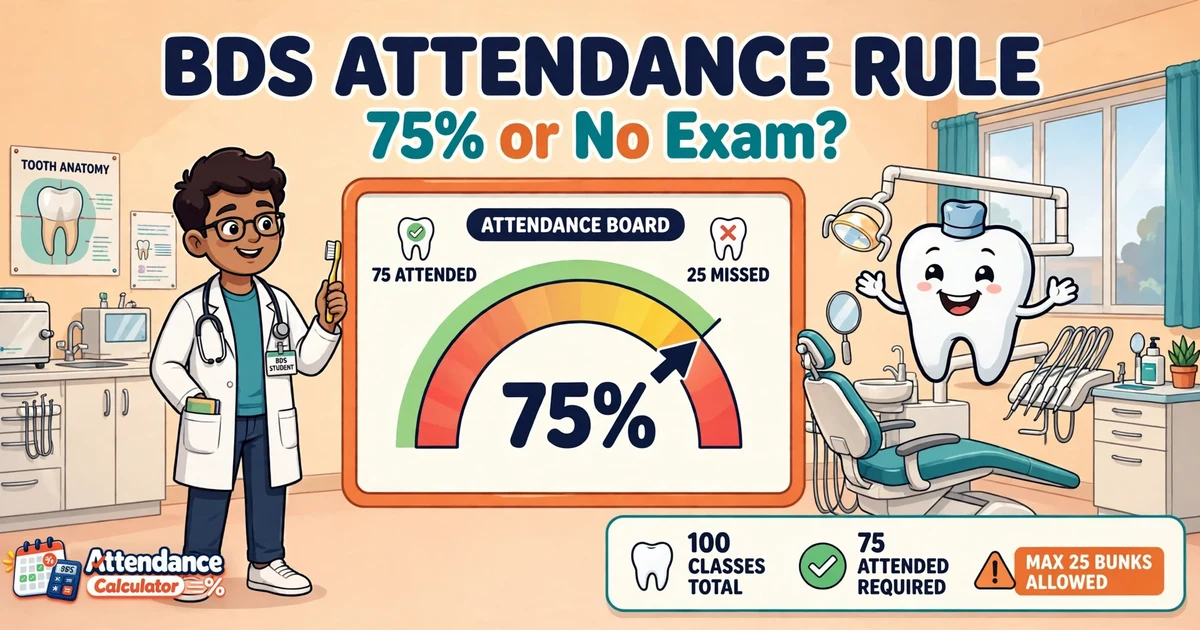
The BDS attendance rule says a dental student must attend at least 75% of theory classes and 75% of practical and clinical classes in each year to sit the university exams. It comes from the Dental Council of India’s Revised BDS Course Regulations, 2007. The two counts stay separate.
The rule comes from the Dental Council of India’s Revised BDS Course Regulations, 2007. It sets the bar for every year of the course. Your college applies it, and your university checks it when the exam forms go in. Neither of them can bend it on a quiet word.
Most colleges count it subject by subject. That is the part that catches people. You can sit at 80% overall and still be barred from one subject where your clinics ran short. The older 1983 regulations spell it out as 75% in theory and 75% in practical or clinical work in each subject in each year. The 2007 version says the same thing in shorter words.
And the count starts on day one of the course, not on the day you joined. If you took admission late, those first weeks still count against you. Students who join more than 30 days after the course starts have to appear for the next exam instead, and finish the work they missed with the head of department signing it off.
| Your position | Theory | Practical / clinical | Can you sit the exam? |
|---|---|---|---|
| Clean pass | 75% or more | 75% or more | Yes |
| Short in theory | Below 75% | 75% or more | No, theory blocks you |
| Short in clinics | 75% or more | Below 75% | No, clinics block you |
| Short in both | Below 75% | Below 75% | No, and the fix takes longer |
What is the 70% rule in the BDS attendance rule?
If a subject has no university exam at the end of the year, the BDS attendance rule asks for at least 70% in that subject for that year. When the subject finally comes up for its professional exam, your total attendance must reach 75% in theory and 75% in practical.
Some BDS subjects run across two years but only get examined in the second year. Dental Materials is the classic case. In the year with no exam, the rule asks for 70% instead of 75%. That sounds like a break. It is not a discount, it is a pause.
That is the part of the BDS attendance rule most students never hear about. A 70% in year one only helps if you pull the total back above 75% by exam time. Students who treat the 70% as the real target walk into the exam year already short.
Work it out with real numbers. Say a subject has 100 theory classes across two years. You need 75 of them by the exam. If you attended 35 of 50 in year one, you need 40 of 50 in year two. That is 80%. The 70% year did not save you any classes. It only moved them.
What happens if you fall below 75%?
Fall short and the college will not let you sit the university exam for that year. That is the blunt version. The longer version depends on how short you are and what your university does next.
Students who get detained or referred have to put in 75% attendance in theory and practical separately during a six-month tenure before the next exam. That is a full half year of showing up before you get another shot. It is the part of the rule nobody tells first-year students about.
Long absences have their own rules. If you stay away for 91 days or more and want to come back within a year, the principal can allow it only after sending your case to the registrar, and the vice-chancellor has to agree. Stay away for a year or more without permission and your admission is treated as cancelled. No fresh notice, no second warning.
Low attendance also hits your internal assessment. The DCI rules base it on day-to-day work, assignments, seminars and clinical case presentations. Miss the clinics and you lose the marks twice, once in the count and once in the assessment.
Is there condonation under the BDS attendance rule?
The DCI regulations do not set a fixed condonation percentage for BDS the way some other councils do. Your university or college decides whether a shortfall can be forgiven, and on what proof. Medical certificates and a written request help. Check your college notice board or university handbook before you assume anything.
The DCI regulations do not hand you a fixed percentage the way some other councils do. That leaves the call with your university. Most universities allow a small relaxation on real medical grounds, with certificates and a written request. A few allow none at all. Ask your college office what your university allows, and ask in writing, before the exam form closes.
If you want the full picture of how condonation works across Indian colleges, my guide on what attendance condonation is and who can apply for it covers the medical proof, the written request, and who decides.
Why clinics cost you more than lectures
A missed lecture can be covered. Notes from a friend, a recording, an hour in the library. A missed clinic cannot. The patient was booked, the chair was set, the procedure went to someone else. That hour is gone, and the count does not give it back.
This is why the practical number falls first for most BDS students. Theory is easy to top up by sitting in a hall. Clinics need you in the room, in an apron, with a patient in the chair. A week of fever costs you far more in clinics than in theory, even though both counts need the same 75%.
Myth vs Fact
Myth: “If my overall attendance is 78%, I am safe.”
Fact: Theory and practical are counted apart, and most colleges count subject by subject. An overall 78% can hide a 68% in one subject’s clinics, and that one subject is enough to hold back your exam form.
What to do if you are below 75% right now
Start with the split. Write down theory and practical for every subject, not one overall number. The subject with the lowest clinic count is your real problem, even if your total looks fine.
Then count what is left. Work out how many classes remain in the year and how many of them you must attend to reach 75% in each count. Run the numbers through the 75 percent attendance calculator so you are working with real figures instead of a guess.
Then go and talk to people. Your head of department first, then the college office. Ask what your university allows for medical cases, and ask about extra clinic hours. Put the request in writing, attach your proof, and keep a copy.
One line I have to say plainly. Do not ask anyone to mark you present for a clinic you missed. Do not pay anyone to fix your attendance. That is fake attendance, and in a dental course it can end your career before it starts. The honest routes are the extra clinics, the written request, and the six-month tenure if you get detained. Nothing else is worth it.
FAQ
Can I write the university exam with 70% attendance in BDS?
Only in a year where your subject has no university exam. In that year the rule asks for 70%, but your total must still reach 75% in theory and 75% in practical by exam time. In an exam year, 70% will not get you an exam form.
Does the BDS attendance rule count theory and practical together?
No. The BDS attendance rule keeps the two counts apart. You need 75% in theory and 75% in practical and clinical work, each on its own. Strong theory attendance cannot cover short clinic hours, and a perfect clinic record cannot cover missed lectures. Both lines must be crossed.
What is the 70% rule for non-exam subjects in BDS?
For a subject with no exam at the end of the year, the rule asks for at least 70% that year. But the total across the years must reach 75% in theory and 75% in practical before the professional exam. Treat 70% as a one-year floor, never as the target.
I was detained for low attendance in BDS. What now?
Detained BDS students must put in 75% attendance in theory and practical separately during a six-month tenure before the next exam. Get the tenure dates in writing from your head of department, and attend every clinic in that period. One more short count can cost you another six months.
Does BDS attendance start from admission or from the first class?
From the first class. The DCI regulations say attendance is counted from the day the course starts, not from the day you joined. Late admission does not wipe out the missed weeks. Join more than 30 days late and you sit the next exam instead, after finishing the missed work.
Your next step
Open your portal today and write down theory and practical for every subject. If both counts sit above 75% everywhere, your job is to keep them there. If one count sits below the line, count the classes left and talk to your head of department this week. And if you want to see how the same kind of rule works in medicine, my guide to the MBBS attendance rule lays out the 75% theory and 80% practical split side by side with this one.