
BCI 70 Percent Attendance Rule for Law Students: Can You Still Write Your Exams?
If you study law in India, one number decides whether you can sit for your exams. Seventy percent. Not 75, like the rest of us. Seventy.
I study computer science, so this rule never applied to me. But when I started reading up on it for this post, I kept finding law students in the same panicked spot I used to be in. Staring at a number on a portal. Trying to work out if the semester was already over. The BCI 70 percent attendance rule for law students is the rule that sets that number. It comes from Rule 12 of the Bar Council of India’s Rules of Legal Education, 2008. And over the past year, the courts have pulled it in two directions at once.
This post explains the rule as it stands, the 65 percent relaxation that most students never hear about, and what the Delhi High Court and Supreme Court cases actually changed. If your number is short, read the whole thing. The middle matters more than the headline.
What is the BCI 70 percent attendance rule for law students?
The BCI 70 percent attendance rule for law students says you cannot take the end-semester test in a subject unless you attended at least 70% of its classes, including moot court exercises, tutorials and practical training. It comes from Rule 12 of the Bar Council of India’s Rules of Legal Education, 2008.
Three parts of that rule catch students out. Each one matters under the BCI 70 percent attendance rule for law students, so read all three before you count your classes.
First, the 70% applies subject by subject. Your overall average does not save you. You can sit at 80% across the semester and still be barred from one subject where you only managed 62%. Each subject is judged on its own count. That subject-by-subject test is the part of the BCI 70 percent attendance rule for law students that catches most students out.
Second, the count is wider than lectures. Moot court room exercises, tutorials and practical training all sit inside the same 70%. A moot you skipped counts the same as a lecture you skipped. That wider count is built into the BCI 70 percent attendance rule for law students, so moot courts count too.
Third, the rule is a Bar Council rule, not a college invention. Your college applies it, but it did not write it. That matters, because it also means your college cannot just waive it on a whim. The waiver route is written into the same rule, and it has its own limits.
The 65% relaxation most law students never hear about
Rule 12 has a second paragraph, and it is the most useful paragraph in the whole rule for a student who is short. That second paragraph is the part of the BCI 70 percent attendance rule for law students most students never hear about.
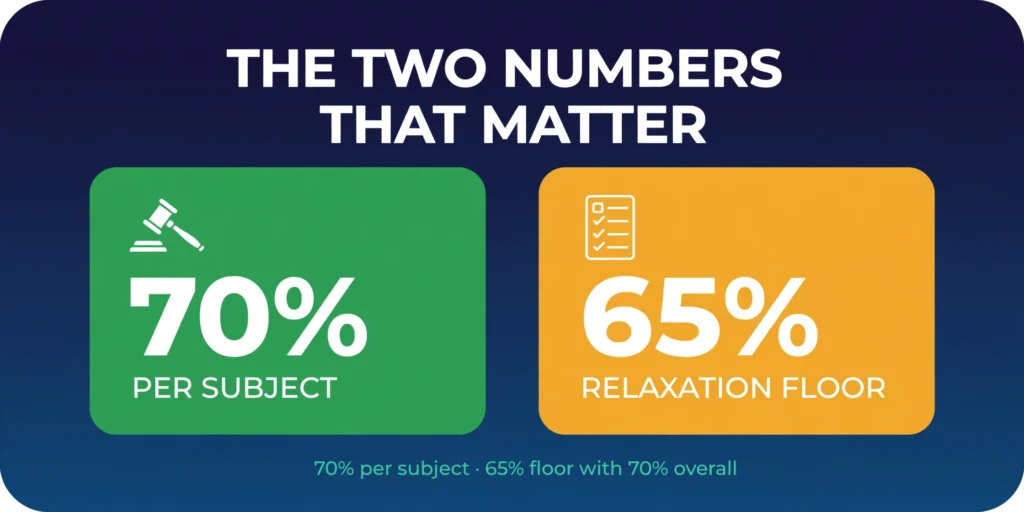
If you miss the 70% mark in a subject for exceptional reasons, the Dean of the university or the Principal of your law college may still let you take the test. Two conditions apply. You must have attended at least 65% of the classes in that subject. And you must have attended 70% of classes across all your subjects taken together.
So the real line is not one number. It is two numbers, and they work together. Here is how that looks with real class counts:
| Your position | Subject attendance | Overall attendance | Can you sit the test? |
|---|---|---|---|
| Clean pass | 70% or more | 70% or more | Yes, under Rule 12 |
| Relaxation zone | 65% to 69% | 70% or more | Yes, if the Dean or Principal allows it |
| Below the floor | Under 65% in the subject | Any figure | No, not under Rule 12 |
| Short overall | 70% in the subject | Under 70% overall | No, the relaxation needs 70% overall |
Read that table twice. The middle row is where most short-attendance law students actually live, and most of them never ask about it. The relaxation is not automatic. You have to ask, and you need a real reason. Illness, a family emergency, something you can show on paper. “I felt like skipping” is not an exceptional reason, and no Dean will treat it as one. The middle row is where the BCI 70 percent attendance rule for law students helps most students who are short.
One more detail from the rule. When a college lets a student sit the test under this relaxation, it has to send a list of those students, with reasons recorded, to the Bar Council of India. That paper trail is why colleges take the request seriously, and why you should put yours in writing too.
What the courts changed, and what they did not
This is where the story gets messy, and I am going to lay it out straight, because a lot of law students online are reading only half of it. The court cases did not rewrite the BCI 70 percent attendance rule for law students, but they changed how it is enforced.
The case started with the death of Sushant Rohilla, a 21-year-old third-year student at Amity Law School in Delhi. He died in August 2016. His family said the college had barred him from exams over attendance and made him repeat the year, and that teachers had shamed him in front of classmates. The Supreme Court took notice in 2016, and the matter reached the Delhi High Court in 2017.
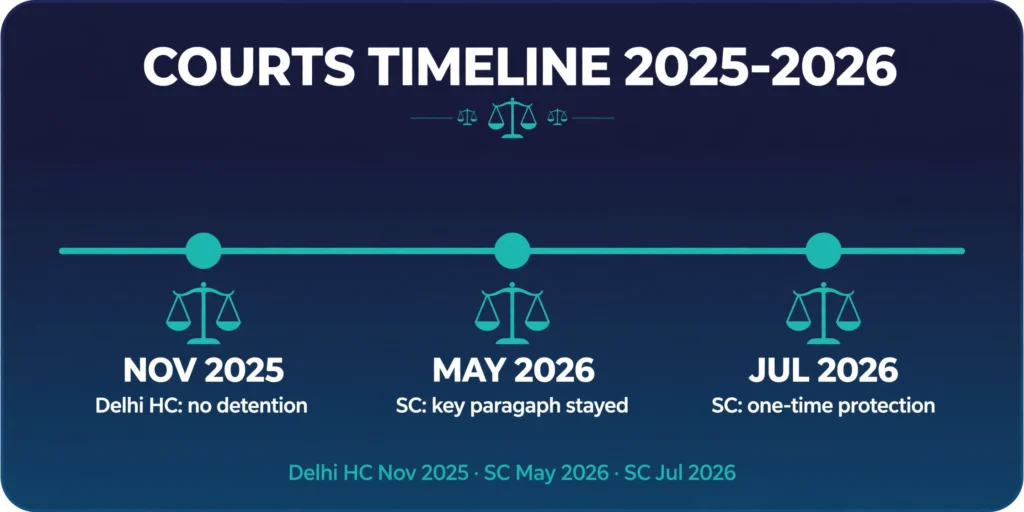
On 3 November 2025, the Delhi High Court gave its judgment. Justices Prathiba M Singh and Amit Sharma held that no student in a recognised law college or university in India should be detained from exams or blocked from academic progression only because of an attendance shortage. The court said the right to sit for exams could not be cut off by an attendance shortage alone, and it called detention an extreme and non-pragmatic approach to the study of law.
Pending a full rethink by the Bar Council, the High Court put an interim regime in place. A student who fell short could still write the exam. The college could cut the final grade by at most 5% where marks were given, or by 0.33 where a CGPA system was used. Colleges also had to share attendance records with students every week, tell parents each month when attendance fell short, and run extra classes, in person or online, so students could make up hours. The court also told the Bar Council to rethink the whole attendance framework after talking to students, parents and teachers, and to consider giving credit for moot courts, seminars, Parliament debates and court visits.
That sounds like the 70% rule is dead. It is not. That is the half of the story people skip. The BCI 70 percent attendance rule for law students still stands, whatever the interim directions say.
The Bar Council of India and NMIMS challenged the judgment in the Supreme Court. In May 2026 the Supreme Court expressed disapproval of the High Court’s approach, and on 26 May 2026 it stayed paragraph 249 of the High Court judgment, the paragraph that stopped colleges from detaining students for attendance shortage. The stay applies prospectively, which means it governs what happens from here on, not what already happened.
Then, on 21 July 2026, the Supreme Court gave one-time protection to students whose academic sessions were already running when the Delhi High Court gave its judgment. Those students could sit their final exams despite attendance shortages, and supplementary exams were allowed in some cases. The Bombay High Court later applied that protection to a group of about 41 law students whose attendance sat between 46% and 54.37%, and it said plainly that the Supreme Court had set no minimum attendance figure for that protected group, so no college could invent one.
As I write this, the Supreme Court has heard the case and reserved its judgment. Nobody outside the court knows which way it will go. So here is the honest position for a law student today. The Delhi High Court’s no-detention direction exists, but a key part of it is stayed. The Bar Council’s Rule 12 still stands as the written rule. And a final Supreme Court answer is still pending. Do not plan your semester on the hope that a court order will save you. That is a gamble, not a plan.
For the general picture of how colleges handle short attendance outside law, my guide on what happens when your attendance falls below 75 percent lays out the detention and repeat-year risk in plain terms.
One real case where an exception worked
Ankita Meena was a final-year law student at Delhi University. Her results for the fourth and fifth semesters were held back because her attendance had fallen short while she was pregnant, with complications in an advanced stage of pregnancy. She had gone to the Delhi High Court back in 2018 asking for her case to be treated as an exception. The High Court refused, saying maternity leave could not be treated as a separate category for attendance relaxation.
In July this year, the Supreme Court directed Delhi University to declare her result. The order turned on the same idea that runs through Rule 12 itself. Exceptional reasons exist, and they deserve an exceptional answer.
The lesson is not that courts always help. They do not, and this case took years. The lesson is that a real reason, backed by paper, is worth raising early and in writing, through the Dean or Principal first. Courts are the last stop, not the first. That is the hard lesson of the BCI 70 percent attendance rule for law students: the rule bends only in rare cases.
What to do if you are below 70% right now
Start with the subject-wise split. Your overall number can lie to you. A student at 74% overall can still be barred from two subjects. Open your portal, or ask your mentor, and write down the figure for every subject.
Next, work out which band you sit in. Above 70% in every subject, you are fine. Between 65% and 69% in a subject with 70% overall, you are in the relaxation zone, and that is a conversation to have with the Dean or Principal now, not in exam week. Below 65% in a subject, Rule 12 gives your college no room to let you in, and you need to talk about repeating the subject or making up classes instead.
Then put your request in writing. A short letter beats a corridor chat. State your subject-wise figures, state your reason, attach your proof, and ask for the relaxation under Rule 12. Keep a copy. If the reason is medical, attach the certificate. If it is a family emergency, attach whatever paper shows it. A verbal promise from a teacher is worth very little when the exam form is rejected. A written request is how you use the BCI 70 percent attendance rule for law students in your favour.
Ask about make-up classes too. The Delhi High Court’s interim directions told colleges to run extra physical or online classes so students could make up hours. Whether your college follows that while the case is pending varies, but asking costs nothing, and a college that runs them will want to see you in them.
One line I need to say plainly. Do not ask anyone to mark you present for a class you missed. Do not pay anyone to fix your attendance. That is fake attendance, and in a law course it can end your career before it starts. The Bar Council also controls who gets enrolled to practise law. A fraud finding now can follow you into practice. The honest routes are the relaxation, the make-up classes, and the appeal. Nothing else is worth it.

Myth vs Fact
Myth: “If you are below 70% as a law student, you are automatically detained for the year.”
Fact: Rule 12 bars you from the test in that subject, but the 65% relaxation exists, and the courts have limited detention as a punishment. Nothing about it is automatic either way. Your college’s current practice, the pending Supreme Court verdict, and whether you asked for the relaxation in writing all shape what happens next.
FAQ
Can a law college detain me for low attendance in 2026?
It depends on where the courts land. The Delhi High Court said no detention for attendance alone, but the Supreme Court stayed that direction in May 2026 and has reserved its final judgment. Until that verdict comes, check what your own college is actually doing, and do not assume you are safe.
What is the 65% relaxation under BCI Rule 12?
If you fall short of 70% in a subject for exceptional reasons, the Dean or Principal may still let you take the test, provided you attended at least 65% in that subject and 70% across all subjects together. It is a discretion, not a right, and your college must report it to the Bar Council.
Does the 5% marks penalty apply to every law college?
The 5% marks or 0.33 CGPA penalty came from the Delhi High Court’s interim directions in November 2025. It was part of the judgment the Supreme Court is now examining, and a key paragraph of that judgment is stayed. Ask your college which penalty, if any, it applies this semester.
Do moot courts and internships count toward attendance?
Moot court exercises, tutorials and practical training sit inside the 70% count under Rule 12, so skipping them hurts the same as skipping a lecture. Internships are different. The High Court asked the Bar Council to consider giving credit for moots, seminars and court visits, but that is a proposal, not a rule yet.
I have 68% in one subject but 78% overall. Can I write the exam?
You are in the relaxation zone. Ask the Dean or Principal in writing for permission under Rule 12, with your reason and proof attached. You meet the two numbers the rule asks for, but the decision is theirs, and the sooner you ask, the better your chances. That is exactly the situation the BCI 70 percent attendance rule for law students was written for.
Your next step
Open your attendance record today and write down the subject-wise figures, not just the total. If every subject is above 70%, you are clear, and your job is to keep it that way. If one subject sits between 65% and 69% while your overall is above 70%, write to the Dean or Principal this week and ask for the relaxation under Rule 12. If you are below 65% anywhere, go and ask about make-up classes and your options for that subject before the exam form closes.
And if you want to see exactly how many more classes you need, run your numbers through the 75 percent attendance calculator and read what attendance condonation is and who can apply for it so you know every route open to you. That is the BCI 70 percent attendance rule for law students in one line: 70 percent per subject, 65 percent at the floor, and no shortcuts.



One Comment