

How To Increase Attendance: 9 Practical Tips
If your attendance is low, the first thing to know is this: you can increase your attendance percentage by attending every remaining class, avoiding unnecessary absences, tracking your attendance, and checking how many classes you actually need to reach your target.
Your attendance doesn’t increase by a fixed amount every time you attend a class. The increase depends on how many classes you’ve attended, how many classes have already been conducted, and how many classes are still left.
This works the same way for school, college, and university students. Before making a recovery plan, calculate your exact numbers with an Attendance Calculator.
How Does Attendance Percentage Increase?
Your attendance percentage increases when you attend a class because your attended-class count goes up. But the amount it increases depends on your existing attendance and total classes.
Attendance Percentage Formula
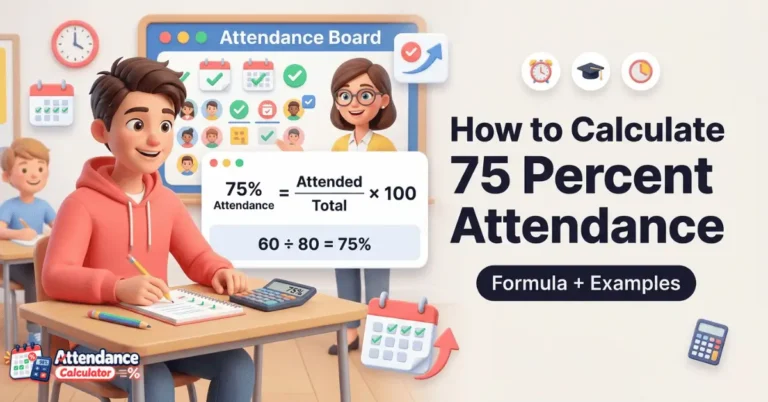
The basic attendance formula is:
Attendance % = (Classes Attended ÷ Total Classes) × 100
For example, if you’ve attended 72 out of 100 classes:
72 ÷ 100 × 100 = 72% attendance
If you attend the next class:
73 ÷ 101 × 100 = 72.28%
So one class doesn’t automatically add 1% to your attendance.
Want to check your attendance numbers?
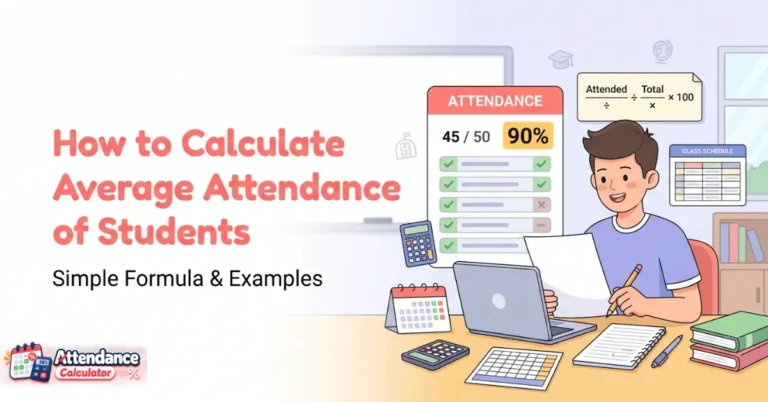
If you’re working with attendance from several classes or students, see how average attendance is calculated with simple examples you can follow.
Why Attendance Increases Slowly When Your Percentage Is Low
Every new class becomes part of the total number of classes.
Suppose you’re at 60% attendance. You have a lot of work to catch up on. Even if you attend every class from now on, the percentage rises gradually because the total number of classes keeps growing.
A student at 70–74% is much closer to a 75% target, so recovery usually takes fewer consecutive attended classes.
Missing another class makes recovery harder because you lose an attended opportunity while the total number of classes still increases.
What Actually Determines How Fast You Can Increase Attendance?
Three numbers control your recovery:
- Classes already attended
- Total classes conducted
- Classes still remaining
Your percentage alone isn’t enough.
For example, two students can both have 70% attendance, but one may have attended 70 of 100 classes while another attended 140 of 200. Their recovery requirements won’t be the same.
Can You Increase Attendance If It Is Already Low?
Yes, sometimes. But not always. Whether you can recover low attendance depends on how many classes have already been conducted and how many are still left.
When Attendance Can Still Be Recovered
You can recover your attendance when enough classes remain and you attend a large share of them.
For example, if you’re at 70% and still have many classes left, attending every remaining class can gradually push your percentage toward 75%.
The earlier you start, the better your chances.
When Is It Mathematically Impossible to Reach Your Target?
Sometimes, attending every remaining class still won’t be enough.
For example, suppose you’ve attended 65 out of 100 classes, giving you 65% attendance.
You want to reach 75%.
You would need 40 more consecutive attended classes:
105 ÷ 140 × 100 = 75%
Now suppose only 20 classes remain.
Even with perfect attendance:
85 ÷ 120 × 100 = 70.83%
You still wouldn’t reach 75%.
That’s why it’s better to check the math than assume that attending every remaining class will fix everything.
Check Your Numbers Before Making a Recovery Plan
Before trying to increase your attendance, find your exact:
- Classes attended
- Total classes conducted
- Target percentage
- Classes remaining
Then calculate whether your target is possible.
If you’re below 75%, don’t guess how many classes you need. Use an Attendance Calculator and build your plan from the actual numbers.
How Many Classes Do You Need to Attend to Increase Attendance?
The number of classes you need depends on your current attendance count and your target.
Formula to Calculate Classes Needed
To find the number of future classes you need to attend:
Classes Needed = (Target × Total Classes − Classes Attended) ÷ (1 − Target)
For a 75% target, use 0.75 as the target.
For example, if you’ve attended 70 out of 100 classes:
(0.75 × 100 − 70) ÷ 0.25 = 20 classes
So you need to attend the next 20 classes without missing one to reach 75%.
Example: Increasing Attendance From 70% to 75%
Suppose:
- Classes attended = 70
- Total classes = 100
- Current attendance = 70%
- Target = 75%
You need 20 consecutive attended classes.
After attending them:
90 ÷ 120 × 100 = 75%
So your attendance reaches 75%.
Example: Increasing Attendance From 65% to 75%
Now suppose you’ve attended:
65 out of 100 classes = 65%
To reach 75%:
(0.75 × 100 − 65) ÷ 0.25 = 40 classes
You need to attend 40 consecutive classes.
After that:
105 ÷ 140 × 100 = 75%
This shows why recovering from 65% takes much longer than recovering from 70%.
Example: Increasing Attendance From 60% to 75%
Suppose you’ve attended:
60 out of 100 classes = 60%
To reach 75%:
(0.75 × 100 − 60) ÷ 0.25 = 60 classes
You’d need to attend 60 consecutive classes.
After those classes:
120 ÷ 160 × 100 = 75%
At 60%, recovery can take a long time.
What If There Aren’t Enough Classes Left?
If the number of classes you need is greater than the number of classes remaining, you cannot reach your target through normal attendance alone.
For example, if you need 40 classes to reach 75% but only 20 classes remain, even perfect attendance won’t be enough.
Don’t make a recovery plan based on hope. Check the numbers first.
For an exact calculation using your own attendance figures, use the Attendance Calculator.

9 Practical Ways to Increase Attendance
The calculation tells you what is possible. Your daily choices determine whether you actually reach it.
1. Attend Every Remaining Class You Can
Attending every remaining class is the fastest legitimate way to improve a low attendance percentage.
If your calculation says you need 20 consecutive classes to reach 75%, missing one of those classes changes the calculation again.
Think of it this way: every class you attend adds to your attended count. Every class you miss adds to the total without increasing your attended count.
So when you’re trying to recover attendance, consistency matters more than trying to make up for everything at the last minute.
2. Stop Unnecessary Absences and Bunking
When your attendance is already low, unnecessary absences hurt twice.
You don’t add an attended class, and the missed class still becomes part of the total number of classes.
For example, if you’re trying to move from 70% toward 75%, another unnecessary absence pushes the recovery target farther away.
This doesn’t mean you should simply guess how many classes you can miss. Calculate it based on your actual numbers and follow your institution’s attendance rules.
For students who specifically want to check how many classes they can miss, use the Bunk Calculator.
3. Track Attendance After Every Class
Don’t rely on memory. A simple record can show a problem before it becomes a shortage.
- Record each attended or missed class.
- Check your attendance subject by subject.
- Compare your current percentage with your target.
- Recheck your numbers every week.
I’ve found that students often notice their low attendance too late because they never track it regularly. A basic attendance tracker can make this much easier.
4. Focus on Your Lowest-Attendance Subjects First
Your overall attendance may look fine while one subject is already below the required level.
Check each subject separately, especially:
- Labs and practicals
- Tutorials
- Individual courses
- Subjects with frequent classes
If one subject has low attendance, prioritize attending its remaining classes.
5. Set a Target Above the Minimum
If your required attendance is 75%, you can set a personal target of 80%.
This creates an attendance buffer for an unexpected absence.
Don’t treat 80% as a universal requirement. It’s simply a safer personal target when your institution requires 75%.
6. Plan Your Remaining Classes Instead of Guessing
If your attendance is low, know exactly what you need to do.
- Count your remaining classes.
- Identify subjects with low attendance.
- Calculate how many classes you need to attend.
- Avoid unnecessary absences.
- Recheck your numbers each week.
Use the Semester Attendance Planner to plan your remaining classes instead of guessing.
7. Deal With the Reason You’re Missing Classes
Sometimes poor attendance has a real cause. Find that cause before trying to fix the percentage.
Common problems include:
- Illness
- Transport problems
- Family responsibilities
- Timetable conflicts
- Repeated lateness
- Low interest or engagement
- Difficulty getting back into class after a long absence
If the problem keeps happening, talk to the right teacher, advisor, or university staff member. Sometimes, simply attending more classes isn’t enough.
8. Act Early Instead of Waiting Until Exams
The earlier you check low attendance, the more chances you have to recover it.
The pattern is simple:
Low attendance → warning → chance to recover → waiting → fewer classes left → harder recovery
Don’t wait until the final weeks.
Check your attendance now and calculate whether you can still reach your target.
9. Follow Your School, College, or University Attendance Policy
Don’t assume every institution follows the same attendance rule.
Check your official policy for:
- Required attendance percentage
- Course-specific requirements
- Medical leave rules
- Condonation or shortage procedures
- Online and offline attendance rules
A 75% requirement may apply to one institution or course but not universally. Your school’s or university’s official policy should always be your final reference.
How to Increase Attendance in School
School attendance needs a slightly different approach from college or university attendance. Focus on consistency, finding the reason for absence, and getting support early.
Attend Regularly and Build a Consistent Routine
Set a simple routine for school days.
Prepare your bag, clothes, and schoolwork the night before so mornings are less rushed.
Fix the Reason You’re Missing School
If transport, illness, family issues, or another problem keeps causing absences, deal with the cause rather than only watching the percentage.
Track Your Attendance Percentage
Keep a simple weekly record of your attended and missed days.
This helps you see whether your school attendance percentage is improving.
Talk to a Parent, Teacher, or School Staff Member if There’s a Problem
If something is making regular attendance difficult, don’t handle it alone.
Tell a parent, teacher, counselor, or appropriate school staff member early. They may be able to help solve the issue.
Make a Simple Weekly Attendance Goal
Set a realistic goal for the coming week.
For example:
Goal: Attend every school day this week unless there’s a genuine reason to be absent.
Small weekly targets are easier to follow than waiting until attendance becomes a serious problem.

How to Increase Attendance in College and University
College and university attendance can become difficult to recover once several classes have been missed. The best approach is to check your numbers early and focus on the subjects where your attendance is lowest.
Check Attendance for Each Subject
Don’t look only at your overall percentage. Check attendance for every subject.
One subject may be below the required level even when your overall college attendance percentage looks fine.
Prioritize Subjects Below the Required Percentage
Start with the subjects where you’re closest to a shortage.
Give extra attention to:
- Lectures
- Tutorials
- Practical classes
- Labs
This helps you avoid finding out too late that one course has become a problem.
Attend Remaining Lectures, Tutorials, and Practicals
If your attendance is low, every remaining class matters.
Attending future classes adds to your attended count while also increasing the total number of classes. That’s why recovery takes time.
Stop Unnecessary Bunking
Once your attendance is already low, skipping an extra class makes recovery harder.
You don’t need to calculate every possible absence. First, get your attendance back into a safer range.
Check Your Attendance Before the Shortage Becomes Serious
Don’t wait for an exam or final attendance warning.
Check your percentage during the semester and calculate how many classes are left. You’ll have more options when you act early.
Understand Your College or University Policy
Attendance rules can differ by institution, course, and department.
Check your official policy for:
- Minimum attendance requirements
- Subject-specific rules
- Attendance warnings
- Medical leave
- Approved absences
- Make-up or condonation procedures
Ask About Legitimate Medical or Approved Attendance Procedures
If you have a genuine documented reason for missing classes, ask your college or university what options are available.
Medical condonation, exemptions, make-up classes, and approved absences aren’t guaranteed. They depend on your institution’s rules.
How to Increase Attendance From 60%, 65%, 70%, 72%, 73% or 74%
Your current percentage alone doesn’t tell you how many classes you need to attend. You also need to know your total classes completed and remaining classes.
| Current Attendance | Target | Main Question |
| 60% | 75% | Is recovery mathematically possible? |
| 65% | 75% | How many consecutive classes are needed? |
| 70% | 75% | Can the remaining semester recover it? |
| 72% | 75% | How close are you? |
| 73% | 75% | How many more classes are needed? |
| 74% | 75% | Can one absence delay recovery? |
For example, two students can both have 70% attendance, but their recovery plans may be completely different if one has completed 20 classes and the other has completed 100.
So don’t rely on the percentage alone. Use your actual attendance numbers.
What If Your Attendance Is Below 75%?
Being below 75% doesn’t automatically mean recovery is impossible. First, check how many classes have already happened and how many are still left.
First, Find Your Exact Attendance Shortage
Write down:
- Classes attended
- Classes missed
- Total classes
- Required percentage
Don’t estimate from memory.
Trying to reach 75% attendance?
Don’t guess how many classes you need. Check your 75% attendance requirement and see how many classes you need to attend to reach your target.
Calculate Whether You Can Still Reach 75%
The important question isn’t only, “How low is my attendance?”
It’s “How many classes are still left?”
If there aren’t enough remaining classes, even attending every class may not get you to 75%.
Attend All Possible Remaining Classes
If recovery is possible, attending every reasonable remaining class gives you the best chance of reaching your target.
Avoid unnecessary absences while your percentage is below the required level.
Check Your Institution’s Shortage Policy
Your college or university may have specific rules for attendance shortages.
Check the official policy rather than relying on what another student says.
Ask About Legitimate Options If You Have a Documented Reason
If illness or another approved reason caused your absence, ask the relevant department about available procedures.
Don’t assume that condonation or an exemption will be granted.
You can use the Attendance Shortage Calculator to check your shortage and plan your next steps.
How to Maintain Your Attendance After Increasing It
Getting back to your target is only half the job. The easier approach is to stop your percentage from falling again.
Keep a Small Attendance Buffer
If your requirement is 75%, you can set a personal target such as 80%.
That extra percentage gives you some room for an unexpected absence. It isn’t a universal requirement.
Track It Regularly
Check your attendance every week instead of waiting for an official warning.
A small change is easier to fix early.
Don’t Use Your Entire Absence Allowance
Being technically allowed to miss a class doesn’t mean you should use every available absence.
Keep some room for situations you can’t predict.
Check Subject-Wise Attendance
Your overall percentage can hide a weak subject.
Check each course separately, especially labs and practicals.
Recalculate After Major Changes
After several absences, approved leave, or timetable changes, check your numbers again.
Your old calculation may no longer be accurate.
Common Mistakes That Stop Attendance From Increasing
Small mistakes can make attendance recovery much harder.
Waiting Until the Last Month
The fewer classes left, the less opportunity you have to recover.
Start checking early.
Looking Only at Overall Attendance
One subject can have a much lower percentage than your overall attendance.
Always check subject-wise attendance.
Assuming 75% Means You Can Miss Classes Freely
A 75% target isn’t a free pass to skip a fixed number of future classes.
Every absence changes your attendance calculation.
Guessing Instead of Calculating
Don’t assume you’ll reach your target just because several classes remain.
Calculate it using your actual numbers.
Ignoring Attendance Warnings
An attendance warning is a signal to act.
Check your numbers immediately and find out what options your institution provides.
Assuming All Subjects Follow the Same Rule
Different courses or departments may have different attendance rules.
Always check the official policy.
When Increasing Attendance Is Not Just About Attending More Classes
Sometimes missing classes isn’t a simple choice. The useful solution depends on why you’re missing them.
If Illness Is Affecting Your Attendance
If an ongoing illness is keeping you away, follow your institution’s process for reporting the absence and submitting any required documents.
If Transportation or Family Circumstances Are a Problem
Repeated transport or family problems can make regular attendance difficult.
If the issue keeps affecting your classes, speak with the appropriate school or university staff rather than letting the absences build up.
If You’re Struggling to Re-Engage With School or College
After missing many classes, returning can feel harder than expected.
Start with the next class. Get your notes, check what you missed, and rebuild your routine one class at a time.
When to Speak With a Teacher, Advisor, Department, or Attendance Office
Ask for help when the problem keeps repeating or you have a genuine reason for missing classes.
Your institution may have support or approved procedures that aren’t visible from the attendance percentage alone.
Frequently Asked Questions About Increasing Attendance
How can I increase my attendance percentage?
The most reliable way to increase attendance is to attend as many remaining classes as possible and avoid unnecessary absences. Track your attendance and calculate whether you can still reach your target. The exact improvement depends on your classes attended, total classes, and number of classes remaining.
How many classes do I need to attend to increase my attendance?
The number depends on your current attended classes, total classes, and target percentage. You can’t get an accurate answer from your current percentage alone. Enter your actual numbers into an attendance calculator to find how many consecutive classes you need to attend.
Can I increase attendance from 60% to 75%?
Sometimes, yes. It depends on how many classes have already been conducted and how many are still remaining. A student with 60% attendance may need many consecutive attended classes to reach 75%. If too few classes remain, reaching 75% may be mathematically impossible.
Can I increase attendance from 70% to 75%?
Yes, it can be possible if enough classes remain. But the exact number depends on your actual attendance count. For example, 70% based on 10 classes is very different from 70% based on 100 classes. Calculate using your real class numbers before making a recovery plan.
Is 75% attendance required everywhere?
No. Attendance requirements aren’t universal. Schools, colleges, universities, departments, and individual courses can have different rules. Check your institution’s official attendance policy for the exact requirement, medical leave rules, approved absences, and shortage procedures.
Conclusion
Increasing attendance starts with knowing your numbers. Attend every remaining class you can, avoid unnecessary absences, track each subject, and calculate whether you can still reach your target.
Don’t wait until exams are near. Check your attendance now, make a simple plan, and follow your school, college, or university’s official rules. A few early changes can make recovery much easier.





3 Comments