Nursing Attendance Rule: The 80% Theory, 100% Practical Line Every Nursing Student Must Know
I am not a nursing student. I study computer science. But nursing students keep landing on my site with the same question, and it is always asked in the same worried tone. How much attendance do I actually need?
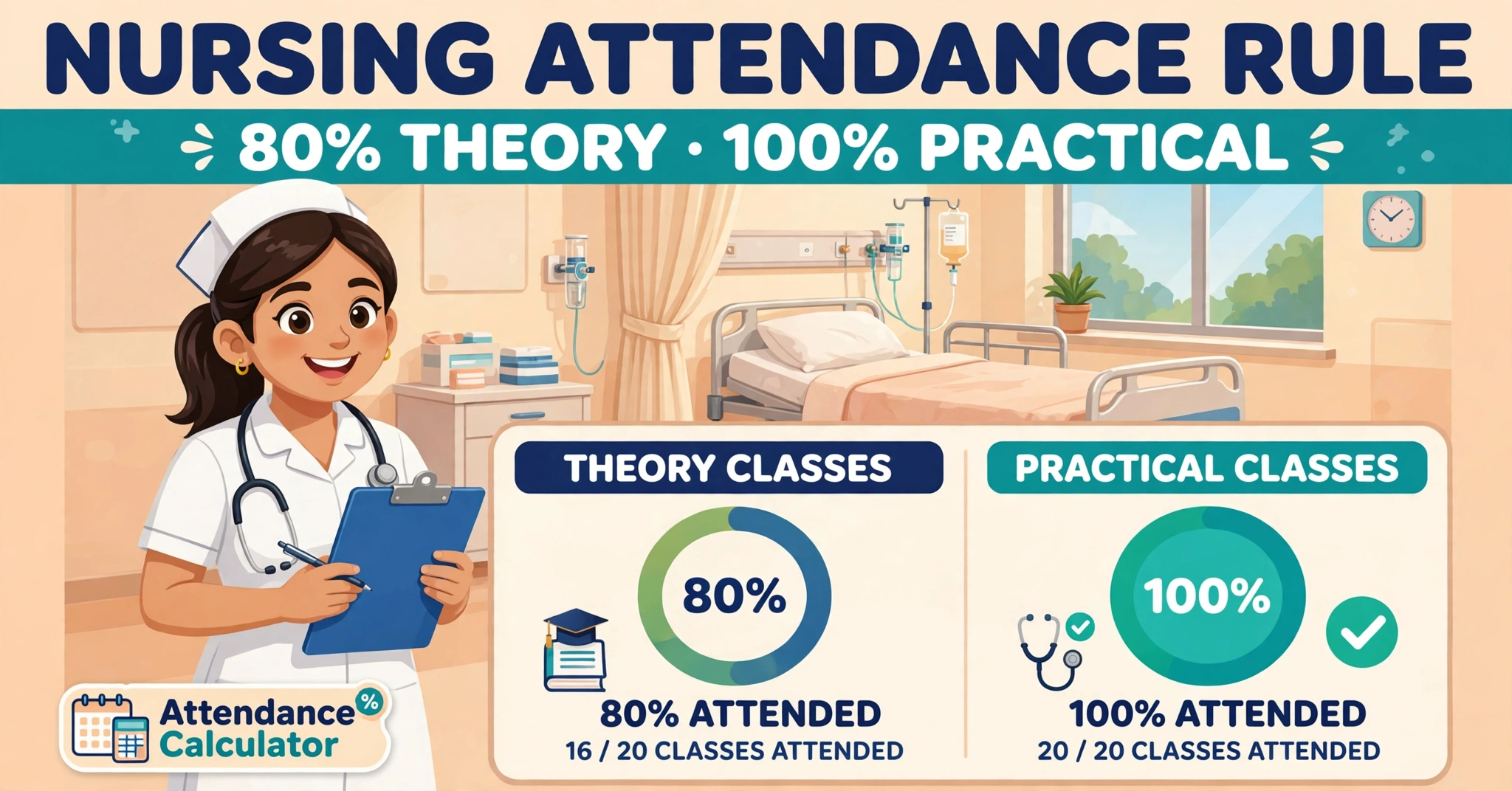
The answer is stricter than almost any other course in India, and it is stricter on purpose. The nursing attendance rule is set by the Indian Nursing Council, and it draws two lines, not one. Eighty percent for theory. One hundred percent for practical. Miss the second line by a single clinical day, and you owe that day back before your degree is awarded.
This post explains both numbers, what happens when you fall short, and how make-up hours actually work. Every rule here comes from the Indian Nursing Council’s Regulations, 2020, and from the rule books colleges publish under them. Where colleges differ, I say so, and I tell you to check your own handbook.
What is the nursing attendance rule?
The nursing attendance rule set by the Indian Nursing Council requires at least 80% attendance in theory and practical in each subject to sit for exams, and 100% attendance in practical areas before your degree is awarded. It applies to B.Sc. Nursing under the INC Regulations, 2020.
Two words in that rule do most of the work, so let me pull them out.
First, “in each subject”. The 80% is not an overall average. It applies subject by subject. You can sit at 90% overall and still be barred from one subject where you only managed 72%. Each subject is judged on its own count, and the exam for that subject is the thing you lose.
Second, “irrespective of the kind of absence”. That phrase sits in the regulation itself, and it means what it says. A medical absence counts against your 80% the same as any other absence. A certificate explains why you were away. It does not erase the absence from the count. That is the part most nursing students learn too late, so I am putting it here, early, in plain words.
The two numbers that matter
Here is the whole rule in one table. If you read nothing else in this post, read this.
| Area | Minimum attendance | What it decides |
|---|---|---|
| Theory classes | 80% in each subject | Whether you can sit for that subject’s exam |
| Practical and clinical | 80% in each subject to sit the exam | Whether you can sit for that subject’s exam |
| Practical areas, total | 100% before the degree is awarded | Whether you get your degree at all |
That third row is the one that surprises people. You can pass every exam and still not get your degree if your practical hours are incomplete. The degree waits until the hours are done. Colleges state it the same way in their own rule books. One college puts it like this: 100% of the clinical experience hours have to be completed before starting the classes for the next higher class, and the degree will not be granted until 100% of the clinical hours are compensated.
Compare that with the course next door. The MBBS attendance rule and how it compares asks for 75% in theory and 80% in practical. Nursing asks for more on both counts, and the 100% practical rule has no equivalent in most other degrees. There is a reason for that, and it is not about discipline. It is about patients.

Why practical is 100%
A missed theory class costs you notes. A missed clinical posting costs you a skill you may need on a real patient.
Clinical hours are where a nursing student learns to take a reading, dress a wound, handle a ward round, and spot a patient going downhill. Those are not things you can learn from a friend’s notes the night before the exam. They are hands-on hours, and the Indian Nursing Council treats them that way. The practical exam checks whether you can do the work, and the attendance rule checks whether you put in the hours to learn it.
That is also why the rule is strict about which hours count. A clinical posting is not a lecture you can catch up on from a recording. It is a posting in a hospital or a community health centre, with real patients and a real instructor watching. Miss the posting, and the hours are gone until you make them up.
I know that sounds harsh when you are sick or when a family emergency pulls you away. It is harsh. But it is also the reason a nursing degree means something to the hospital that hires you. The 100% rule is the Council’s way of saying that every graduate has done every hour.
What happens if you fall below 80%
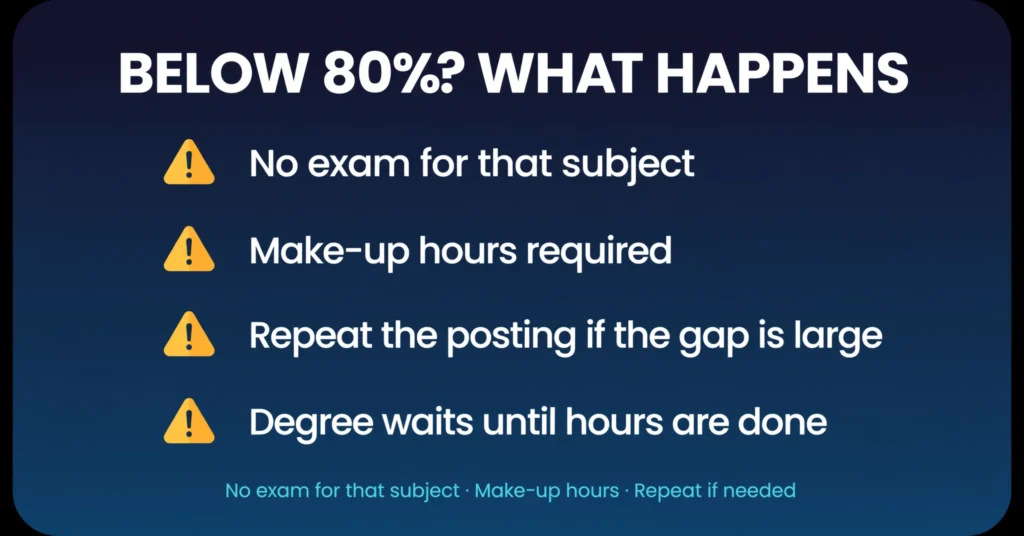
Below 80% in a theory subject, you cannot sit for that subject’s exam. That is the direct consequence, and it applies subject by subject. Your other subjects are not affected, but the one you are short in is closed to you until the shortage is fixed.
Below 80% in practical for a subject, the same bar applies. You cannot sit for the practical exam for that subject. And if your total practical hours are incomplete, the degree itself waits, even if every exam is passed.
Colleges handle the fix in two ways, and you will usually meet both. The first is make-up hours, covered in the next section. The second is repeating the posting or the subject with the next batch, if the shortage is too large to make up inside the year. A few colleges also ask for a written application to the Principal, with the reason and the proof attached, before they allow make-up hours at all. Ask your class coordinator what your college asks for, before the shortage grows.
One more thing to know. Some colleges split the clinical rule further. They ask for 80% attendance in clinical experience to sit the exam, and then ask for the remaining 20% to be compensated before the next academic year starts. The maths is the same in the end. Every clinical hour has to be done before you move on. The only difference is when the college makes you do them.
How make-up hours actually work
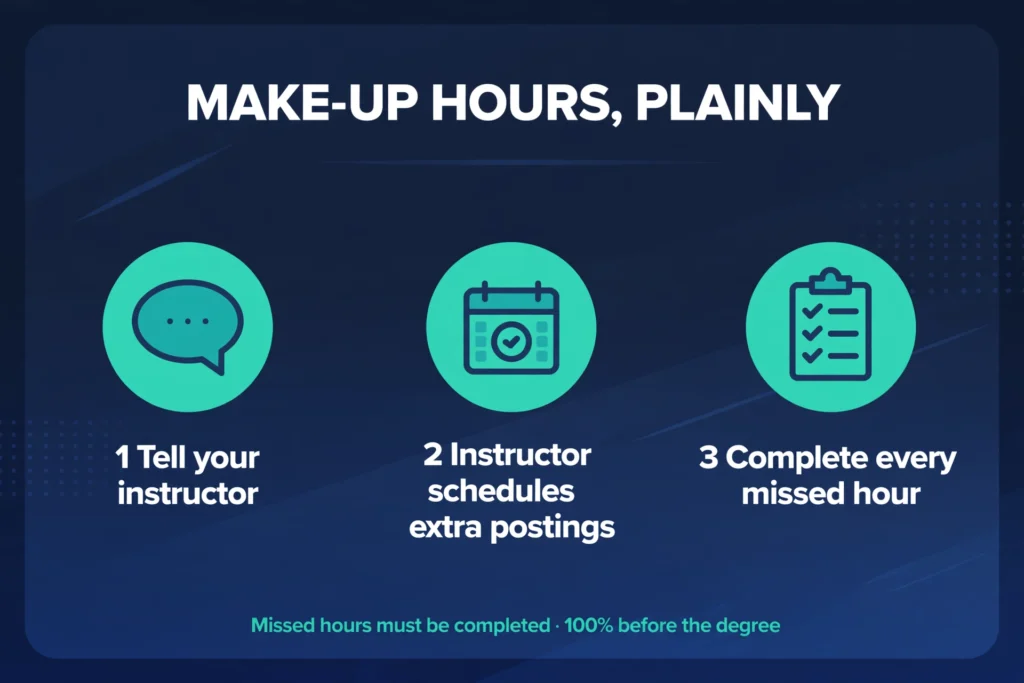
Make-up hours are the fix the system gives you, and they work like this in practice.
You tell your clinical instructor about the missed hours. Not your friend, not the class group, your instructor. The instructor, together with the class coordinator, decides what make-up experience you need. Then the instructor schedules it, usually as extra clinical postings on days you would otherwise be free, or during a vacation block.
You do the hours. All of them. There is no partial credit here, because the rule is 100%. If you missed 24 clinical hours, you make up 24 clinical hours. If you missed a full week of postings, you make up a full week. The hours are logged the same way as regular postings, and they count only when the instructor signs them off.
A few honest notes on how this plays out. Make-up postings are scheduled around the hospital’s needs, not yours, so they can land on weekends or holidays. They also pile up fast. Miss two weeks of postings in a semester, and you may spend your entire vacation making them up. The students who stay out of trouble are the ones who report a missed posting the same week it happens, not the ones who find the gap in the last month.
And a warning that belongs in this post. Never ask anyone to sign off hours you did not do. A forged clinical record is not a shortcut. It is a fraud finding on a professional course, and it can end a nursing career before it starts. The make-up system is slow and annoying. Use it anyway.
A worked example, with real numbers
Take a B.Sc. Nursing student in one semester, with 100 theory hours and 240 clinical hours in a subject.
Theory first. Eighty percent of 100 hours is 80 hours. She can miss at most 20 theory hours and still sit the exam. Miss 21, and the subject is closed to her until the shortage is fixed.
Clinical next. Eighty percent of 240 hours is 192 hours. She needs 192 hours to sit the practical exam. But the degree rule is separate. All 240 hours have to be completed before the degree is awarded. So if she misses 24 clinical hours, she can still sit the exam if she has 192, but she owes 24 make-up hours before she moves on, and the degree waits until they are done.
Now run your own numbers through the attendance shortage calculator and see where you stand. And if you are not sure what your college shows, my guide on how to check your attendance percentage walks through finding the official figure on your portal or notice board.
How to stay above the line
Clinical days are non-negotiable. Treat them that way. A theory class can be caught up from notes. A clinical posting cannot be caught up at all, except by doing it again. If you have to miss a day, miss a theory day, never a clinical day, and tell your instructor the same day.
Check your numbers every week, not every month. Nursing hours pile up fast, and a month of postings is a lot of hours to lose track of. Write down your theory hours and your clinical hours separately, because the college counts them separately too.
Plan your leave around the postings, not the other way round. Family functions, festivals, trips home. Look at the posting schedule first, then plan. A wedding that falls on a clinical week costs you make-up hours in your vacation. A wedding that falls on a theory week costs you notes.
And keep your medical papers from day one. If you fall ill, get the certificate from a registered doctor at the time, not a month later when the office asks for it. A certificate written weeks after the illness is worth far less than one written on the day.
Myth vs Fact
Myth: “A medical certificate excuses missed nursing classes, so the hours do not count against you.”
Fact: A medical certificate explains why you were away, and it supports a make-up request. It does not erase the absence. The INC rule counts attendance irrespective of the kind of absence, and the missed clinical hours still have to be made up before your degree is awarded.
FAQ
What is the minimum attendance for B.Sc. Nursing?
The Indian Nursing Council requires at least 80% attendance in theory and practical in each subject to sit for exams, and 100% attendance in practical areas before the degree is awarded. Both figures come from the INC Regulations, 2020.
What happens if my nursing attendance is below 80%?
You cannot sit for the exam in that subject until the shortage is fixed. For theory, that usually means a written application and approval. For practical, it means completing make-up hours, and if the shortage is large, repeating the posting with the next batch.
Do I have to make up missed clinical hours?
Yes, every one of them. The rule is 100% of practical hours before the degree is awarded. Your clinical instructor schedules the make-up postings, and the hours count only when they are signed off.
Does a medical certificate excuse missed nursing classes?
No. A medical certificate explains the absence and supports your make-up request, but the INC counts attendance irrespective of the kind of absence. The missed hours still have to be completed.
Is the nursing attendance rule the same in every college?
The INC rule is the same across India, but colleges apply it through their own handbooks, and state nursing councils and universities can add their own conditions. GNM and diploma courses follow the same 80% theory and 100% practical pattern, but your own college’s rule book is the final word for you.
Your next step
Open your attendance record today and write down two numbers, separately. Your theory percentage for each subject, and your clinical hours done against clinical hours posted. If both are above the line, keep the habit that got you there. If your theory is between 75% and 80%, stop missing theory classes until you are clear. And if your clinical hours are short, go to your clinical instructor this week and ask for make-up postings, before the gap grows into your vacation. In nursing, the hours are the degree. Guard them like it.