Hotel Management Attendance Rule: 5 Powerful 75% Facts
I learned about attendance the hard way, and not in a hotel college. I was a BSCS student, sitting in the back row, tracking my own attendance by hand in a notes app because no one else was going to do it for me. I would add up my classes at night, guess at the maths in my head, and hope I was above the line.
That is why I write these guides now. If you are studying hotel management, your attendance rule is stricter than most students realise, and it is written down in exam-rule documents that almost nobody reads until it is too late. I have read them so you do not have to learn the way I did — by panic, the week before exams.
Here is the short version: you need 75% overall, and in some colleges you also need 70% in every subject. Miss either one and you can be stopped from sitting exams. Below, I show how the rule works, what counts, what condonation can fix, and how to work out your number fast.
What is the hotel management attendance rule?
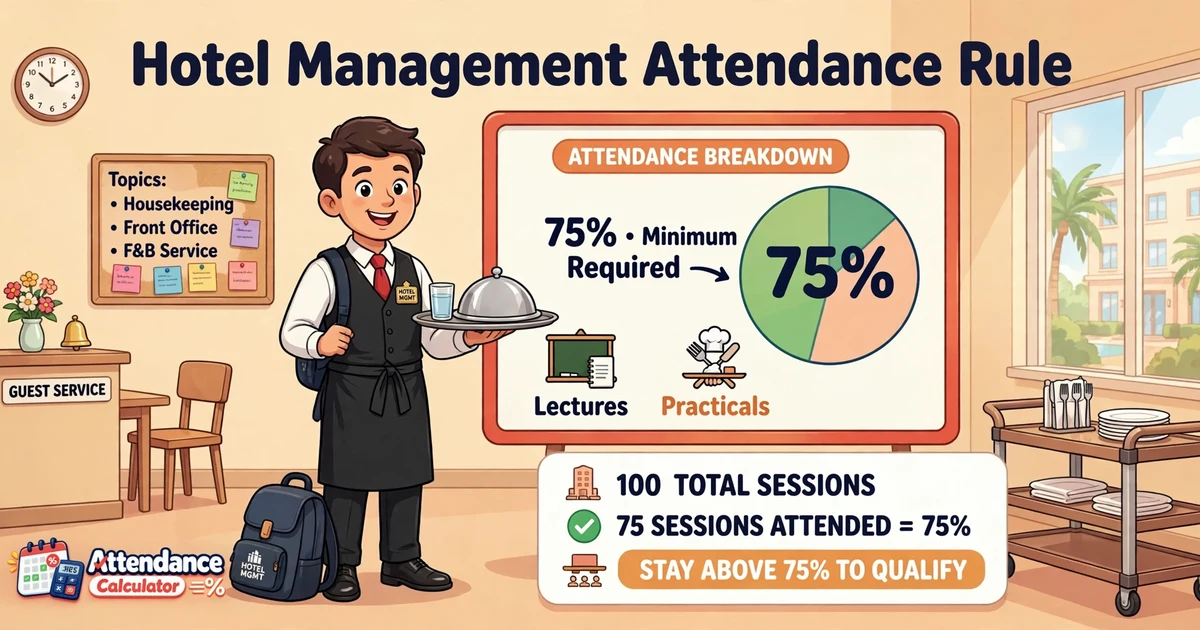
The hotel management attendance rule is the NCHMCT rule that a student must attend not less than 75% of the aggregate of lectures, practicals and tutorials in a course. If your attendance falls below that line and is not condoned, your college can debar you from the Council examinations.
That one sentence is the whole game. Notice the word “aggregate”. It means all your lectures, practicals and tutorials added together. It does not mean 75% in one easy subject can quietly carry a subject you never attended. Well, actually, it can carry it in the overall total — but that is where the trap comes in, and I will get to that in a minute.
NCHMCT is the National Council for Hotel Management and Catering Technology. It runs the exam system for the Institutes of Hotel Management, the IHMs, across India. Your college follows its rules, and your college also has its own rule book that fills in the gaps. That is why two IHM students in two cities can hear slightly different versions of the same rule. The national line is 75%. The local details are where you need to check your own college.
What counts as a unit of attendance?
A unit of attendance is normally one lecture, one practical session, or one tutorial that you were supposed to attend. Your percentage is your attended units divided by your total scheduled units, multiplied by 100, and practicals count just as much as theory classes.
This matters a lot in hotel management, because so much of your course is practical. Food production practicals, front office labs, housekeeping practicals — these are not optional extras. They sit inside that same aggregate total. I have seen students treat practicals like they matter less than theory. They do not. Skip a four-hour practical and you have lost the same kind of ground as skipping a lecture, sometimes more, because practical hours stack up fast.
So when you count, count everything: lectures, practicals, tutorials. If your college counts a full-day practical as one unit or as several hours, that detail changes your maths, so check your own college handbook. The idea stays the same either way. Attended divided by total, times 100.
The 70% per-subject trap most students miss
Some IHMs add a second rule on top of the 75% overall line: you must also secure at least 70% attendance in each individual subject. One IHM states this plainly as 75% aggregate plus 70% individual, so a student can clear the overall total and still be in trouble in one subject.
This is the trap I wish someone had warned me about in my own degree. Picture it. Your overall attendance is 78%. You feel safe. Then your college checks subject by subject, and your food production attendance is 62%. Under a per-subject rule, that one subject can hold you back even though your total looks fine.
Not every IHM words it the same way. The IHM Lucknow rule text requires 70% in each individual subject, and another IHM states the pair as 75% aggregate plus 70% individual. Your college may or may not apply the per-subject line, and that is exactly why “check your own college” is not a throwaway line in this article. It is the difference between safe and debarred. Ask your department office, in writing if you can, whether a per-subject minimum applies to you. Do not assume your friend’s college rule is your rule.
My own habit, back in the notes-app days, was to track only the total. If I could go back, I would track every subject separately. It takes two extra minutes and it catches the trap before it catches you.
Hotel management attendance rule at a glance
| Rule | What it says | What it means for you |
|---|---|---|
| Overall attendance | Not less than 75% of aggregate lectures, practicals and tutorials | Your headline number — never let it slide |
| Per-subject attendance (some IHMs) | 70% in each individual subject | One weak subject can hurt you even if your total is fine |
| Condonation | Principal or head can condone up to 10% shortfall on medical grounds with a certificate | A genuine medical case can be saved — with proof |
| Extra-curricular | Activities with the principal’s permission count as present | Approved duties are not absences |
| Below the line | Debarred from Council exams; detained candidates may be re-admitted as repeaters on full fees in some IHMs | The penalty is real, and repeating costs money |

Worked example: how many classes do you need to attend?
If you have attended 110 out of 160 classes so far, you need to attend the next 40 classes in a row to reach exactly 75%. The formula is: classes needed = (target × total − attended) ÷ (1 − target), so (0.75 × 160 − 110) ÷ 0.25 = 40.
Let me show the maths slowly, because this is the part most guides skip and it is the part that actually helps you.
- Your target is 75%, written as 0.75.
- Your total classes so far is 160.
- 0.75 × 160 = 120. That is how many classes you would need to have attended out of 160 to be at 75%.
- You have attended 110. So you are 10 short: 120 − 110 = 10.
- Every new class you attend adds one to both your attended count and your total. That is why we divide by (1 − 0.75) = 0.25.
- 10 ÷ 0.25 = 40. You need 40 straight attendances.
Check it: (110 + 40) ÷ (160 + 40) = 150 ÷ 200 = 75%. It works.
Now the per-subject version, because that trap deserves its own example. Say a subject has 40 classes so far and you attended 26. The subject target is 70%.
- 0.70 × 40 = 28.
- 28 − 26 = 2 short.
- 2 ÷ (1 − 0.70) = 2 ÷ 0.30 = 6.67, so round up to 7 classes.
- Check: (26 + 7) ÷ (40 + 7) = 33 ÷ 47 = about 70.2%. Good.
If doing this by hand feels like a chore, that is exactly why I built the tools on this site. Run your numbers through the 75% attendance calculator and it does this same maths for you in seconds. My notes app could never do that, and honestly, neither could my tired brain at midnight.
What counts as present — and what does not?
- Attending a lecture, practical or tutorial: present, obviously.
- Extra-curricular activity with the principal’s permission: counts as present. This is a real rule in the IHM exam rules, and it matters for hotel management students because competitions, events and official duties are part of the course culture.
- Extra-curricular activity without permission: do not assume it counts. Get the permission first, in writing if possible.
- Sick leave without a certificate: usually counted as absent unless your college condones it later.
- Sick leave with a proper medical certificate: can support condonation, but it is not automatic — see below.
The permission point is worth repeating. If your college sends you to represent it at an event, that should not wreck your attendance. But “should not” and “does not” are different things unless the principal has approved it. Get the approval before you travel, not after you come back with a trophy and a shortfall.
Can short attendance be condoned?
Yes, in genuine cases. The principal or head of the institute can condone a shortfall of up to 10% on medical grounds, provided you produce a medical certificate. Condonation is a decision by your college, not a right you can claim by turning up with a note.
Here is the honest version of how it works, step by step:
- Get treated and get proof. A real medical certificate from a registered doctor, covering the actual dates you missed.
- Apply in time. Do not wait until the exam form stage. Apply as soon as you are back, through whatever channel your college uses.
- Attach everything. Certificate, any hospital papers, your attendance record if you have it.
- Wait for the principal’s decision. The rule says the principal or head “can” condone up to 10%. That word matters. It is discretion, not a guarantee.
- Understand the limit. Up to 10% shortfall. If you are at 60% overall, condonation alone will not carry you to 75%.
I explain the wider idea in my guide on how attendance condonation works, because the same pattern shows up across Indian colleges. The hotel management version is just stricter about who decides and what proof counts. Also, be straight about this: condonation covers genuine medical cases. It is not a route for faking attendance, and I do not write guides that help anyone fake it. If you were ill, document it properly. If you were not, the honest fix is to attend from today and rebuild the number.
What happens if you fall below the line?
If you fall below the required attendance and it is not condoned, you can be debarred from the Council examinations. In some IHMs, a detained candidate is re-admitted as a repeater on payment of full fees, which means repeating the year and paying again.
Read that twice. Debarred does not mean a fine or a warning. It means you do not sit the exam with your batch. And repeating on full fees is not a small cost — it is a full year of fees plus a full year of your life. I am not writing that to scare you. I am writing it because when I was tracking my attendance in a notes app, nobody told me the stakes plainly, and I coasted far too close to the line for comfort.
The good news is that this is one of the few college problems with a completely mechanical fix. Attendance is a number. You can see it, you can count it, and every class you attend from today moves it in the right direction. There is no mystery subject to master and no examiner to impress. You just have to show up.
How to check your own attendance this week
- Get your real numbers. Ask your department or check your college portal for attended and total classes, subject by subject.
- Work out both numbers. Your overall percentage and your weakest subject percentage.
- Run the formula. Or use the 75% attendance calculator and save yourself the hand maths.
- Find your gap. How many straight classes do you need? Write that number down.
- Protect the weak subject first. If one subject is near 70%, that subject gets priority, not your favourite one.
- Recheck weekly. Attendance moves slowly and then suddenly. A weekly five-minute check beats a panicked count at exam time.
If you are not sure how to read your own percentage in the first place, my guide on how to check attendance percentage walks through the basic calculation with examples.
How attendance slips without you noticing
Nobody plans to fall below 75%. It happens in small pieces, and that is what makes it dangerous. You miss one practical because you felt unwell but never got a certificate. You miss a tutorial because the timetable changed and you did not see the notice. You take a long weekend for a family event and tell yourself you will catch up next week. Each piece on its own looks harmless. Added together across a term, they can cost you five or six points, and five points is often the gap between safe and debarred.
Hotel management makes this worse because the timetable is not a simple row of lectures. You have early practicals, split shifts, event duties and industrial training blocks. A student who only counts lectures will think they are fine while their practical attendance quietly drops. I know that feeling. In my own degree I counted the classes I liked and forgot the ones I did not, and my notes app gave me a number that flattered me. The official count did not.
The fix is boring and it works: count everything, every week, subject by subject. If a week goes badly, you see it in the number straight away, while you still have time to fix it with a run of full-attendance weeks. If you only check at the end of the term, the number is already fixed and the only question left is whether condonation will save you. Do not hand that decision to anyone else if you can avoid it.
What to do if you are already short
First, do not panic and do not look for shortcuts. Work out the real gap with the formula above, for your overall total and for your weakest subject. That gap tells you how many straight classes you need, and that number is your plan. If the gap is small — ten or fifteen classes — then full attendance from today, with no more casual absences, can close it. If the gap is large, go and talk to your department office now, not at exam time. Ask what your options are, whether condonation applies to your case, and what proof you need. Bring your own count with you. A student who walks in with clear numbers gets taken more seriously than one who walks in with a guess.
Also, protect the practicals. It is tempting to skip a long practical when you feel tired, because one lecture feels easier to catch up on. But practicals carry the same weight in the aggregate, and in hotel management there are a lot of them. The cheapest way to rebuild attendance is to attend the classes that are already on your timetable, starting with the next one.
Frequently asked questions
Is 75% attendance compulsory for hotel management students?
Yes, under the NCHMCT pattern you must attend not less than 75% of the aggregate of lectures, practicals and tutorials. Some IHMs also require 70% in each subject, so always check your own college rule book before assuming the overall figure alone is enough.
Can IHM attendance be condoned for medical reasons?
Yes, the principal or head can condone up to 10% shortfall on medical grounds if you produce a medical certificate. It is a discretionary decision, not an automatic right, so apply early with genuine documents and do not rely on it to cover a large gap.
What happens if my IHM attendance is below 75%?
You can be debarred from the Council examinations if the shortfall is not condoned. In some IHMs, detained candidates are re-admitted as repeaters on full fees, so falling short can cost you both a year and a full set of fees.
Do practicals count in hotel management attendance?
Yes, practicals and tutorials count inside the same aggregate total as lectures. In hotel management this matters a great deal, because practical sessions make up a large share of the course and skipping them damages your percentage just like skipping theory classes.
Your next step today
Do not close this tab and forget it. Open your attendance record right now, get your attended and total numbers, and run them through the calculator on the Attendance Calculator homepage. If you are above 75% overall and above 70% in every subject, great — keep the habit going. If you are below on either number, you now know exactly how many classes you need, and the only honest fix is to start attending them today.
For the official exam rules behind this guide, see the IHM examination rules published by FHRAI-IHM: https://www.fhrai-ihm.com/Examination_rules.aspx — and remember, your own college handbook is the final word for your batch.