
Minimum Attendance Required for Scholarship: Don’t Lose Your Money Over Missed Classes
Your scholarship money has a second condition hiding behind the marks. The minimum attendance required for scholarship renewal is the rule most students never hear about until the money stops. I nearly learned it the hard way in my second year. I had the marks. My attendance was sliding, and I had no idea the two were tied together. A senior in my batch lost his scholarship that year, and that was the first time anyone sat me down and explained the rule. This post covers the exact numbers, the NSP rule in plain words, and what to do if your attendance is already low. Check your number before the renewal window opens, not after it closes.
What is the minimum attendance required for scholarship?
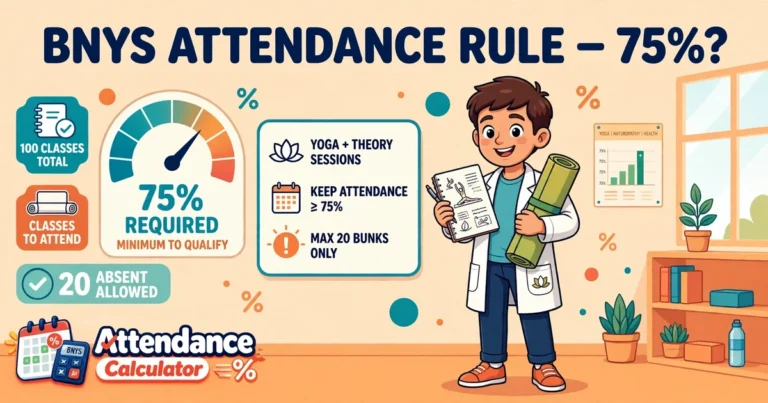
The minimum attendance required for scholarship renewal is 75 percent for most Indian schemes, including the NSP Central Sector Scholarship. Some college and private scholarships ask for 80 percent or 85 percent. Your own scholarship letter states the exact number, so check that first before you trust any general rule.
Seventy-five percent is the floor, not the target. It comes from the same 75 percent rule that decides exam eligibility in most Indian colleges. Scholarship bodies use it because it is simple to check and hard to argue with. Your college sends your attendance record with your renewal, and if the number sits below the line, the renewal stops. No warning letter. No second look at your marks.
That last part catches people out. Marks and attendance are checked on their own. A student with 90 percent marks and 70 percent attendance still fails the renewal check. I have watched good students lose money this way, and every one of them told me the same thing: nobody had spelled out that attendance was part of the deal.
The NSP rule: 50 percent marks and 75 percent attendance
The big one for most Indian students is the Central Sector Scheme of Scholarship for College and University Students, run through the National Scholarship Portal (NSP). It is also called the PM-USP Central Sector Scheme. About 82,000 scholarships go out each year under it, worth up to Rs. 20,000 a year based on your course level.
For renewal each year, the scheme asks for three things. You need at least 50 percent marks in your annual exam. You need at least 75 percent attendance. And you need a clean conduct record. Complaints about indiscipline, criminal behaviour or ragging can end the scholarship on their own. These three conditions come straight from the official scheme guidelines, and they apply every single year you renew, not just once.
Fresh applicants face a different set of bars. You need to be above the 80th percentile in your Class 12 board exams, in a regular course at a recognised college, with family income up to Rs. 4.5 lakh a year, and you must not hold any other scholarship. But once you are in, renewal is where attendance starts to matter. That is the part people forget.
For the 2026-27 year, renewal applications closed on 31 October 2026, with institute verification due by 15 November 2026. Dates change each year, so check the NSP portal for the current year’s window. Do not trust a date you saw in an old post, including this one, when next year’s window opens.

What most colleges and schemes actually ask for
Not every scholarship uses the same number. The table below shows the figures I see most often. Treat them as a starting point. Your award letter beats this table every time.
| Scholarship type | Typical minimum attendance | What else they check |
|---|---|---|
| NSP Central Sector Scholarship | 75 percent | 50 percent marks, good conduct |
| State government scholarships | 75 percent (common pattern) | Marks, income limit, varies by state |
| College merit scholarships | 75 to 85 percent | CGPA bar set by the college |
| Private and trust scholarships | 75 percent (common pattern) | Varies, check the terms |
The pattern is clear. Seventy-five percent is the common floor, and stricter schemes push it to 80 or 85 percent. Merit scholarships from colleges tend to sit at the higher end, because the college is paying from its own pocket and wants proof you are showing up. State schemes mostly copy the NSP figure. Private trusts vary the most, so their terms deserve a slow read.
One more thing the table hides: some schemes count attendance across the full year, while others check it semester by semester. A bad first semester can sink a yearly check even if your second semester is clean. Ask your scholarship office which window they use. It takes one question and it can save you a nasty surprise.
Why your scholarship cares about your attendance
Scholarship money is trust. Someone is paying for your seat because they believe you will use it. Marks show what you learned. Attendance shows you actually turned up to learn it. That is why the two are checked apart. A high score in one cannot cover a gap in the other.
Most students get this backwards. They treat attendance as a college rule and marks as the real game. Then renewal season arrives and the scholarship office asks for the attendance sheet first. I did the same in my first year. I tracked my classes in a notes app because I was scared of falling below 75 percent for exams. It never crossed my mind that the same number guarded my money too.
Here is the part nobody says out loud. Scholarship bodies cannot sit in your classroom. Attendance is the cheapest proof they have that you are a real, active student. It is a rough tool and it misses a lot, like the student who learns more from the library than the lecture hall. But it is the tool they use, and arguing with it after the money stops does not work. Check the rule before you need it.
What happens when you slip below the line
First, the renewal gets blocked. The money stops with the next cycle. Your college marks the renewal as not eligible, and the scholarship office has little room to bend the rule, because the attendance figure comes from the college record itself.
Second, the same low number can hit your exams too. Most colleges need 75 percent attendance to let you sit for finals. So one bad semester can cost you the scholarship and the exam hall in the same stroke. That is the double hit I warn every junior about.
There is some good news, and it matters. Under the NSP Central Sector Scheme, missing a renewal year does not end the story for good. If you meet the renewal conditions again the next year, you can apply for renewal for that year. Other schemes have their own rules, and some do not allow a second chance at all. Ask your college scholarship office what your scheme allows, and ask early, while you still have time to fix the number.
If your low attendance came from a real illness or a family emergency, keep every paper. Medical certificates and approved leave can change how your college counts those days. My post on what condonation covers and how to apply walks through that process step by step.
My 4-week plan to pull your attendance back up
You cannot fix a semester in a day, but four honest weeks can move the number enough to matter. This is the plan I used in my third semester when my own attendance dipped to 71 percent.
Week 1: count your real number. Work out your exact percentage today with my guide on how to work out your attendance percentage. Guesswork is what got you here. A real number tells you how many classes you still need.
Week 2: attend everything. No picking and choosing. Every lecture, every lab, every tutorial. Boring classes count exactly the same as fun ones in the register. Two full weeks of perfect attendance can lift your number by a few points, and that is often the whole gap.
Week 3: talk to your mentor. Tell them the number, show them your plan, and ask what else counts. Some colleges let you make up lab hours or count approved activities. You will not know unless you ask, and mentors help students who show up with a plan far more than students who show up with an excuse.
Week 4: lock in the habit. Keep tracking in a notes app or a sheet, the way I still do. Check the number every Monday. If you want the longer version of this plan, my post on how to lift your attendance back up covers each step in more detail.

Myth vs Fact
Myth: “If my marks are high, low attendance won’t cost me my scholarship.”
Fact: Marks and attendance are checked on their own. The NSP Central Sector Scheme needs at least 50 percent marks and at least 75 percent attendance for renewal, and failing either one blocks the renewal. A student with 90 percent marks and 70 percent attendance still loses the money. High marks never rescue low attendance, so protect both numbers.
FAQ
What is the minimum attendance required for scholarship renewal in India?
For most Indian scholarships it is 75 percent, including the NSP Central Sector Scholarship. Some college merit scholarships and private schemes ask for 80 percent or 85 percent instead. Your scholarship letter states the exact number for your scheme, so treat that letter as the final word.
Can I get my scholarship back after losing it for low attendance?
Sometimes. Under the NSP Central Sector Scheme, you can apply for renewal in the next year if you meet the renewal conditions again. Other schemes have their own rules, and some do not allow a second chance. Ask your college scholarship office what your scheme allows before you assume anything.
Does medical leave count against my scholarship attendance?
It depends on your college and your scheme. Many colleges treat genuine medical leave with a proper certificate as approved leave, not an absence. Some schemes still count it in the total. Keep every medical certificate safe and ask your college office how your scheme treats medical leave.
Is the 75 percent rule the same for every scholarship?
No. Seventy-five percent is the common floor, but some schemes ask for 80 percent or 85 percent, and a few ask for less. State scholarships, college merit awards and private trusts each set their own bar. Read your award letter instead of trusting a number you heard from a friend.
When should I check my attendance if I have a scholarship?
Check it once a month, at least. A monthly check gives you time to fix a slide before it becomes a failed renewal. I write my number in the same notes app where I track my classes. Small gaps are easy to close early and hard to close late.
Your next step
Your scholarship has two guards, not one, and the quiet one is attendance. Open your award letter today and find the exact number your scheme asks for. Then work out your real percentage and see where you stand. If you are above the line, a monthly check keeps you there. If you are below it, start the four-week plan this week, not next month. The money is worth four weeks of showing up.