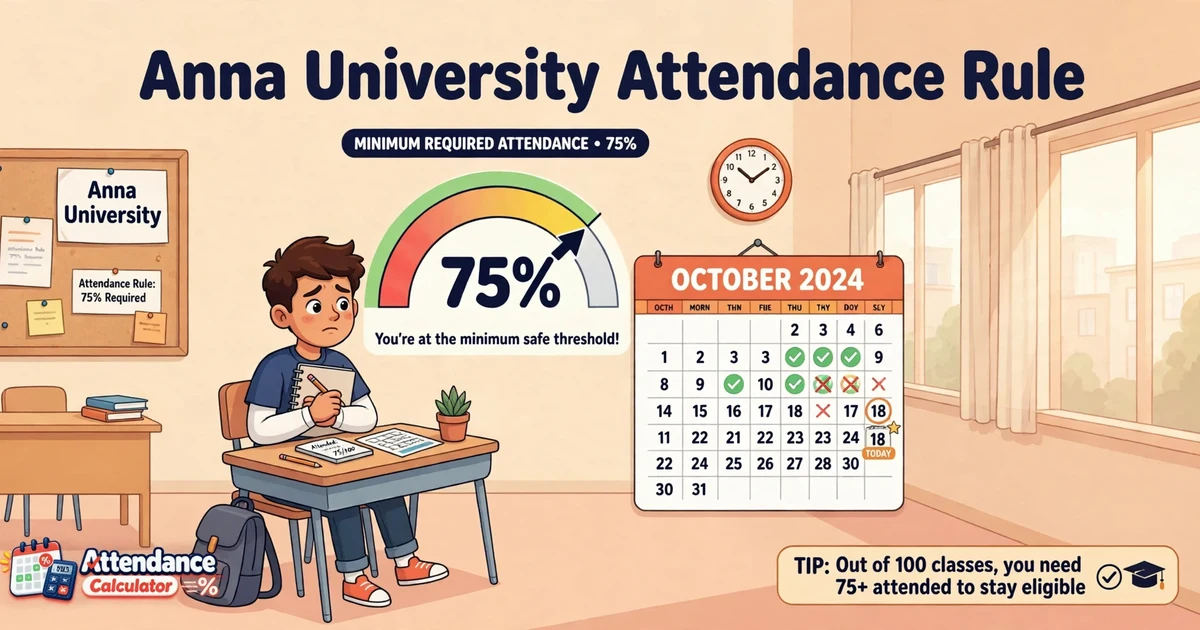
Anna University Attendance Rule: 5 Powerful 75% Facts
I learned attendance the hard way, and not from a rule book. Back in my BSCS days, I kept my attendance in a notes app on my phone. No fancy tracker, no alert, just a list I updated after class when I remembered. Some weeks I remembered. Some weeks I did not. Then one evening I sat down, counted properly, and felt my stomach drop. I was closer to the line than I thought. That is why I write these guides the way I do. I do not want you to get that same sinking feeling a week before hall tickets come out.
If you study under Anna University, this one matters a lot. The rule sounds simple — 75% — but the details around it are where students get caught. There is a medical window. There is a hard floor. And there is a regulation-year trap that can change what applies to your batch. I will walk you through all of it in plain words, with real numbers you can check for yourself.
A warning first: check which regulation year your batch follows
This is the most important part of this article, so I am putting it right up top. Anna University’s long-standing rule is 75% overall attendance per semester. Older regulations talk about 450 periods in 90 working days, rounded to the nearest integer. That is the version most students and colleges have lived with for years.
But a 2025 regulations snippet I found mentions 75% in each registered course, and prevention from exams below 80%. That conflicts with the older texts. I am not going to pretend that conflict does not exist, and I am not going to state the 80% prevention rule as settled fact. It is not settled, at least not in what I could verify. Your batch follows one regulation year. Your college office knows which one. Before you make any big decision — skipping classes, planning a trip, counting on an exemption — ask your department office, in person, which regulation year applies to you. Get the answer in writing if you can. That one question can save you a semester.
What is the Anna University attendance rule in simple words?
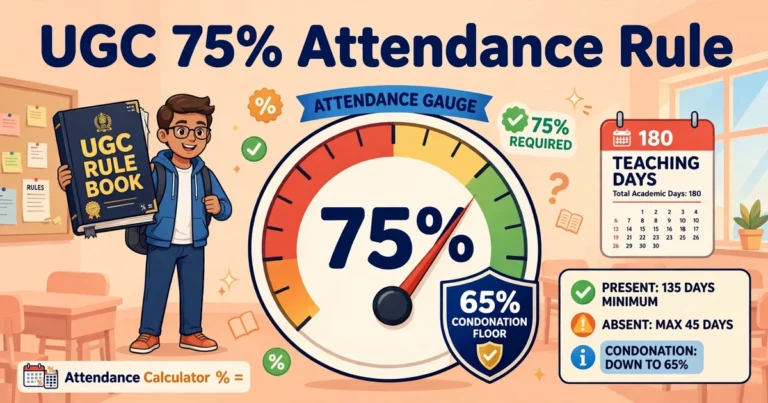
The Anna University attendance rule asks for 75% overall attendance in a semester, and students below 65% are not permitted to write the end-semester exams or move to the next semester, so early tracking matters more than last-minute panic for every student in the batch, without exception.
That is the core of it. Think of 75% as the safe line. If you are at or above it, you are fine on attendance. Between 65% and 74%, there is a possible way through, but only for genuine reasons, and only with the right papers. Below 65%, the rule is blunt. You do not write the exams, and you do not move to the next semester. You repeat the semester in the next academic year. I know that sounds harsh. It is harsh. That is exactly why you need to know where you stand early, not in the last week.
Older regulations frame the same idea in periods, not just percentages. They talk about 450 periods in 90 working days, rounded to the nearest integer. Do not get confused by that. Your college will turn it into a percentage for you on your attendance sheet. The percentage is what you should track week by week. If your sheet says 71%, you are in the medical window, not the safe zone. If it says 64%, you are below the floor, and you need to talk to your department right away.
Is the rule 75% overall, or 75% in each subject?
Under the long-standing rule, the 75% test is overall attendance for the semester, but a newer 2025 snippet mentions 75% in each registered course, so you must confirm which version your batch follows before you relax and keep every subject healthy in the meantime.
This is the trap I mentioned, and it is a real one. Under the older, widely used version, a weak subject does not sink you on its own as long as your overall total stays at 75% or above. You could be low in one subject and strong in others, and still clear the overall line. That is how most seniors I know understood the rule.
The newer snippet changes the picture completely. If your batch falls under a version that tests each registered course separately, then one weak subject could block you even if your overall number looks fine. I cannot tell you which version covers your batch from here, because it depends on your year of admission and your college’s implementation. So here is my honest advice: do not rely on the overall number alone. Keep every subject as healthy as you can, and ask your college office whether the per-course test applies to you. It takes five minutes to ask. It can take a whole year to fix if you guess wrong.
What happens if your attendance is between 65% and 74%?
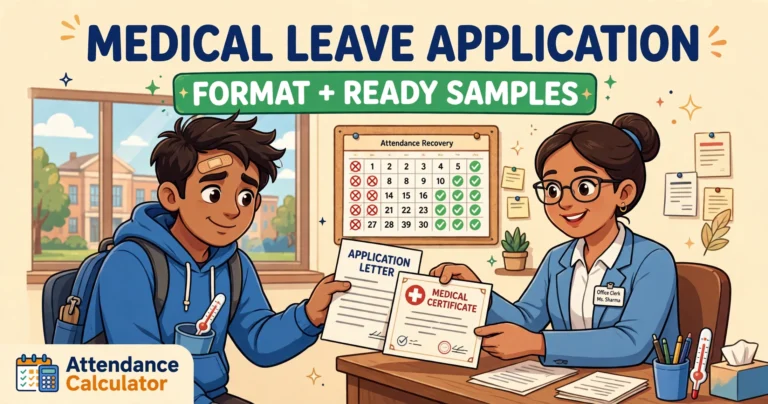
Students between 65% and 74% may be exempted from the 75% rule for genuine medical reasons or approved sports participation, with a medical certificate attested by the Head of Institution and filed promptly after returning through your college office, with copies kept for your own records.
This is the window most students ask me about, and it is narrower than people think. It is not a general excuse. The older texts allow exemption for prolonged hospitalisation, an accident, or a specific illness, or for sports participation that the college approved. In both cases, you need proof. For medical cases, that means a medical certificate attested by the Head of Institution. Not just a note from a clinic. Not a message from home. A proper certificate, attested the right way.
Timing matters too, and this is where I have to hedge a little. Newer texts say the certificate should reach the college within 5 days of returning after the absence. I have seen that timing in newer material, but rules and forms change by college, so treat it as a strong warning, not a promise. The safe move is simple: file as soon as you are back, and keep a copy of everything you submit. If you wait three weeks and then try to explain, you are asking for trouble. Colleges deal with these cases through a process, and late papers make that process much harder.
Also, be honest with yourself here. This window is for genuine cases. If you were just bunking and then try to dress it up as medical, that is not a plan. It is a risk. I am not here to help anyone fake attendance, and this guide will not do that. If you were genuinely ill or on approved sports duty, gather your proof early and talk to your class advisor before the shortage becomes a crisis.

What happens if you fall below 65%?
Below 65%, you are not permitted to write the end-semester exams and you are not permitted to move to the next semester, so you repeat the semester in the next academic year instead of moving ahead with your batch, which is why early action matters so much.
I wish I could soften that, but I should not. This is the part students sometimes hear too late. Below 65%, there is no medical window in the older texts I checked. The consequence is not a fine or a warning letter. It is a lost semester. You wait for the next academic year and repeat it. That means your batch moves on without you, your timetable changes, and your graduation date shifts. It is a heavy price, and it is why I keep saying: check your number early.
If you are already below 65% or heading there fast, do not just hope it works out. Go and talk to your Head of Department or class advisor this week. Ask what options exist under your regulation year. Sometimes there is a process you have not heard about. Sometimes there is not, and you need to hear that plainly so you can plan. Either way, hearing it from your college beats guessing from a blog post, including this one. My job here is to give you the shape of the rule and the questions to ask. Your college gives you the final answer for your case.
How do I work out how many classes I still need?
Use this formula: classes needed = (target x total classes held – classes attended) / (1 – target), and round up, because you cannot attend part of a class, and check your answer by adding the needed classes to both totals before you plan anything else.
Let me show you with real numbers, step by step, so you can copy the method for your own sheet. Say you have attended 90 classes out of 140 held so far, and your target is 75%.
Step 1: Multiply your target by the total classes held. That is 0.75 x 140 = 105.
Step 2: Subtract the classes you attended. That is 105 – 90 = 15.
Step 3: Work out 1 minus your target. That is 1 – 0.75 = 0.25.
Step 4: Divide the Step 2 answer by the Step 3 answer. That is 15 / 0.25 = 60.
So you need to attend the next 60 classes in a row, with no misses, to reach 75%. Let me check that, because I do not want to hand you a wrong number. After 60 more classes, you will have attended 90 + 60 = 150 classes, out of 140 + 60 = 200 held. And 150 / 200 = 0.75, which is 75%. The maths checks out.
If doing this by hand feels fiddly, use the 75 percent attendance calculator on my site and punch in your own numbers. It does the same calculation for you. The point is not the tool, though. The point is knowing your number while you still have time to change it. Sixty classes in a row is a lot. Finding that out with two weeks left is very different from finding it out with two months left.
Here is a simple way to read your own position:
| Your overall attendance | What it usually means | What to do now |
|---|---|---|
| 75% or above | Safe on attendance | Keep tracking weekly, do not drift |
| 65% to 74% | Medical or approved sports window only | Gather proof, talk to your advisor now |
| Below 65% | Not permitted for exams under the older rule | Talk to your department this week, plan ahead |

What should I do this week if I am short?
If your number is below 75%, do not panic, but do not drift either. Here is a short checklist that has helped students I know:
- Count your real attendance today, subject by subject and overall, from your college sheet, not from memory.
- Work out your classes-needed number with the formula above, or with the calculator, so you know the size of the gap.
- If illness or approved sports caused the gap, collect your certificates now and ask your advisor what form and attestation your college wants.
- Ask your department office which regulation year your batch follows, and whether any per-course test applies to you.
- Read up on how condonation works so you understand the general idea, but remember Anna University’s own medical window has its own papers and limits.
- Make a simple weekly plan: which classes you will not miss, and what you will do if you fall ill again.
One more thing from my own notes-app days. Tracking only works if you update it. I used to tell myself I would count at the end of the month, and then the month would vanish. Count every Friday. Five minutes, once a week, beats a frantic count the night before hall tickets. If you want a starting point, the Attendance Calculator homepage has the tools I built after living through this myself.
For a fuller picture of how colleges frame these rules, a college academic page that lays out attendance expectations is worth a look: Anna University attendance rules as published by a college academic office. It is not your college’s final word for your batch, but it shows how the rule is normally written up. Your own college office still has the last say.
Quick questions students ask me
Can I still write exams at 70% attendance?
Yes, you may be able to, but only through the medical or approved sports exemption window, with a proper certificate attested by the Head of Institution, and only if your college accepts your case after checking your papers, so talk to your advisor early, not in exam week.
That is the honest answer. Seventy percent on its own does not clear the 75% line. It puts you in the window where a genuine case can be considered. File early, keep copies, and talk to your advisor before you assume anything.
Does one low subject fail me if my overall is above 75%?
Under the long-standing overall rule, no, but under a newer per-course version, possibly yes, so confirm which regulation year and which test your batch follows before you count on any single number, and ask your department office to confirm it in writing.
I know that answer is annoying. I would love to give you one clean yes or no. The truth is that the two versions point in different directions, and your batch’s regulation year decides. Ask your office and do not guess.
How soon should I submit a medical certificate?
File as soon as you return, since newer texts say within 5 days of returning, and late papers make an already strict process much harder for you, so hand it in promptly and keep proof of submission, plus a photo of the form you filed.
Do not sit on it. Hand it in, ask for a receipt or an acknowledgement, and keep a photo of the submitted form. If your college has its own form, use that form, not a random format.
What does repeating a semester actually mean?
It means you do not write the end-semester exams and do not move to the next semester, and you repeat that semester in the next academic year, while your batch moves ahead without you, which costs a year, even though your degree is not over.
Your friends move ahead. Your subjects and timetable change. It is not the end of your degree, and plenty of students recover from it, but it costs a year. That is why early tracking matters so much.
Your next step today
Do one thing today, not ten things someday. Open your attendance sheet, count your overall percentage, and work out your classes-needed number. If you are at 75% or above, keep your Friday counting habit and stay there. If you are in the 65% to 74% window, talk to your advisor this week about your papers. If you are below 65%, talk to your department now, while you still have choices to make. And ask that one regulation-year question, because it shapes everything else. You have got this, but only if you know your number. Go and find it today.